What “full size” has to mean to be useful
A number. Manufacturers in this category reach for XL, extra-large and family-size freely, and none of those words tells you whether a 9 × 13 pan goes in. So this ranking uses published interior volume as the sorting key and ignores the adjectives entirely. Roughly speaking, once an oven is past about 1.4 cubic feet — 40 liters, 42 quarts — it will take a whole chicken, a 9 × 13 dish and a 13-inch pizza, which is the practical definition of doing the range's job for most weeknight meals.
The honest trade in this band is stated up front because it recurs on every pick: the biggest interiors come from the brands that publish the least, and the best-documented ovens are smaller. You are choosing which of those two things you want more.
Reading the order
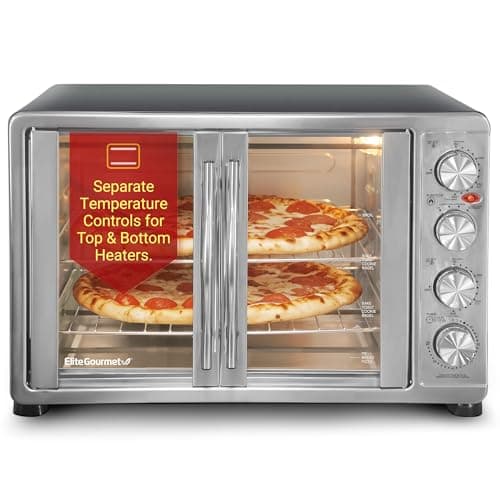
The Elite Gourmet ETO4510B leads on raw published room — 47.5 quarts, quoted as 18 slices, behind French doors and four manual control knobs. That is the largest published interior on this site by a clear margin, and it costs a fraction of the documented ovens below it. What Elite Gourmet does not publish is a wattage, so we give it no running-cost figure at all, and the manual knobs mean you are steering by dial rather than by set point.
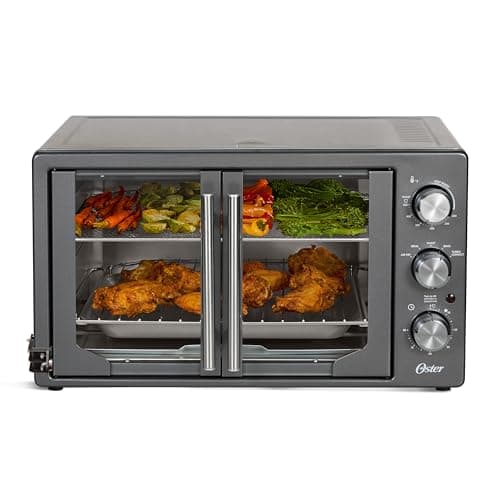
The Oster 42 L French Door is second and is the more conventional big oven: 42 liters published, ten functions including air fry, and doors that swing outward from the center so they need almost no clearance in front — a genuine advantage on a counter where a drop-down door would become a hot shelf at reaching height. Its review is here. Oster publishes no wattage either.
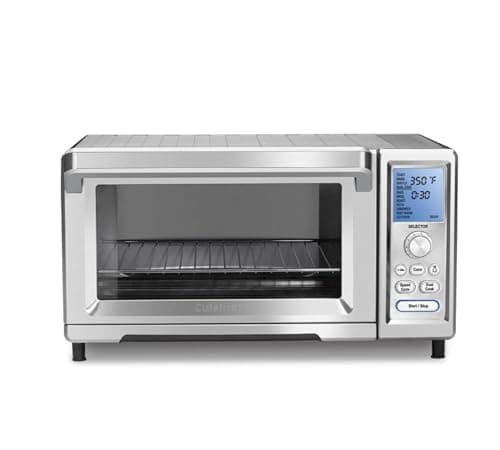
The Cuisinart TOB-260N1 is third and is the pick if you want the numbers. At 0.95 cubic feet it is smaller than the two above it, but Cuisinart publishes that volume alongside a 1,800-watt rating on the same page — the only oven on this site whose maker does both — and states what fits: a 13-inch pizza, a 9 × 13 pan, nine slices. It is genuinely full-size by the definition at the top of this page, and it is the only one here you can calculate a running cost for. Our review is here.
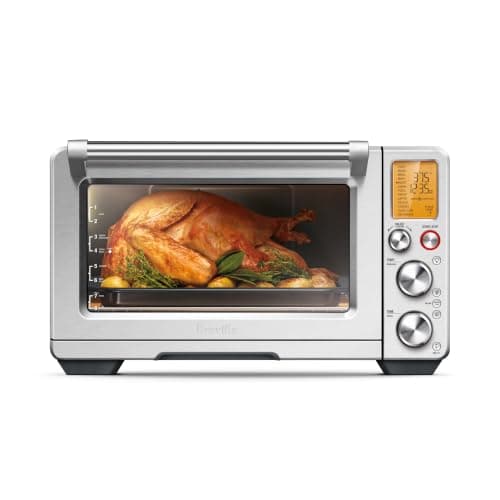
The Breville Smart Oven Air Fryer Pro is fourth on volume and first on almost everything else: one published cubic foot, 1,800 watts from the rating plate in its own instruction book, thirteen functions, and six elements driven independently rather than switched in banks. It is also the widest thing here at 21.4 inches, which is wider than most upper-cabinet clearances allow you to slide it under. Its review is here.
Published interiors, side by side
| Oven | Published interior | Published wattage |
|---|
| Elite Gourmet ETO4510B | 47.5 qt / 18 slice | None published |
|---|
| Oster 42 L French Door | 42 L | None published |
|---|
| Cuisinart TOB-260N1 | 0.95 cu ft | 1,800 W |
|---|
| Breville Smart Oven Air Fryer Pro | 1 cu ft | 1,800 W |
|---|
Units are as each manufacturer publishes them. We do not convert between quarts, liters and cubic feet on the page, because the conversions imply a precision the underlying claims do not have — a “47.5 quart” figure is an external-shell estimate in a way a stated cubic foot generally is not.
What a big cavity costs you
Counter depth, permanently. These are large objects that live out. Measure the depth to your backsplash and the height to the underside of your wall cabinets before anything else — our sizing page covers the four measurements that matter.
Time and energy per use. More cavity means more air to heat. A big countertop oven still beats a full-size range comfortably — we have put numbers on that — but it loses the fast-preheat advantage that makes small countertop ovens feel quick.
Evenness, potentially. A larger cavity is harder to heat uniformly, which is why the well-documented ovens in this band invest in element control rather than raw room. The mechanics of that are here.
How to choose
If the biggest thing you cook is a turkey or two trays at once, take the room and accept the missing paperwork — the Elite Gourmet or the Oster. If you want a countertop oven you can actually reason about, and a 13-inch pizza and a 9 × 13 pan cover what you cook, the Cuisinart is the better machine and the one we would buy. If you will keep it a decade and the width fits, the Breville is the best-built object here by a distance. Our overall convection ranking sorts the same catalog on documentation first, and the under-$200 ranking is here if budget rather than volume is the binding constraint.
How we picked
Ovens we claim to have cooked in: 0
Everyone in this category tells you they roasted forty chickens. We have roasted none, and we say so. Here is what we do instead: read the manufacturer's manual and spec sheet, record the published wattage, interior volume, temperature range and warranty term, work out what the oven costs to run for an hour and for a year, show the arithmetic so you can redo it with your own electricity rate, and cite all of it. Where a brand publishes no wattage, we print no running cost rather than borrowing a number from a similar model. Prices come live from Amazon's API and disappear rather than go stale.
The scores above are judgments from that documented research — not test results. One of the five metrics is Documentation: whether the manufacturer will tell you what its oven draws at all. The full rubric, including what disqualifies an oven, is published in full.