Skip to content
CC

HUB 04 · Comparisons

Convection Toaster Oven vs Toaster Oven

One component separates these two categories, and it is a fan. Everything the convection model does differently follows from it — including the things it does worse. Compared here on two Cuisinarts, because holding the brand constant is what isolates the variable.

By Stephen V.Updated How we rank
#ad

We earn a commission if you buy through our links. It does not change the price you pay, and it does not decide our picks — the scoring rubric is published in full, including what disqualifies an oven. How this works.

The short answer

Quick picks

#OvenBest forScorePrice
01
Cuisinart Cuisinart Chef's Convection Toaster Oven (TOB-260N1)
Cuisinart Chef's Convection Toaster Oven (TOB-260N1)

The best-documented interior in the category

1,800 W
8.6
$269.95Amazon
021,800 W
7.6
$99.95Amazon

#ad · Prices pulled live from the Amazon Product API, last checked Aug 19, 2026. Where we have no verified live price we show none — we would rather leave a gap than print a number that has gone stale. The wattage column is what the manufacturer publishes; “not published” means exactly that, and we have not estimated one. Scores are ours, compiled from published specifications, and are not test results.

The short answer

Buy convection if you want crisping, even browning and air frying. Buy a plain radiant toaster oven if you mostly toast, bake and broil, and would rather spend the difference on watts or build. A convection toaster oven is a toaster oven with a fan added — that is the entire difference in hardware, and every advantage and disadvantage below is downstream of it. In this matchup the fan is roughly the price of a second oven.

The two ovens, held constant

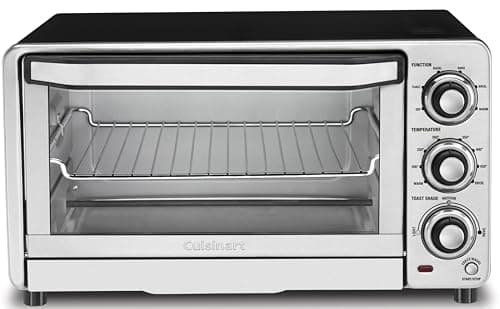
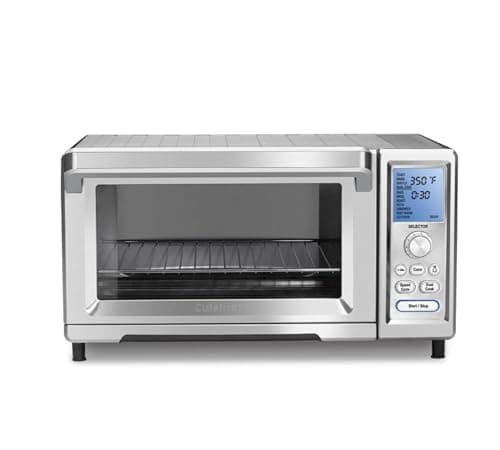
Comparing across brands muddies the question, because you end up measuring build quality rather than the fan. So both picks here are Cuisinarts, and — usefully — both publish the same wattage. The Cuisinart Chef's Convection Toaster Oven (TOB-260N1) is a fan oven at a published 1,800 watts with a published 0.95-cubic-foot interior, the only oven on this site whose maker puts both numbers on one page. Its review is here. The Cuisinart Custom Classic (TOB-40N) is a radiant oven at the same published 1,800 watts, behind three knobs, sold essentially unchanged for over a decade. Its review is here.

Same brand, same service network, same published power. That is what makes this pair worth using: with the wattage held constant, every difference you see below is attributable to the fan and the cavity rather than to one oven simply being stronger. The full published-wattage table is here — and it shows how rare it is for two ovens in this category to publish the same figure at all.

What the fan buys

Even browning. In a radiant oven the side facing the element cooks faster than the side facing the wall. A fan removes that asymmetry by keeping the air in motion, which is why a tray of vegetables comes out uniformly coloured rather than mottled.

Crisping — which is all air frying is.Moving hot air strips moisture off a food's surface faster than still air, and a dry surface browns. That is the whole mechanism; we explain it in one paragraph here. A plain radiant oven cannot do this at any temperature, which is the one capability gap that is genuinely absolute rather than a matter of degree.

Speed, modestly. Faster heat transfer means shorter cooks at the same set temperature — conventionally about 25°F down or a fifth of the time off. The conversion chart works it out. What the fan does not buy is power: two ovens at the same wattage put the same heat into the cavity, and the fan only decides where it goes.

What the fan costs

Money, obviously. Here the fan oven costs multiples of the radiant one from the same manufacturer, for the same three core functions at the same published wattage. Some of that premium is the larger cavity and the extra functions rather than the fan alone — but you cannot buy the fan without buying the rest of it.

Delicate bakes. Moving air sets a crust before a batter has finished rising and can visibly push the top of a cake around. This is why serious baking ovens let you switch the fan off, and why our bread ranking cares more about a stable floor than a fast fan. If cakes are the reason you are buying, convection is not automatically the upgrade.

Something else to fail.A fan is a motor, and a motor is a moving part in an appliance whose other failure modes are a thermostat and a bell. The Custom Classic's decade-long unchanged production run is the strongest reliability signal this category offers, and part of what makes it possible is that there is so little in there.

The decision table

If you mostly…BuyWhy
Roast vegetables, reheat pizza, want fries crispConvectionOnly a fan crisps. Nothing about a radiant oven substitutes for it.
Toast, melt cheese, bake a trayPlainAll three are radiant jobs. The fan changes very little and costs a lot.
Bake cakes and delicate thingsPlain, or convection you can switch offMoving air sets crusts early and can distort a rising batter.
Want the fewest things that can breakPlainA fan is a motor. A radiant oven is a thermostat, a timer and elements.
Care about a published wattageCheck the SKU, not the categoryBoth ovens here publish 1,800 W. Plenty of others in both categories publish nothing.

A note on “natural convection”

Some budget listings advertise natural convection. That means there is no fan — it is the physics term for hot air rising, which happens in every oven ever built. It is not a middle tier between these two categories; it is the plain category wearing a longer name. We untangle all five convection terms here.

The rule

If crisping is on your list at all, buy the fan; nothing else delivers it, and you will resent the saving every time you reheat something. If it is not, buy the plain oven and spend the difference on wattage and build — an 1,800-watt radiant oven from a brand with a service network will outlast a cheap convection one, and it does the three jobs you actually bought it for without compromise. Our plain toaster oven ranking is here; the fan ovens are ranked here.

In detail

The picks, in full

01
Cuisinart Cuisinart Chef's Convection Toaster Oven (TOB-260N1)

The best-documented interior in the category

Cuisinart Chef's Convection Toaster Oven (TOB-260N1)

Wattage and volume both publishedDeep cabinet footprint
8.6/10

The only oven here whose manufacturer publishes both a wattage and an interior volume in cubic feet on the same page. 0.95 cubic feet at 1,800 W, with a stated list of what fits — a 13-inch pizza, a 9x13 pan, nine slices.

Power
9.5
Usable space
9.5
Footprint
5.5
Documentation
10
Value
8.5

What it gets right

  • 0.95 cubic feet published in the same place as the 1,800 W rating, which makes it the easiest oven here to compare on paper
  • Within 5% of the Breville Pro's interior for a good deal less money
  • Fifteen functions including a genuine dual-cook mode that runs two temperatures in sequence

What it doesn't

  • 530 mm deep is a lot of counter — deeper than the Breville Pro
  • Fifteen functions on a backlit panel is a lot of interface between you and heat
  • Cuisinart lists this model as discontinued on its own site, so availability moves around

What it costs to run

About 33.9¢ an hour at full draw, or $61.86 a year at 30 minutes a day, 365 days a year and 18.83¢ per kWh.

1,800 W ÷ 1000 × 182.5 h × 18.83¢ = $61.86

1800 watts as published by Cuisinart on the TOB-260N1 product page, alongside the 0.95 cubic foot interior figure. This is an upper bound: the elements cycle off once the cavity is at temperature, and no manufacturer publishes a duty cycle, so we compute at full rated draw rather than invent a correction factor. The full method is published.

Skip this if…

your counter is shallow. At 530 mm deep this is the deepest oven on the list, and depth is the dimension people forget to measure until the door will not clear the backsplash.

$269.95on Amazon

$299.9510% off

Price last checked Aug 19, 2026. Prices move constantly — Amazon's at checkout is the one that counts.

#ad · we may earn a commission from this link to Cuisinart Chef's Convection Toaster Oven (TOB-260N1)

02
Cuisinart Cuisinart Custom Classic Toaster Oven Broiler (TOB-40N)

1,800 W without a control panel

Cuisinart Custom Classic Toaster Oven Broiler (TOB-40N)

Full 1,800 W
7.6/10

1,800 W behind three knobs. It has been sold essentially unchanged for over a decade, which in small appliances is the strongest reliability signal available short of taking one apart.

Power
9.5
Usable space
7
Footprint
7.5
Documentation
5
Value
9

What it gets right

  • Full 1,800 W at well under half what an 1,800 W Breville costs
  • Knobs, a bell and a timer — there is essentially nothing here to fail electronically
  • A production run long enough that its failure modes are well known

What it doesn't

  • No convection fan
  • No published interior volume
  • The dated look is not accidental; this design has not changed in years

What it costs to run

About 33.9¢ an hour at full draw, or $61.86 a year at 30 minutes a day, 365 days a year and 18.83¢ per kWh.

1,800 W ÷ 1000 × 182.5 h × 18.83¢ = $61.86

1800 Watt as stated in Cuisinart's own listing title and copy. Cuisinart publishes no separate spec sheet for this model, so this is brand-supplied rather than manual-verified. This is an upper bound: the elements cycle off once the cavity is at temperature, and no manufacturer publishes a duty cycle, so we compute at full rated draw rather than invent a correction factor. The full method is published.

Skip this if…

you want convection or air fry. This is a radiant oven, and everything the rest of this site says about moving air does not apply to it.

$99.95on Amazon

$129.9523% off

Price last checked Aug 19, 2026. Prices move constantly — Amazon's at checkout is the one that counts.

#ad · we may earn a commission from this link to Cuisinart Custom Classic Toaster Oven Broiler (TOB-40N)

How we picked

Ovens we claim to have cooked in: 0

Everyone in this category tells you they roasted forty chickens. We have roasted none, and we say so. Here is what we do instead: read the manufacturer's manual and spec sheet, record the published wattage, interior volume, temperature range and warranty term, work out what the oven costs to run for an hour and for a year, show the arithmetic so you can redo it with your own electricity rate, and cite all of it. Where a brand publishes no wattage, we print no running cost rather than borrowing a number from a similar model. Prices come live from Amazon's API and disappear rather than go stale.

The scores above are judgments from that documented research — not test results. One of the five metrics is Documentation: whether the manufacturer will tell you what its oven draws at all. The full rubric, including what disqualifies an oven, is published in full.
Questions

Frequently asked

What is the difference between a convection toaster oven and a toaster oven?
A fan. A convection toaster oven adds a fan that circulates the hot air the elements produce; a plain toaster oven lets that air sit still. Everything else -- the elements, the thermostat, the cavity -- is the same idea. The fan browns more evenly and crisps, which is what air frying is.
Is a convection toaster oven worth the extra money?
If you want crisping or even browning, yes -- nothing else provides it. If you mostly toast, bake and broil, it is often not: in this matchup the fan costs roughly the price of a second oven from the same brand, and the plain model publishes a wattage the convection one does not.
Can a convection toaster oven air fry?
Mechanically, yes — air frying is a convection fan run fast, usually with a perforated basket to expose more surface. Whether a given model markets an air fry preset is a labelling decision, not a hardware one. The difference between the two settings is explained here.
Does a convection toaster oven use more electricity?
Not meaningfully. The fan motor draws a tiny fraction of what the heating elements do, and because convection cooks faster it often uses less energy per dish. Running cost is decided by rated wattage and time, not by whether a fan is turning — the arithmetic is here.
Is convection bad for baking cakes?
It can be. Moving air sets the crust before a batter has finished rising, which is why serious baking ovens let you switch the fan off. For bread and cakes, an oven with a stable temperature and switchable convection beats one that can only run with the fan on.

Keep reading

Receipts

Sources

We have not cooked in these ovens and we do not pretend to have. Specifications come from the manufacturer's own published documents; electricity rates come from the US Energy Information Administration; prices come from the live Amazon API. Where a figure is not published, the page says “not published” rather than guessing. Read the full method.