HUB 06 · Guides & Answers
Can You Put Glass or Ceramic in an Air Fryer Oven?
Yes, if it is oven-safe — which is doing more work in that sentence than it looks. The manuals are specific about glass, specific about ceramic, and unanimous about one thing almost nobody knows: do not put a lid on it.
We earn a commission if you buy through our links. It does not change the price you pay, and it does not decide our picks — the scoring rubric is published in full, including what disqualifies an oven. How this works.
The short answer
Metal, oven-safe glass and oven-safe ceramic are all permitted. BLACK+DECKER says it in one sentence in the TO3250XSB manual: metal, ovenproof glass or ceramic bakeware without glass lids can be used in your oven. The three qualifiers in that sentence are the whole answer — ovenproof, without glass lids, and a clearance figure that follows immediately: be sure the top edge of the container is at least 1½ inches (3.8 cm) from the upper heating elements.
What is not permitted anywhere: plastic, silicone, paper, and anything sealed. Our Place's manual bans plastic and silicone containers by name in the same clause that bans parchment.
“Oven-safe” is a claim about the dish, not the oven
Breville's books put the responsibility exactly where it belongs. Their safety pages ask you to exercise caution when using pans and dishes constructed of materials other than metal and to ensure pans and dishes are oven safe before using in the oven— a check against the cookware manufacturer, not against the oven. Our Place's manual is more specific about why: use caution when using containers made of materials other than heat-proof metal or glass. If using ceramic or glass pans or dishes, it is important that they are oven safe to prevent cracking.
The failure mode is thermal shock, and a countertop oven is unusually good at producing it. The cavity is small, the elements are close, and the temperature at the glass surface nearest an element rises much faster than the average air temperature the display is showing you. A dish rated for a full-size oven at 400°F is not necessarily seeing 400°F two inches under a glowing quartz element. That is the real reason the 1½-inch clearance figure exists, and it is the only published number in this whole area.
Three practical consequences. A dish straight from the refrigerator into a preheated countertop oven is the highest-risk move available; let it stand. Glass in an air-fry cycle is riskier than glass in a bake cycle, because air fry runs a faster fan at a higher set point and drives more heat into the surface. And a cracked dish in a small cavity is a much worse outcome than a cracked dish in a range, because there is nowhere for the contents to go.
The lid warning nobody repeats
Every Breville book on this site carries the same clause: caution should be exercised when using lids in the oven, as pressure build up in a covered pan or dish may cause hot ingredients to expel or the dish to crack. Our Place goes further and simply prohibits them: do not use lids in the appliance. Pressure build up in a covered pan or dish may cause hot ingredients to expel or the dish to crack. BLACK+DECKER's permission is explicitly conditional — bakeware without glass lids.
This is the least-known rule in the category and the one with the nastiest failure mode. Three manufacturers, independently, warning about the same thing is not boilerplate. The exception that proves it: Breville's own slow-cook instructions do use a lid, and they tell you to cover the cookware with a layer of aluminum foil first and to fill it between a half and three-quarters full. A slow cook runs far below boiling and is a different pressure case from a covered dish at 425°F.
What about a dinner plate?
If it is genuinely oven-safe ceramic, mechanically it is no different from a ceramic baking dish, and the same three rules apply: oven-safe, 1½ inches clear of the top element, no lid. But two things usually make a plate the wrong choice. Most dinnerware carries no oven rating at all, and decorated or metallic-rimmed plates are specifically excluded by their own makers. And a flat plate blocks airflow under the food, which removes the entire benefit of the oven you bought — the fan cannot reach the underside, so you get radiant reheating rather than crisping. The mechanism explains why that matters.
The shipped accessories exist for this reason. Almost every oven on this site comes with a roasting pan, a wire rack and — on the air-fry models — a perforated basket, and those are the pieces designed for the cavity, the clearance and the airflow. Using them is free.
What to check before you put cookware in
The rating on the dish, from its own manufacturer.Not the oven's manual — the dish's. “Oven safe” usually comes with a maximum temperature, and it is often lower than the 450–500°F these ovens reach.
The height, against the top element. BLACK+DECKER publishes 1½ inches and it is the only figure any brand here publishes. Measure the tallest point of the dish, not the rim.
Whether it has a lid, and whether you can leave it off.If the recipe needs a cover, foil is the safer cover in a countertop oven — Breville's own method uses foil under the lid rather than the lid alone. The foil rules are here.
Whether the function is air fry. If it is, prefer the basket or a metal pan. Air fry is the setting that runs the fan hardest and the surface temperatures highest — it is the wrong cycle to test a borderline dish in.
Whether the interior coating is what you are worried about. If the reason you are reaching for glass is that you do not want food on a non-stick surface, that is a reasonable thing to want and it is a different page: what the coatings actually are, and which ovens use what, with the ovens ranked on it here.
The ovens below are the three whose manuals are quoted on this page, so if you own one of them the clauses above are yours.
The hardware
The ovens this page is about
The ovens referred to above, with prices pulled live from Amazon and dated on every card. Full rankings live in the roundups linked from this page.
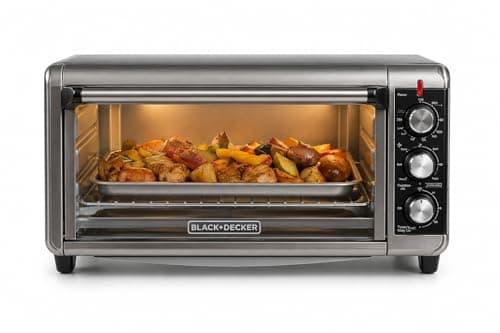
1,500 W
BLACK+DECKER 8-Slice Extra Wide Convection Toaster Oven (TO3250XSB)
A dial-controlled convection toaster oven whose maker publishes the wattage, the dimensions, the weight and a two-year warranty on its own page, and prints the rating line in the manual — 1500 W, 120 V, 60 Hz. Eight slices, a 12-inch pizza and a 9 x 13 pan with handles, for under a hundred dollars. It is a convection baker, not an air fryer: there is no basket and no air-fry setting.
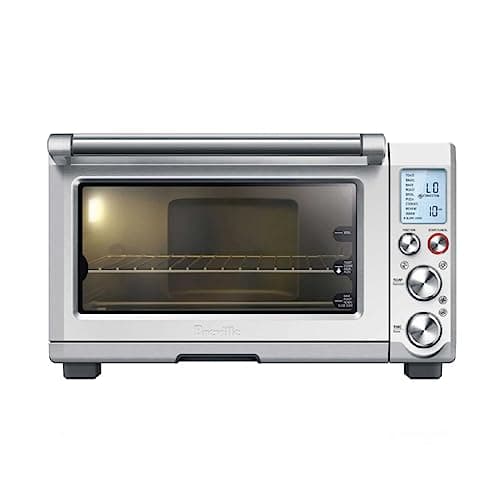
1,800 W
Breville Smart Oven Pro (BOV845BSS)
No air fry function, which is the point. This is the convection oven from the range with the marketing layer removed — ten functions, 1,800 W, and a published 120°F floor on Bake and Roast: no Proof preset, but a stated low end most ovens in the category never print.
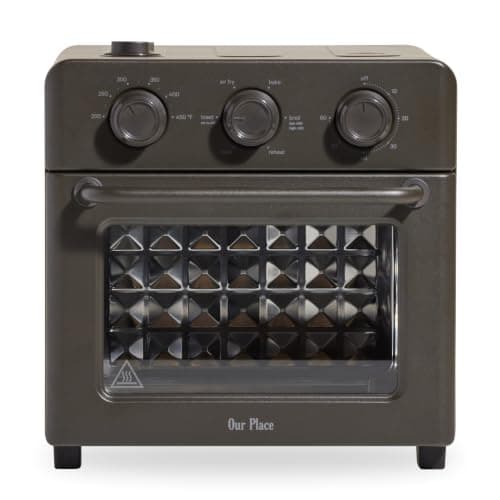
1,400 W
Our Place Wonder Oven (6-in-1, 13 Qt)
The most completely documented small oven we have covered, from a brand better known for pans. Our Place publishes the rating-plate wattage, the temperature range, the interior dimensions and the warranty term — all four things we score documentation on. At 1,400 W it costs less per hour than the 1,800 W field; at four slices and a 9-inch pizza it is genuinely small; and the limits are published too — a 200°F floor and a 60-minute timer.
#ad · As an Amazon Associate we earn from qualifying purchases.
Questions
Frequently asked
Can you put a glass dish in an air fryer oven?
Can you use ceramic in an air fryer oven?
Why can't you use a lid in an air fryer oven?
Can you put plastic or silicone in an air fryer oven?
Can you put a plate in an air fryer oven to reheat food?
Keep reading
Related
- Can you put foil in one?The liner half of the same question, from the same manuals.
- What pans fit a toaster ovenSizes, from published interior dimensions.
- Non-toxic air fryer materialsIf glass is what you reach for to avoid a coating.
- How to clean an air fryer ovenIncluding which accessories are dishwasher safe and which are not.
Receipts
Sources
- BLACK+DECKER — TO3250XSB / TO3260XSBD / TO3240XSBD use and care manual [PDF]
- Breville — the Smart Oven Pro (BOV845) instruction book [PDF]
- Breville — the Smart Oven Air Fryer Pro (BOV900) instruction book, L23 edition [PDF]
- Our Place — Wonder Oven user manual, model APL.WDO.ESN [PDF, retailer-hosted copy]
We have not cooked in these ovens and we do not pretend to have. Specifications come from the manufacturer's own published documents; electricity rates come from the US Energy Information Administration; prices come from the live Amazon API. Where a figure is not published, the page says “not published” rather than guessing. Read the full method.