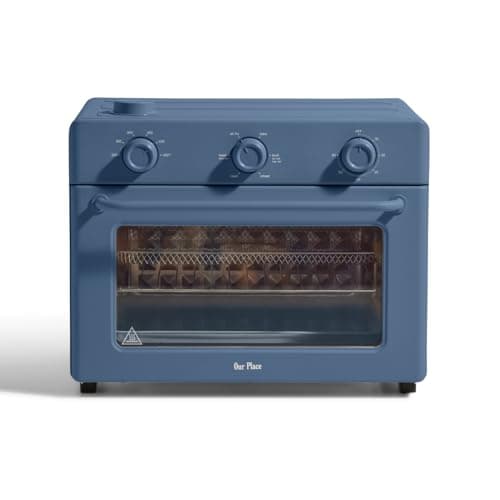
The short answer
Buy it if you want the big Wonder Oven and do not care about a digital panel. Our Place publishes the Large and the Wonder Oven Prowith the same interior dimensions, the same exterior dimensions, the same 28-liter capacity and the same three rack levels — and says so in its own comparison, where the Pro “shares the larger size” and adds a control panel and two modes. On published figures, the Pro's premium buys a digital display, a lower temperature floor, a longer timer, Proof and Dehydrate. It does not buy a cubic inch.
Do not buy it if a low temperature or a long run is the reason you outgrew the standard Wonder Oven. The Large keeps that oven's published 200°F floor and its 60-minute timer exactly — no proofing, no dehydrating, nothing past the hour — while drawing the Pro's 1,700 watts to do it. That is the Pro's electricity bill with the entry model's range, and it is the one real objection to this oven.
What Our Place publishes — and what it does not
This site has no test kitchen and says so in the rubric. What we can do is read what a manufacturer puts in writing, and Our Place puts an unusual amount in writing: a wattage, a voltage, a temperature range, a timer range, a capacity, interior and exterior dimensions, a weight, a rack count, the named modes, the materials, and a length, width, height and weight for each of the four accessories individually.
| What is published | Figure | Where |
|---|
| Rated power | 1700w, 120V | Product page, Getting Technical |
|---|
| Temperature | 200–450°F | Product page, Getting Technical |
|---|
| Timer | 0–60 minutes | Product page, Getting Technical |
|---|
| Capacity | 28 L | Product page, Getting Technical |
|---|
| Interior (W×D×H) | 13.75 × 13 × 7.75 in | Product page, Getting Technical |
|---|
| Exterior (W×D×H) | 16.75 × 13.25 × 13 in | Product page, What's Included |
|---|
| Weight | 17.5 lb (without inserts) | Product page, Getting Technical |
|---|
| Rack levels | 3 | Product page, How It Compares |
|---|
| Modes | Air fry, bake, roast, toast, broil, reheat | Product page, Getting Technical |
|---|
| Fan | Dual-speed convection fan | Product page, Getting Technical |
|---|
| Rated power on a rating plate | Not read | No manual we could open |
|---|
| Warranty | 1 year from delivery | Our Place warranty policy |
|---|
The same honest gap as the Pro's review: Our Place links no manual PDF for this model, and the third-party libraries that index Our Place manuals refuse automated requests. So 1,700 watts here is a product-page figure, not a rating-plate one, and nothing on this page is sourced to a document we have not read — no clearance minimum, no element wattages, no accessory placement rule. The standard Wonder Oven remains the only model in this line whose rating line we have actually seen: 120V 60Hz 1400W, printed on the cover of its manual.
The Large and the Pro are the same box
This is the finding, and it is not an inference — it is two spec sheets read side by side, and then Our Place confirming it in its own words. Put the published dimensions next to each other:
| Published figure | Large Wonder Oven | Wonder Oven Pro |
|---|
| Interior (W×D×H) | 13.75 × 13 × 7.75 in | 13.75 × 13 × 7.75 in |
|---|
| Exterior (W×D×H) | 16.75 × 13.25 × 13 in | 16.75 × 13.25 × 13 in |
|---|
| Stated capacity | 28 L | 28 L |
|---|
| Rack levels | 3 | 3 |
|---|
| Rated power | 1700w | 1700W |
|---|
| Weight (no inserts) | 17.5 lb | 18 lb |
|---|
| Temperature floor | 200°F | 80°F |
|---|
| Timer ceiling | 60 minutes | 24 hours |
|---|
| Modes | 6 | 8 (adds Proof, Dehydrate) |
|---|
| Controls | 3 knobs | Digital display |
|---|
The top four rows are identical, the fifth is identical, and the sixth differs by half a pound — which is about what a control board and a display weigh. Our Place's own FAQ puts it beyond argument: the Large “increases the capacity to 28 liters with three racks and the same six versatile modes”, and the Pro “shares the larger size and adds a digital control panel for precise time and temperature settings, plus two additional functions”.
So the choice between these two is not a size question at all, and anyone shopping it as one is being misled by the word Pro. It is a question about a control board. If you will proof bread, dry fruit or run a low oven for four hours, the Pro is the only one of the three that publishes a floor and a timer that permit it, and the extra money is the price of that capability. If you will not, the Large is the same cavity for less, and the knobs are arguably the better interface — there is nothing to reset after a power cut.
The 28 liters that is not 28 liters
The Large inherits the Pro's arithmetic problem along with its box, and a reader can check this one in a calculator. Our Place states the capacity as 28 L and, in the same specification block, the interior as 13.75 inches wide, 13 deep and 7.75 high. Multiply those: 13.75 × 13 × 7.75 is about 1,385 cubic inches. At 61.02 cubic inches to the liter that is roughly 22.7 liters— about 0.8 cubic feet, and some five liters under the stated figure. Amazon's own title rounds the claim further still, selling it as “30 Qt”, which is 28 liters converted rather than an interior measured.
We are not calling that a false claim, because there is a mundane explanation: a stated oven volume usually includes the space around the elements and above the top rack slot that no pan can occupy, while an interior measurement may be taken between the rack rails. Our Place does not say which it has done, and that is the criticism. It is also worth noting the contrast with the smallest model in the line: run the same sum on the standard Wonder Oven's published 10 × 10.3 × 7.6 inches and you get about 783 cubic inches, or 12.8 liters, against a stated 12 L. Those agree. Buy this one on the inches — 13.75 by 13 by 7.75 is what you can put a pan into, and it is the figure the pan-fit arithmetic uses.
Three figures, published twice
Our Place publishes more of this oven's spec sheet than most brands publish of anything, and that makes the next part worth stating plainly rather than smoothing over. On one product page, three figures appear twice with two different values:
- Exterior width. The What's Included block says 16.75 in.; the Getting Technical block says 16.7 in. A twentieth of an inch does not matter to anybody, but it tells you the two blocks were not generated from one source of truth.
- Chicken weight. The capacity list says the oven fits a 4.5 lb chicken — the same figure Our Place publishes for the much smaller standard model. The feature copy further down the same page says “up to 4.5 pounds for standard Wonder Oven and 5.5 pounds for Large Wonder oven”. One of those two sentences is wrong, and the conservative one is the one in the spec block.
- Steam water. The care instructions say to add 4–6 teaspoons of waterafter preheating for steam infusion; the feature copy says the technology “uses just 1–2 teaspoonsof water”. That is a three-to-six-fold difference in a quantity the user has to measure, on a feature Our Place markets as exclusive, with no manual published to settle it.
None of this makes the oven worse than its figures say. It does mean the figures are a marketing page rather than a controlled document, and it is why this entry scores 8.0 on Documentation where the standard Wonder Oven — whose wattage we read off a rating line and whose volume reconciles — scores a 10. If you buy it, measure the steam water on the low side first.
What it costs to run
At the published 1,700 watts, and at the US average residential rate this site uses throughout, the Large costs about 31.2 cents an hourat full rated draw. On the site's standing assumption of half an hour a day that is roughly $57 a year. Both figures are ceilings and we label them as such everywhere: an oven draws its rated wattage only while the elements are energized, and the thermostat cycles them off once the cavity is up to temperature. Manufacturers do not publish duty cycles, so we compute honestly at full draw rather than invent a fudge factor.
Set against the line: the standard Wonder Oven's 1,400 watts is about 25.7 cents an hour, the Pro's 1,700 is the same 31.2 as this, and the 1,800-watt ovens that make up most of the full-size field run about 33.0. In other words the Large gives up most of the saving that makes the small Wonder Oven interesting, for a cavity that is genuinely much bigger. That is a fair trade; it is just not a cheap-to-run oven. Every published wattage we hold is here, and the full arithmetic is set out here.
One practical consequence: 1,700 watts at 120 volts is about 14.2 amps, which is most of a 15-amp kitchen circuit. If the outlet you plan to use also feeds a kettle or a coffee maker, expect to run them one at a time. When a countertop oven needs its own circuit is worked through here.
What the cavity actually takes
Our Place publishes a fit list for this model, which is more than most brands do. Per the Getting Technical block it takes a 12-inch pizza, a 4.5 lb chicken, six slices of toast per wire rack, 12 cookies per bake pan, 2 lb of french fries per air fryer basket and 3 lb of chicken wings per basket. Against the standard Wonder Oven's published four slices and 9-inch pizza, that is a real step up, and the three rack levels mean two of those things at once.
The number to hold against your own cookware is the 7.75-inch interior height, which is within two tenths of an inch of the standard model's 7.6. Both big Wonder Ovens grew sideways, not upward. If a lidded casserole or a tall loaf tin is what does not fit in your current oven, neither of them solves it. The published bake pan is 13.8 × 11 × 0.7 inches, which is a quarter-sheet footprint — larger than a 9 × 13 pan's base and well short of an 18 × 13 half-sheet, the same ceiling we found across the whole category when we ranked ovens for a home bakery. The household-size question is worked through here.
Which Wonder Oven
Read the floor and the timer, not the name. The standard Wonder Oven is 1,400 W, 12 L, two racks, six modes, a 200°F floor and a 60-minute timer — the cheapest to buy, the cheapest to run, and the only one in the line whose stated volume and printed interior agree. The Large is the same six modes, the same floor and the same timer in the big cavity, at 1,700 W. The Prois the Large's box with a digital board, an 80°F floor, a 24-hour timer and Proof and Dehydrate added.
So: cooking for one or two and not chasing low temperatures, buy the standard. Cooking for four to six and not chasing low temperatures, buy this one — it is the cheapest way into the 28-liter cavity and nothing above it is physically bigger. Proofing, dehydrating or cooking anything for more than an hour, only the Pro publishes the numbers that allow it, and the Large would be the wrong purchase at any discount.
Against the alternatives
Outside the line, the comparison at this size is a 1,800-watt field with more published detail. The Breville Smart Oven Air Fryer Pro (BOV900) costs considerably more but publishes an 80–480°F band out of its own instruction book, a rating line, a stated 1 cubic foot interior, nine slices of toast, a 13-inch pizza, thirteen functions and a two-year warranty — it wins on documentation outright. The Ninja Foodi 10-in-1 XL Pro publishes two 12-inch pizzas across two levels at 1,800 W for less money than Breville. And cheaper still, the BLACK+DECKER TO3250XSB is the only oven in our catalog that publishes a pan-fit claim with the handles included — a 13 × 9 pan, a 12-inch pizza and eight slices — at 1,500 W, and it is also one of the ovens here that deliberately has no air-fry mode at all.
What none of them have is Our Place's materials position: a stainless interior, steel accessories and a cast-aluminum bake pan with a ceramic coating, with Our Place stating the interior and food-contact surfaces are made without PFAS. If that is the deciding factor, the Wonder Ovens are the shortlist and this is the mid-size one. What each coating is, and what it degrades at, is here, and the full non-toxic ranking is here.
Who should skip it
Anyone who needs a low oven or a long one. The published floor is 200°F and the timer stops at 60 minutes, which rules out proofing, dehydrating and any slow cook, and no mode on the dial changes either — this is the oven the Pro's reviewwarns against buying for that reason. Anyone buying on running cost, because 1,700 watts is within a hundred of the 1,800-watt field and gives up most of the small Wonder Oven's advantage. Anyone who needs interior height: 7.75 inches is the same shelf clearance as the 12-liter model. Anyone who wants a rating-plate wattage they can read before buying, or a capacity figure that reconciles with the interior printed beside it — Breville publishes the first and the standard Wonder Oven satisfies both. And anyone who wants the most cavity per dollar, because the big-batch ovens we rank include several that publish more space for less money, with far less of the spec sheet filled in.