HUB 06 · Guides & Answers
Do Countertop Ovens Heat Up the Kitchen?
Yes, and unusually for this category the answer is computable rather than a matter of opinion. Essentially every watt an oven draws ends up as heat in the room, the EIA publishes the conversion, and the arithmetic says a half-hour countertop run puts about 1,900 to 3,100 Btu into your kitchen.
We earn a commission if you buy through our links. It does not change the price you pay, and it does not decide our picks — the scoring rubric is published in full, including what disqualifies an oven. How this works.
The answer, first
Yes, and you can put a number on it. Essentially all the electrical energy a countertop oven consumes ends up as heat in the room it is standing in — some immediately through the door glass and the case, the rest as the oven and the food cool down afterwards. The EIA publishes the conversion: 1 kilowatthour = 3,412 Btu. So a half-hour run at 1,800 watts puts roughly 3,071 Btu into your kitchen, and at 1,100 watts about 1,877 Btu.
For scale, a window air conditioner is typically rated in the 5,000 to 8,000 Btu-per-hour range. Half an hour of countertop oven is a meaningful fraction of what a small AC unit removes in an hour — noticeable in a small kitchen, and far less than the alternative.
The arithmetic, written out
There are only two steps and no estimation in either. Convert the run to kilowatthours, then convert kilowatthours to Btu using the EIA's published factor.
Run that for every published wattage we hold and the whole category fits on one table:
| Published wattage | Ovens in our catalog | kWh per 30 min | Heat into the room |
|---|---|---|---|
| 1,800 W | Both Cuisinarts, four Brevilles, several Ninjas, Nuwave | 0.90 | 3,071 Btu |
| 1,700 W | Our Place Wonder Oven Pro and Large | 0.85 | 2,900 Btu |
| 1,500 W | BLACK+DECKER TO3250XSB | 0.75 | 2,559 Btu |
| 1,400 W | Our Place Wonder Oven | 0.70 | 2,388 Btu |
| 1,300 W | Panasonic FlashXpress | 0.65 | 2,218 Btu |
| 1,150 W | BLACK+DECKER TO1785SG | 0.575 | 1,962 Btu |
| 1,120 W | Hamilton Beach Sure-Crisp 31403 | 0.56 | 1,911 Btu |
| 1,100 W | Proctor Silex 31260 | 0.55 | 1,877 Btu |
Every one of those is a ceiling, and the reason is the same one that makes our running-cost figures ceilings: an oven draws its rated wattage only while the elements are energized, and the thermostat cycles them off once the cavity is at temperature. Nobody in this category publishes a duty cycle, so we compute at full draw rather than invent a correction factor. In practice a long low bake will be well under the figure above and a short hot one close to it. Every published wattage we hold, with the cost arithmetic beside it.
Why the countertop oven is the cool option, not the hot one
The question people usually mean is comparative: is this going to heat the kitchen more than using the big oven? Almost certainly not, for two reasons that compound.
The first is draw. A wall oven's bake element is typically in the 2,000 to 3,500-watt range — illustrative figures rather than a specification, since domestic ranges vary — so it is pushing more energy per minute into the same room.
The second is time, and it is the bigger factor. A wall oven has roughly five cubic feet of air plus a great deal of steel and insulation to bring up to temperature, which can mean ten to fifteen minutes of near-continuous draw before any cooking happens. A countertop oven with under a cubic foot gets there in a fraction of that. On a single tray, the countertop oven may run for twenty minutes where the wall oven runs for thirty-five, at two-thirds the wattage — which lands it at something like a third of the heat into the room.
We label that illustrative deliberately: the wall-oven figure is a typical element rating and an assumed preheat, not a specification off a document, and your range may be very different. The cost version of the same comparison states its assumptions the same way.
Where the heat actually leaves the oven
Three paths, and only one of them is avoidable:
- Through the case and the door glass, continuously.This is what you feel standing next to it. No manufacturer in this category publishes an exterior surface temperature or a heat-loss figure, so there is no number to give you — what they publish instead is instruction. BLACK+DECKER's manual: “This oven gets hot. When in use, always use oven mitts or pot holders when touching any outer or inner surface of the oven.”
- Out of the vents as hot air and steam.Every one of these ovens vents, and Nuwave's manual warns explicitly against covering or blocking the vents. Steam carries heat efficiently, which is why a wet dish feels like it warms the room more than a dry one.
- Afterwards, as the oven and the food cool.The energy stored in the metal does not disappear when the timer stops; it finishes arriving in your kitchen over the next half hour. This is why the full consumption figure, not the “while cooking” figure, is the right one for a heat question.
Which also answers a common assumption: closing a kitchen door does not reduce the heat produced, it concentrates it. The only real levers are a lower wattage, a shorter run, a smaller cavity, and moving air out of the room.
What to do about it in summer
Buy the lower wattage if heat is the problem.Three ovens in our catalog publish a wattage under 1,200 — Proctor Silex at 1,100, Hamilton Beach's Sure-Crisp 4-slice at 1,120 and BLACK+DECKER's TO1785SG at 1,150 — and they put roughly a third less heat into the room than an 1,800-watt oven for the same clock time. The trade is real and we say so on each: lower wattage means longer to preheat and longer to cook, so cheaper per hour is not automatically cheaper per meal, and it is not automatically cooler per meal either.
Use the smallest cavity that fits the job. Heating less air is the entire efficiency argument for this category and it applies to room heat exactly as it applies to the bill. A 7.2-quart Panasonic reheating a plate is not comparable to a 30-quart cabinet doing the same job — and the density arithmetic behind that is worked through here.
Give it clearance and ventilation. Published clearance requirements across this catalog vary by a factor of six, and one brand bans operating its oven in an appliance garage or under a wall cabinet outright. A vent blowing hot air at the underside of a cabinet is both a heat problem and a damage problem. Every published figure, collected. For what it is worth on the extraction question, no manual we have read requires a hood — what they require is space.
What we will not tell youis what this costs you in air conditioning. That depends on your climate, your unit's efficiency, your insulation and your electricity rate, and nobody publishes a figure that would let us compute it honestly for your kitchen. The Btu number above is real and checkable; a cooling cost derived from it would be invention.
Compute it for your own oven
Three numbers and two multiplications. Take the rated wattageoff the manufacturer's page or the rating plate on the back, divide by 1,000, and multiply by the hours you run it — that is kilowatthours. Multiply that by 3,412, the EIA's published Btu-per-kWh factor, and you have the heat delivered to the room. The same kilowatthour figure times your own rate per kWh gives the cost, which is the other thing worth knowing.
If your oven publishes no wattage, you cannot do this — and roughly a third of the ovens we cover publish none. There is no honest workaround: we do not borrow a sibling model's figure, and neither should you. Why Documentation is one of the five metrics we score.
The one thing that changes the answer
Duty cycle, which nobody publishes. Every figure on this page assumes the elements are energized for the whole run, and they are not — the thermostat cycles them off once the cavity is up to temperature, then back on to hold it. A twenty-minute bake at a moderate set point might spend half its time with the elements off; a short run at 450°F spends almost all of it with them on. Treat the table as the worst case, which is what it is.
The hardware
The ovens this page is about
The ovens referred to above, with prices pulled live from Amazon and dated on every card. Full rankings live in the roundups linked from this page.
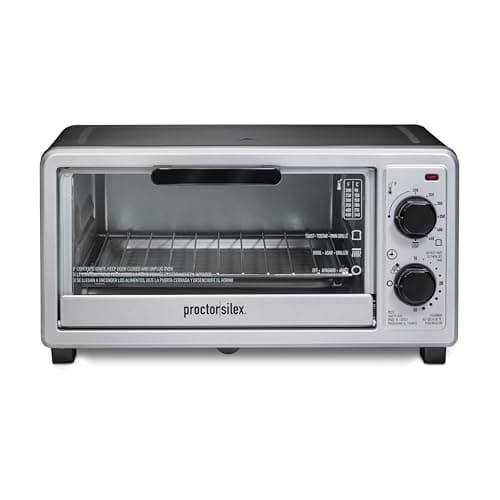
1,100 W
Proctor Silex 4 Slice Countertop Toaster Oven (31260)
Fifty dollars, four slices, three manual controls — and, unusually for the price, a published wattage and a three-year warranty. It does the same three things the ovens at four times the money do; what you give up is the fan, the evenness and the interior.
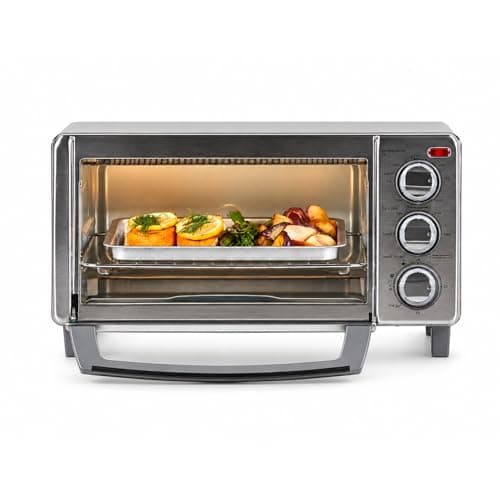
1,150 W
BLACK+DECKER 4-Slice Toaster Oven with Natural Convection (TO1785SG)
1,150 W, 120 V, four slices, a 9-inch pizza and a two-year warranty — all published by BLACK+DECKER on its own site. For sixty-five dollars that is a more complete specification than several ovens here costing three hundred.
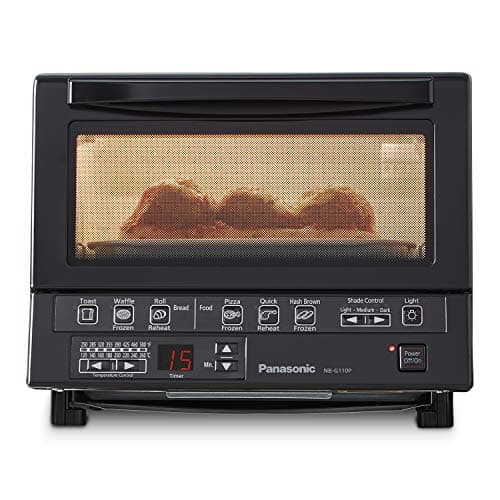
1,300 W
Panasonic FlashXpress Toaster Oven (NB-G110P)
The most completely documented oven on this entire site relative to its size: 1,300 W, 120 V, 60 Hz, 7.2 quarts, 250–500°F, exact millimeter dimensions and a stated weight. Panasonic publishes all of it, and almost nobody else does.
#ad · As an Amazon Associate we earn from qualifying purchases.
Questions
Frequently asked
Do countertop ovens heat up the kitchen?
Does a toaster oven heat the house less than a regular oven?
How many Btu does a toaster oven produce?
Which countertop ovens put the least heat into the room?
Will closing the kitchen door help?
How much does the extra air conditioning cost?
Keep reading
Related
- Countertop oven vs full oven costThe money version of this page, with the same assumptions stated in full.
- Running cost by modelEvery published wattage we hold -- the input to all the arithmetic here.
- How much clearance does one need?Where the heat goes, and the published requirements that vary by a factor of six.
- Best budget toaster ovensWhere the sub-1,200-watt ovens that put the least heat into a room are ranked.
- Best toaster ovens for reheatingWhy the smallest cavity is the right one when heating less air is the goal.
Receipts
Sources
- US EIA — Energy conversion calculators, electricity: “1 kilowatthour = 3,412 Btu” (stated as the standard conversion factor)
- US EIA, Electric Power Monthly Table 5.3 — average residential price, US total, June 2026
- BLACK+DECKER — TO3250XSB / TO3260XSBD / TO3240XSBD use and care manual [PDF]: “During first few minutes of use you may notice smoke and a slight odor. This is normal and should cause no concern.”; “Temperatures in the oven will be lower than your set point.”; the 1½-inch top-element clearance rule; the timer rule; the short-power-supply-cord note
- Nuwave — Bravo XL Pro owner's manual, model 20813 [PDF]: Before First Use (remove glue and labels; “it is perfectly normal for your new unit to produce a heated plastic smell when used for the first time”), automatic shut-off odor note, white-smoke troubleshooting entry, probe target range
- Panasonic — FlashXpress Toaster Oven NB-G110P product page (power consumption, supply, capacity, 250–500°F range, dimensions)
- BLACK+DECKER — Crisp 'N Bake Air Fry 4-Slice Toaster Oven (TO1785SG) product page: 1150 W, 120 V, 4 slices / 9-inch pizza, dimensions, 2-year limited warranty, and the “natural convection” designation
- Proctor Silex — 4 Slice Toaster Oven Broiler (31260G) product page (temperature range, timer, 3-year limited warranty)
We have not cooked in these ovens and we do not pretend to have. Specifications come from the manufacturer's own published documents; electricity rates come from the US Energy Information Administration; prices come from the live Amazon API. Where a figure is not published, the page says “not published” rather than guessing. Read the full method.