The short answer
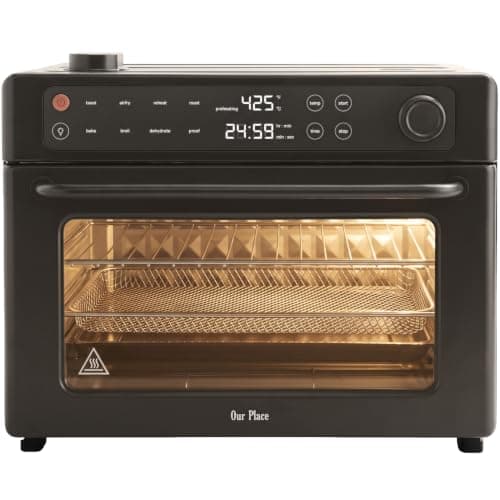
Buy it if the reason you would not buy the standard Wonder Ovenis its limits. That oven's published floor is 200°F and its timer stops at 60 minutes, which rules out proofing, dehydrating and anything slow. The Pro publishes an 80°F floor and a timer Our Place states runs from 30 seconds to 24 hours, and it names Proof and Dehydrate among its eight modes. On its own spec sheet it is the only oven in this catalog that can do all three of those things.
Do not buy it expecting the cheaper running cost that makes the standard model interesting. The Pro is rated at 1,700 watts against the standard oven's 1,400, which puts it within a hundred watts of the 1,800-watt field and removes most of the saving. And do not take the 28-liter capacity at face value: Our Place prints an interior of 13.75 by 13 by 7.75 inches directly beside it, and those two numbers do not describe the same box.
What Our Place publishes — and what it does not
This site has no test kitchen and says so on every page of the rubric. What we can do is read what a manufacturer puts in writing. Our Place is better at that than most brands at any price: the Wonder Oven Pro's product page carries a wattage, a voltage, a temperature range, a timer range, a capacity, interior and exterior dimensions, a weight, a rack count, the named modes and the materials.
| What is published | Figure | Where |
|---|
| Rated power | 1700W, 120V | Product page specifications |
|---|
| Temperature | 80–450°F | Product page specifications |
|---|
| Timer | 30 seconds to 24 hours | Product page specifications |
|---|
| Capacity | 28 L | Product page specifications |
|---|
| Interior (W×D×H) | 13.75 × 13 × 7.75 in | Product page specifications |
|---|
| Exterior (W×D×H) | 16.75 × 13.25 × 13 in | Product page specifications |
|---|
| Weight | 18 lb (without inserts) | Product page specifications |
|---|
| Rack levels | 3 | Product page specifications |
|---|
| Modes | Air fry, bake, roast, toast, broil, dehydrate, proof, reheat | Product page specifications |
|---|
| Rated power on a rating plate | Not read | No manual we could open |
|---|
| Warranty | 1 year from delivery | Our Place warranty policy |
|---|
One honest difference from the standard Wonder Oven's review: there, we could cite the rating line printed on the manual's cover — 120V 60Hz 1400W, model APL.WDO.ESN. For the Pro we could not. Our Place links no PDF from its own site, and the third-party libraries that index the Pro's manual refuse automated requests. So the 1,700-watt figure here is a product-page figure, not a rating-plate one, and nothing on this page is sourced to a manual we have not read — no clearance minimum, no steam quantity, no accessory placement. Where the standard review could quote the document, this one says it cannot.
The 28 liters that is not 28 liters
This is the finding, and it is the kind a reader can check in a calculator. Our Place states the capacity as 28 L, and in the same specifications block states the interior as 13.75 inches wide, 13 deep and 7.75 high. Multiply those three: 13.75 × 13 × 7.75 comes to about 1,385 cubic inches. There are 61.02 cubic inches in a liter, so that interior is about 22.7 liters — roughly 0.8 cubic feet, and about five liters short of the stated figure.
That matters because of what the comparison does to it. We ran the same sum on the standard Wonder Oven when we reviewed it: 10 × 10.3 × 7.6 inches is about 783 cubic inches, which is 12.8 liters against a stated 12 L and 13 qt. Those agree. The Pro's do not, and Amazon rounds the stated figure further still, listing the oven as “30 Qt” — which is 28 liters converted, not the interior measured.
We are not calling it a false claim, because there is a mundane explanation available: a stated oven volume often includes the space above the top rack slot and around the element that no pan can occupy, while an interior measurement may be taken between the rack rails. Our Place does not say which it has done, and that is the actual criticism. If you are buying on volume, buy on the inches: 13.75 by 13 by 7.75 is what you can put a pan into, and it is the figure the pan-fit arithmetic uses.
What that interior actually takes
Our Place states the oven “fits a whole chicken or 12" pizza” across its three rack levels. The 12-inch pizza is the useful half of that: it puts the Pro in the same class as the full-size countertop ovens rather than the small ones, and it is three inches more than the standard Wonder Oven's published 9-inch limit. A whole chicken is less useful as a figure, because Our Place publishes no weight for it — the standard model does say 4.5 pounds, so the Pro's silence here is a gap rather than an upgrade.
The number to weigh against your own shelf is the 7.75-inch interior height. That is almost exactly the standard Wonder Oven's 7.6 inches: the Pro grew sideways, not upward. Height is what decides whether a lidded casserole or a tall loaf goes in at all, so if that is your constraint, the Pro does not solve it. The household-size question is worked through here, and the ovens we rank purely on published interior volume are here.
Our Place also publishes no toast-slice count for the Pro, which is a strange omission on an appliance whose other name is a toaster oven. Four slices is the standard model's stated figure; a 13.75-inch-wide cavity will plainly take more than four, but we are not going to print a number the manufacturer has not. How slice counts and interior sizes line up across the category is here.
80°F to 450°F, and the two modes that need it
A published temperature floor below 100°F is rare, and it is the only thing that makes proofing and dehydrating real rather than a label on a button. Our Place publishes 80–450°F for the Pro, and names Proof and Dehydrate among the eight modes. The standard Wonder Oven publishes 200–450°F and has neither mode — and no setting on it reaches below the floor, which is why its review tells a reader who proofs dough to look at this model instead.
For context on the floor: the only other ovens in this catalog that publish anything that low are Breville's Smart Oven Air Fryer Pro and Joule Oven Air Fryer Pro, both of which publish 80–480°F in their instruction books. The Breville Smart Oven Pro and the Smart Oven Air Fryer Compact stop at a published 120°F. Everything else either starts near 200°F or publishes no range at all. Why a low published floor is the figure that decides a bread oven is here, and the ovens that publish a low-temperature drying program are ranked here.
The timer is the Pro's genuinely unusual specification. Our Place states 30 seconds to 24 hours. No other oven in this catalog publishes a timer longer than 60 minutes — the standard Wonder Oven stops there, and so does the Cuisinart TOA-70. Dehydrating is the reason it exists: fruit leather and jerky run for eight to twelve hours, and an oven whose timer stops at an hour cannot do it unattended no matter how low the dial goes. A 24-hour timer plus an 80°F floor is a coherent pair, not two separate marketing numbers.
The honest caveat is that we have not cooked in this oven and Our Place publishes no per-mode temperature table — so we know the oven's overall band is 80–450°F, but not whether Proof and Dehydrate expose the whole of it or run at fixed preset points. Several brands do the latter. How much of a mode is really a separate machine is covered here.
1,700 watts: the saving mostly goes away
The standard Wonder Oven's best argument is its 1,400-watt rating, which is 400 watts below the 1,800 that almost every full-power countertop oven is built to because 15 amps at 120 volts is 1,800 watts. The Pro gives most of that back. At 1,700 watts and the US average residential rate, it costs about 31.2 cents an hour at full draw — against 33.0 cents for an 1,800-watt oven and 25.7 cents for the standard Wonder Oven. Over a year at half an hour a day that is roughly $57, against $60 and $47 respectively. The spec card above shows the sum with every input, and every published wattage we hold is tabulated here.
All three figures are upper bounds, because elements cycle off once a cavity is hot and no brand publishes a duty cycle. But the direction is not in doubt: if the reason you were looking at Our Place was a lower bill, the Pro is not that oven — the standard model is, and it is the cheaper purchase as well. The full electricity calculation is here.
The circuit is the practical consequence. 1,700 watts at 120 volts is about 14.2 amps, which is nearly the whole of a 15-amp circuit. The standard Wonder Oven's 1,400 watts leaves about 3.3 amps of headroom; the Pro leaves under one. In a kitchen where the oven shares a circuit with a kettle or a coffee maker, that is the difference between the two models that will actually show up. Whether an air fryer oven needs its own circuit is worked through here, and the ovens that fit a limited supply are ranked here.
Digital controls, and what that costs you later
The clearest hardware difference from the standard model is the panel. Our Place's own comparison says the Pro has “a digital control panel for exact time and temperature settings” where the standard oven has three knobs, and adds “3 cooking tiers (vs. 2), two wire racks, and a deeper bake pan to catch grease”.
Exact setting is a real benefit on an oven whose selling point is an 80°F floor — “a bit above the bottom stop” on a dial is not a proofing temperature. The cost is the one every digital oven carries: a control board and a capacitive panel are the parts that retire an appliance while its elements are still fine, and they are not user-serviceable. Our Place covers the oven for one year from delivery and no longer. Two of the ovens we rate highest for longevity — the Cuisinart Custom Classic and the BLACK+DECKER TO3250XSB — score where they do partly because there is essentially nothing on them to fail electronically.
Materials, and the non-toxic claim
Our Place built its brand on cookware without PFAS and the Pro follows the same line. The product page publishes quartz and stainless steel heating elements, a bake pan of cast aluminum with a toxin-free non-stick ceramic coating, and steel accessories — basket, rack and crumb tray — and states that the interiors and accessories are made without what it calls Forever Chemicals.
That is the profile our materials guiderecommends when coatings are the concern: food sits on bare steel in a steel box, and the only coated part is a pan you can replace. The trade is the one that guide describes for ceramic in general — no PTFE, but a release that tends to fade faster with use than PTFE's does. Note also that the standard Wonder Oven's manual states none of its accessories is dishwasher safe; we have not read a manual for the Pro, so we are not extending that to this model, but it is worth checking the booklet in the box before you load a rack into a dishwasher. The lowest-coating air fryer ovens are ranked here.
Footprint
16.75 inches wide, 13.25 deep and 13 high, at 18 pounds without the inserts. That is a real counter appliance rather than a small one — five inches wider than the standard Wonder Oven and nearly seven pounds heavier — but it is still narrower than the ovens that genuinely become furniture: Breville's BOV900 and BOV950 are both 21.4 inches wide and 38.89 pounds, and the BLACK+DECKER TO3250XSB is 22 inches.
The number we cannot give you is the clearance. Our Place publishes a minimum in the standard model's manual — an inch above, behind and each side — and we have no equivalent document for the Pro, so do not assume the same figure for a bigger, hotter oven. At 13 inches tall it is also close to the ceiling of a standard 18-inch under-cabinet gap once any clearance at all is added. The ovens we rank for under-cabinet fit are here, and the small-kitchen ranking, by footprint, is here.
The warranty, and where you buy it
Our Place's warranty page states that “the Warranty period for appliances is limited to one (1) year from the date of delivery to the purchaser”, and names the Wonder Oven Pro among the appliances it covers. The same page limits the warranty to products bought from Our Place or an Our Place authorized retailer. On Amazon this oven appears under several color variants at near-identical prices, and they do not all have the same stock position — at our last check two colorways were In Stock within a dollar of each other, one read “Currently unavailable”, and one had no buyable offer at all. The positions rotate, so the variant we link is whichever one is live. Check the seller and the condition before you order; the price is not the only thing that differs between listings.
Which Wonder Oven
Our Place sells three, and the decision between them is unusually clean because the published specifications differ in ways you can act on.
| Model | Rated power | Published range | Modes | Racks |
|---|
| Wonder Oven | 1,400 W | 200–450°F | 6 | 2 |
|---|
| Large Wonder Oven | 1,700 W | 200–450°F | 6 | 3 |
|---|
| Wonder Oven Pro | 1,700 W | 80–450°F | 8 | 3 |
|---|
Read down the range column and the choice makes itself. The Large Wonder Oven buys you size and nothing else — and it is published with this oven’s exact interior and exterior, so it is not even a step down in space: same six modes, same 200°F floor, same knobs, so it has the Pro's electricity bill without the Pro's capability. If you want a bigger Wonder Oven, it is the cheaper way to get one. If the 200°F floor or the 60-minute timer is your reason for looking past the standard model, the Pro is the only one of the three that fixes it, and the Large is a trap. If neither limit affects how you cook, the standard oven is cheaper to buy, cheaper to run and the one whose figures reconcile. The three-model comparison works the whole decision through.
Against the alternatives
At this price the comparison that matters is Breville. The Smart Oven Air Fryer Pro (BOV900) sits in the same bracket and publishes a wider band — 80–480°F — out of its own instruction book, with a rating line, an independently driven element system, a stated 1 cubic foot interior, nine slices of toast, a 13-inch pizza and a two-year warranty. On documentation it beats the Pro outright, and it is the oven to buy if a verifiable spec sheet is why you are here. What it does not have is a dehydrate program a 24-hour timer can actually finish, or Our Place's materials position.
Below that, the Nuwave Bravo XL Pro — ranked on the probe roundup — offers a bigger stated capacity for substantially less money with a probe, at the cost of a wattage that is brand-supplied rather than rating-plate. And the standard Wonder Oven remains the better buy for anyone cooking for one or two who does not need the low end of the dial. The full ranking is here.
Who should skip it
Anyone buying on running cost. 1,700 watts is within a hundred of the 1,800-watt field, so the saving that makes the standard Wonder Oven interesting is mostly gone — and at 14.2 amps it needs more of a shared circuit than the smaller model does. Anyone who needs interior height: 7.75 inches is a fifth of an inch more than the standard oven, so a lidded casserole or a tall loaf is no more likely to fit. Anyone who wants to buy on a reconcilable number, because the headline 28 liters and the printed interior dimensions do not agree. Anyone who wants a rating-plate wattage they can read for themselves before buying — Breville prints one, and Our Place prints one for the standard model, but we could not find one for this. And anyone who wants the cheapest route to a large cavity: the big-batch ovens we rank are here, and several of them hold more for a third of the money, with far less on paper.