Skip to content
CC

HUB 04 · Comparisons

Instant Omni Plus vs Ninja Foodi XL

These two are cross-shopped constantly and compared badly, because neither maker publishes what the other does. Instant states 19 quarts and 170 to 450°F and never states a wattage. Ninja states 1,800 watts and never states how big the inside is.

By Stephen V.Updated How we rank
#ad

We earn a commission if you buy through our links. It does not change the price you pay, and it does not decide our picks — the scoring rubric is published in full, including what disqualifies an oven. How this works.

The short answer

Quick picks

#OvenBest forScorePrice
01Wattage not published
6.9
$249.99Amazon
021,800 W
8.1
$379.99Amazon
03Wattage not published
7.0
$429.95Amazon

#ad · Prices pulled live from the Amazon Product API, last checked October 20, 2026. Where we have no verified live price we show none — we would rather leave a gap than print a number that has gone stale. The wattage column is what the manufacturer publishes; “not published” means exactly that, and we have not estimated one. Scores are ours, compiled from published specifications, and are not test results.

The short version

If you want to know what you are buying, the Instant Pot Omni Plus wins — narrowly, and on paperwork rather than on cooking. Instant publishes a 19 QT / 18 L interior, a 170 to 450°F range and ten functions including a rotisserie. That 170°F floor is the lowest published figure of any oven on this page by 30 degrees and it is what makes dehydrating and holding possible rather than hopeful.

Buy the Ninja Foodi 10-in-1 XL Pro (DT201) if usable area is the whole point. Ninja publishes a rated 1,800 watts and a capacity claim of two 12-inch pizzas across two cooking levels — which is the most food-per-dollar on this page — and publishes no interior volume, no interior dimension and no temperature range at all.

The Ninja Prestige Smart XL (DT551) is the version to buy if you cook meat to a target temperature, because it adds an integrated probe inside the same two-level XL cavity. It publishes no wattage, which means on this one you cannot even do the running-cost arithmetic.

We have cooked in none of them. There is no test kitchen behind this site and every figure below came off a manufacturer document.

The finding: between two brands, one spec sheet

This pairing is the clearest example on this site of a pattern we keep running into. Each brand publishes precisely the half of the specification the other withholds, so no row of the table below is filled in for both.

Published figureInstant Pot Omni PlusNinja Foodi XL Pro (DT201)Ninja Prestige Smart XL (DT551)
Rated powerNot published1800 WNot published
Interior volume19 QT / 18 LNot publishedNot published
Temperature range170–450°FNot publishedNot published
Capacity claimPublished as a volumeTwo 12-inch pizzas, two cooking levelsTwo 9x9 trays / 9 slices / 12 lb turkey
FunctionsTen, including rotisserieTenTen, with an integrated probe
Running cost per hourCannot be calculated33.0¢ at 18.34¢/kWhCannot be calculated

Read that table as a buying instruction rather than a complaint. If the thing you cannot afford to get wrong is whether it fits what you cook, Instant is the brand that committed a number to paper. If the thing you cannot get wrong is whether your circuit can carry it, Ninja is. Nobody here lets you check both.

Where the 170°F floor earns its place

Instant's published floor is 170°F. Three jobs sit below the 200°F mark that most of this category treats as its bottom: dehydrating fruit and jerky, holding a cooked dish warm without drying it, and proofing with the door ajar. A published 170°F makes the first two defensible claims; it is still too high for a true proof, which wants something closer to 75 to 100°F.

Neither Ninja on this page publishes a floor at all, and that absence is worth being precise about: both DT201 and DT551 are marketed with a Dehydrate function. A dehydrate setting with no published temperature band is a function whose working range you cannot verify before buying, which is the argument made in full in our dehydrator guide and the reason the Instant tops the dehydrator ranking.

Two levels versus one cavity

The honest case for the Ninja is geometry, and it is a strong one. A published claim of two 12-inch pizzas on two levels is a specific, checkable statement about what the oven holds — less precise than a dimension, far more useful than a quart figure, because it names objects. For a household cooking a main and a side at once, two shelves that both work beats a larger single cavity most nights.

The Instant's 19 quarts is roughly comparable in volume and arranged differently, and it adds a rotisserie spit — the mechanism the Ninja does not have at any price here, and one of only two rotisserie claims in this catalog. Both are ranked on that axis here.

What the missing wattage actually costs you

For the DT201 the arithmetic works: 1,800 watts at the EIA's published 18.34¢ per kWh is 33.0 cents an hour, about 13.8 cents for a 25-minute cook, and roughly 15 amps — which is a full household circuit on its own.

For the Instant Omni Plus and the DT551 it does not work at all, and we print no number rather than borrowing one from a similar model. The practical gap is narrow: ovens this size are almost all in the 1,500 to 1,800-watt band, which at this rate is a spread of about five and a half cents an hour. The real cost of the missing figure is not the money, it is the amperage — you cannot confirm the oven is safe on a shared kitchen circuit, and that is a question you want answered before the first use rather than by a tripped breaker. Every published wattage on this site is in one table, and the blanks in it are mostly these two brands.

Which to buy

Choose the Instant Omni Plus if you want a verified interior volume, a published low end, or a rotisserie. Choose the Ninja DT201 if you want the most usable area per dollar and can live with an undocumented temperature range. Choose the Ninja DT551 only if the probe is the point — it is the feature neither of the others has, and the probe ranking explains what a published probe target range is worth.

In detail

The picks, in full

01
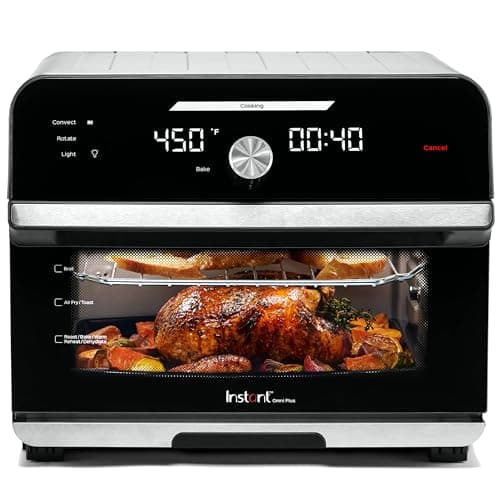
Instant Brands Instant Pot Omni Plus 19QT/18L Toaster Oven Air Fryer, 10-in-1

Rotisserie without a separate machine

Instant Pot Omni Plus 19QT/18L Toaster Oven Air Fryer, 10-in-1

Interior volume publishedNo published wattage
6.9/10

One of the few ovens here that publishes its interior in liters, which makes it the easiest in the category to compare on paper. The rotisserie is a genuine mechanical addition rather than a relabeled fan setting.

Power
5
Usable space
8.5
Footprint
6.5
Documentation
7
Value
7.5

What it gets right

  • 18 liters stated plainly, so you can compare it to a Breville's cubic foot without converting a marketing claim
  • A published temperature range, which is rarer than it should be and matters if you proof dough
  • The rotisserie spit is real hardware, not a preset

What it doesn't

  • Instant Brands publishes no wattage on the product page, so this oven gets no running-cost figure from us
  • 450°F is a low ceiling — several ovens here reach 500°F, which matters for pizza and for a hard finish on roast vegetables
  • Rotisserie is the kind of feature that gets used twice

What it costs to run

Instant Brands publishes no wattage for this oven in any document we could find, so we do not show a running-cost figure for it. We are not going to estimate one from a similar model. Here is the method we would have used.

Skip this if…

…you bake pizza at high heat. The published ceiling is 450°F, and that is fifty degrees short of where a thin crust actually wants to be.

$249.99on Amazon

Price last checked October 20, 2026. Prices move constantly — Amazon's at checkout is the one that counts.

#ad · we may earn a commission from this link to Instant Pot Omni Plus 19QT/18L Toaster Oven Air Fryer, 10-in-1

02
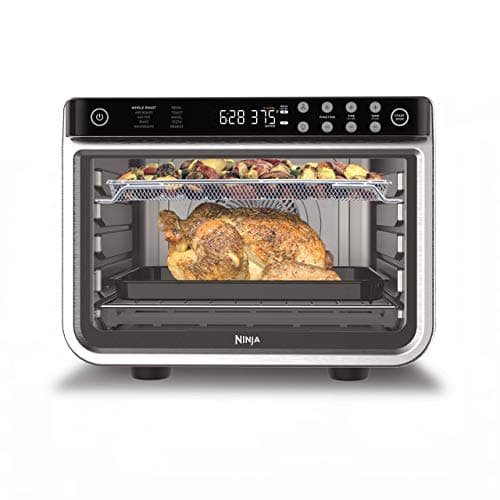
Ninja Ninja Foodi 10-in-1 XL Pro Air Fry Oven (DT201)

Most usable interior per dollar

Ninja Foodi 10-in-1 XL Pro Air Fry Oven (DT201)

Two cooking levelsLarge external footprint
8.1/10

The value pick, and it is not close. Same 1,800 W as ovens costing more than twice as much, two full cooking levels, and a published capacity claim — two 12-inch pizzas — that is specific enough to be checkable rather than a vibe.

Power
9.5
Usable space
9
Footprint
5.5
Documentation
7
Value
9.5

What it gets right

  • Identical 1,800 W draw to the Breville Pro for substantially less money — on running cost alone they are the same oven
  • Two genuine cooking levels rather than one shelf and an optimistic second slot
  • The capacity claim is stated as objects that fit, which you can measure against your own baking sheet

What it doesn't

  • SharkNinja publishes no interior volume in cubic feet or liters, so cross-brand space comparison is guesswork
  • The external footprint is large enough that it stops being a countertop appliance and starts being furniture
  • Ten functions on a dial that mostly changes fan speed and set point

What it costs to run

About 33.0¢ an hour at full draw, or $60.25 a year at 30 minutes a day, 365 days a year and 18.34¢ per kWh.

1,800 W ÷ 1000 × 182.5 h × 18.34¢ = $60.25

1800 W as published by SharkNinja on the DT201 product page and repeated in the brand's own retail listings. This is an upper bound: the elements cycle off once the cavity is at temperature, and no manufacturer publishes a duty cycle, so we compute at full rated draw rather than invent a correction factor. The full method is published.

Skip this if…

…counter space is the binding constraint rather than money — this is one of the biggest boxes in the category, and a smaller oven that costs more may still be the right buy.

$379.99on Amazon

Price last checked October 20, 2026. Prices move constantly — Amazon's at checkout is the one that counts.

#ad · we may earn a commission from this link to Ninja Foodi 10-in-1 XL Pro Air Fry Oven (DT201)

03
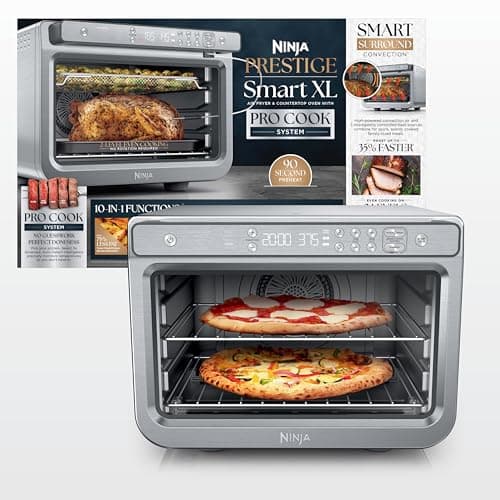
Ninja Ninja Prestige Smart XL with Pro Cook System, 10-in-1 (DT551)

A probe inside the two-level XL cavity

Ninja Prestige Smart XL with Pro Cook System, 10-in-1 (DT551)

Integrated probe
7.0/10

The two-level XL Ninja with an integrated thermometer, and it now costs roughly what the probe-less DT201 costs. That changes the question from whether one sensor is worth the premium to whether you have any reason not to take it.

Power
8
Usable space
9
Footprint
5.5
Documentation
5
Value
7.5

What it gets right

  • The probe is the reason to buy it — cooking a roast to internal temperature is the single biggest improvement available to a home cook
  • Two genuine cooking levels in an XL cavity, with a capacity claim stated as objects you can measure against
  • Ninja's presets are mapped to the probe rather than sitting alongside it

What it doesn't

  • No published wattage or interior volume from SharkNinja for this SKU, so we print no running cost
  • Large footprint — Ninja states 20.2 x 17.1 x 13.3 inches and 33.75 lb
  • The thermometer is the whole premium, and it is useless on the food these ovens mostly cook

What it costs to run

Ninja publishes no wattage for this oven in any document we could find, so we do not show a running-cost figure for it. We are not going to estimate one from a similar model. Here is the method we would have used.

Skip this if…

…you mostly cook things that do not have an internal temperature worth measuring. Toast, vegetables and reheated pizza do not need a probe, and that is most of what these ovens do.

$429.95on Amazon

Price last checked October 20, 2026. Prices move constantly — Amazon's at checkout is the one that counts.

#ad · we may earn a commission from this link to Ninja Prestige Smart XL with Pro Cook System, 10-in-1 (DT551)

How we picked

Ovens we claim to have cooked in: 0

Everyone in this category tells you they roasted forty chickens. We have roasted none, and we say so. Here is what we do instead: read the manufacturer's manual and spec sheet, record the published wattage, interior volume, temperature range and warranty term, work out what the oven costs to run for an hour and for a year, show the arithmetic so you can redo it with your own electricity rate, and cite all of it. Where a brand publishes no wattage, we print no running cost rather than borrowing a number from a similar model. Prices come live from Amazon's API and disappear rather than go stale.

The scores above are judgments from that documented research — not test results. One of the five metrics is Documentation: whether the manufacturer will tell you what its oven draws at all. The full rubric, including what disqualifies an oven, is published in full.
Questions

Frequently asked

Which is bigger, the Instant Omni Plus or the Ninja Foodi XL?
On published figures the question cannot be answered properly, which is the point of this page. Instant publishes 19 QT / 18 L. Ninja publishes no volume for the DT201 at all, only a claim of two 12-inch pizzas on two cooking levels. Those are different kinds of statement and they are not comparable. If you need to be certain something specific fits, the Instant is the one with a number.
Does the Ninja Foodi XL Pro publish a temperature range?
No. SharkNinja publishes 1,800 watts, ten functions and a capacity claim for the DT201, and no temperature range — which also means the published Dehydrate function has no verifiable working band. Every published range in this catalog is collected here, and the Ninja column is empty throughout.
Can I calculate what the Instant Omni Plus costs to run?
Not honestly, because Instant Brands publishes no wattage for it. We will not borrow a figure from a similar oven to fill the gap. What can be said is the band: ovens of this size are typically 1,500 to 1,800 watts, which at 18.34¢ per kWh is 27.5 to 33.0 cents an hour. Read the rating plate on the back inside the return window if the number matters to you.
Which one has a rotisserie?
The Instant Pot Omni Plus, which publishes a rotisserie among its ten functions. Neither Ninja on this page does. It is one of only two published rotisserie mechanisms in this whole catalog — the other being the Emeril Lagasse Everyday 360 — and both are ranked here.
Is the DT551 worth the extra over the DT201?
Only for the probe. Both are two-level XL ovens from the same maker with the same function count, and the DT551 publishes less than the DT201 does — it drops the rated wattage the DT201 states. So you are paying more for an integrated probe and losing the one figure that lets you check your circuit. The within-brand comparison goes through this in detail.

Keep reading

Receipts

Sources

We have not cooked in these ovens and we do not pretend to have. Specifications come from the manufacturer's own published documents; electricity rates come from the US Energy Information Administration; prices come from the live Amazon API. Where a figure is not published, the page says “not published” rather than guessing. Read the full method.