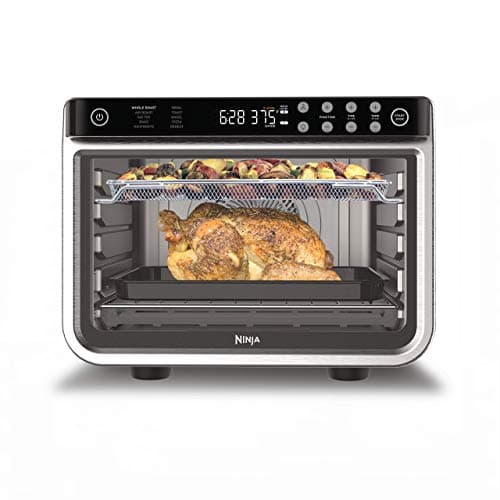
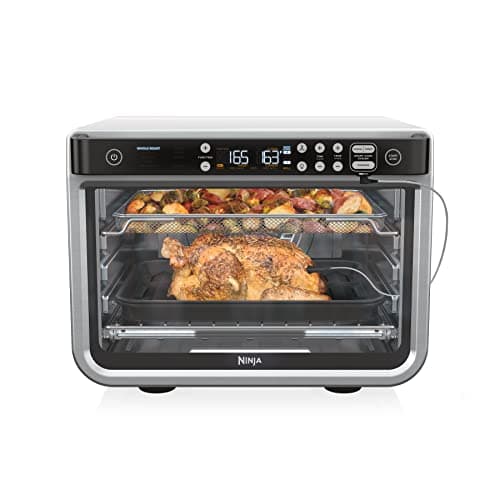
The short answer
Buy the DT201 unless you roast meat often. The two ovens are the same two-level XL air fry oven; the DT251 adds a smart thermometer and costs roughly double for it. A probe is the single biggest upgrade available to a home cook who roasts — it cooks to a real internal temperature instead of to a timer that does not know how cold the meat started. If most of what you cook does not have an internal temperature worth measuring, you are paying twice as much for a sensor you will not use.
What is identical
Almost everything. Both have the same two genuine cooking levels, the same XL cavity Ninja describes as taking two 12-inch pizzas, the same 1,800-watt class of element, and the same large footprint. Neither publishes a rated wattage or an interior volume for its SKU, so neither gets a running-cost figure from us — the same documentation gap runs across the whole Ninja line. The DT201 review and the DT251 review cover the shared hardware in full.
What the probe is worth
Everything, or nothing, depending on what you cook. A roast, a whole chicken, a pork loin, a thick steak — these are cooked correctly to a number, and a probe removes the largest source of home-roasting failure. A tray of fries, toast, or reheated pizza has no meaningful internal temperature, so the probe sits unused. The honest test is frequency: if you roast a cut of meat weekly, the DT251 earns its premium; if it is a few times a year, buy the DT201 and a ten-dollar instant-read thermometer and keep the difference.
The decision rule
Buy the DT201 if you want the two-level XL oven for the lowest price and rarely roast to a target temperature — most cooking. Buy the DT251 if you roast meat often enough that cooking to internal temperature, not to a timer, is worth roughly double the money. Everything else is the same oven — same cavity, same power, same footprint.
If counter space is the real constraint rather than the probe, the flip-away Ninja SP line keeps the power and folds away, and higher SP trims pair vertical storage with a thermometer of their own — the probe without the footprint.
And if the thing you actually want from a bigger Ninja is two temperatures at once rather than a probe, the Double Oven with FlexDoor against this same DT201 is the comparison that settles it — with the caveat that Ninja publishes no wattage for the Double Oven, so only one side of that page carries a running cost.
How we picked
Ovens we claim to have cooked in: 0
Everyone in this category tells you they roasted forty chickens. We have roasted none, and we say so. Here is what we do instead: read the manufacturer's manual and spec sheet, record the published wattage, interior volume, temperature range and warranty term, work out what the oven costs to run for an hour and for a year, show the arithmetic so you can redo it with your own electricity rate, and cite all of it. Where a brand publishes no wattage, we print no running cost rather than borrowing a number from a similar model. Prices come live from Amazon's API and disappear rather than go stale.
The scores above are judgments from that documented research — not test results. One of the five metrics is Documentation: whether the manufacturer will tell you what its oven draws at all. The full rubric, including what disqualifies an oven, is published in full.