Skip to content
CC

HUB 03 · Toaster Ovens

The Best Toaster Ovens Under $50

Three of the four ovens here draw 650 to 800 watts, against 1,100 to 1,800 for the shelf above. That is the whole difference, it is published, and it decides whether an oven under fifty dollars is the right buy or a false economy.

By Stephen V.Updated How we rank
#ad

We earn a commission if you buy through our links. It does not change the price you pay, and it does not decide our picks — the scoring rubric is published in full, including what disqualifies an oven. How this works.

The short answer

Quick picks

#ad · Prices pulled live from the Amazon Product API, last checked October 23, 2026. Where we have no verified live price we show none — we would rather leave a gap than print a number that has gone stale. The wattage column is what the manufacturer publishes; “not published” means exactly that, and we have not estimated one. Scores are ours, compiled from published specifications, and are not test results.

The short answer

Buy the Proctor Silex 31260 if it is still at or under fifty dollars when you look, because 1,100 published watts and a three-year published warranty are a different class of appliance from the rest of this band for about fifteen dollars more. Buy the Elite Gourmet ETO449X if the budget is firm at thirty-five, because it is the cheapest oven on this site whose maker publishes a rated wattage, a temperature range and a timer on its own website. Below that, the ETO236 at thirty dollars is an honest toast-and-reheat appliance and nothing more, and its own specification says so.

We have not cooked in any of these. Our rubric says that in those words — there is no test kitchen behind this site. What follows is what each manufacturer publishes, the arithmetic those figures support, and what nobody in this price band publishes at all.

Why this page exists separately from the other budget pages

We already rank the best budget toaster ovens under $80 and the best under $100, and the honest reason this is a third page rather than a fourth paragraph on one of those is that neither of them contains a single oven that sells under fifty dollars. The under-$80 page ranks four ovens between about sixty and ninety-seven dollars; the under-$100 page ranks four between about sixty and a hundred and eight. Both are built on the premise that the interesting question under a hundred dollars is how much oven you can get before you cross the line — which is the right question if your line is $80 or $100, and the wrong one if your line is $50.

Below fifty dollars the question inverts. You are no longer choosing which capable oven to get for the money; you are choosing which capability to give up. This page ranks on which ovens tell you that honestly, in published figures, before you spend anything.

The criteria, in the order they decided the ranking

1. A published rated wattage. In this band power is not a nice-to-have specification, it is the specification: it sets how long a preheat takes, how fast the cavity recovers when you open the door, and whether a bake is a bake or a long warm. Every oven on this page publishes one, which is genuinely unusual — eleven of the thirty-eight products in our catalog publish a wattage anywhere, and three of those eleven are here.

2. A published temperature range.All four publish 200–450°F, and that lower figure matters more than the upper one: a 200°F floor rules out dehydrating, proofing and low-and-slow work whatever the dial is labeled. If you need a lower floor, nothing in this band has one — our dehydrator ranking explains where the floor drops and what it costs.

3. A published timer, because the timer is also the shut-off. These are mechanical ovens: the dial winds down, a bell rings, the elements stop. There is no thermostat-independent safety sensor published for any of them, which means the timer length is a hard ceiling on an unattended cook. We wrote the whole mechanism up separately, and the short version is that any setting that bypasses the timer bypasses the shut-off. Thirty minutes is the band norm; the ETO236 gives you fifteen.

4. A published warranty term. One of the four publishes one. It is not the most expensive.

5. Footprint and published capacity. This is the band where the oven is often bought becauseit is small — a second kitchen, an office, a camper, a studio apartment — so the exterior figures are ranked as an advantage rather than a compromise.

Reading the order

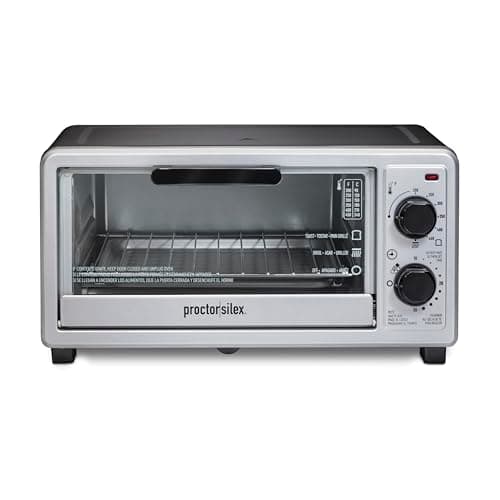
The Proctor Silex 31260wins on the two figures that separate it from everything below: a published 1,100 watts and a published three-year limited warranty, which is the longest term of any oven on this site at any price. At about fifty dollars it is the top of this band rather than the middle of it, and the trade is honest — no fan, no published interior volume, and four slices is the ceiling. Proctor Silex also contradicts itself about its own temperature floor, publishing 200°F in one place on its page and 150°F in another, and we quote both rather than choosing.

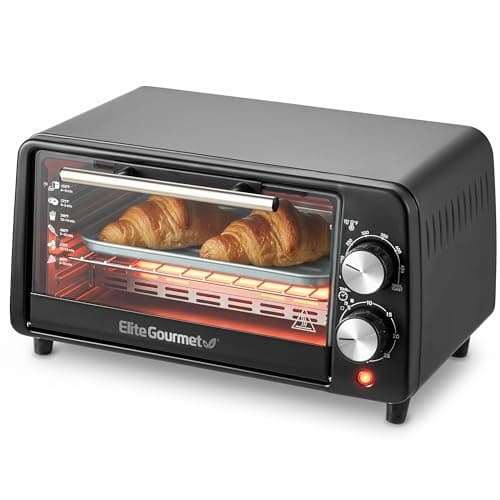
The Elite Gourmet ETO449Xis second and is the value pick of the page at about thirty-five dollars. Elite Gourmet publishes 800 watts, a 200–450°F range and a 30-minute timer in a Specifications list on its own storefront, plus something no other oven under fifty dollars here discloses: the element technology, dual quartz. It also publishes a stated pizza fit of eight inches, which is a real number you can measure a frozen pizza against rather than an adjective.

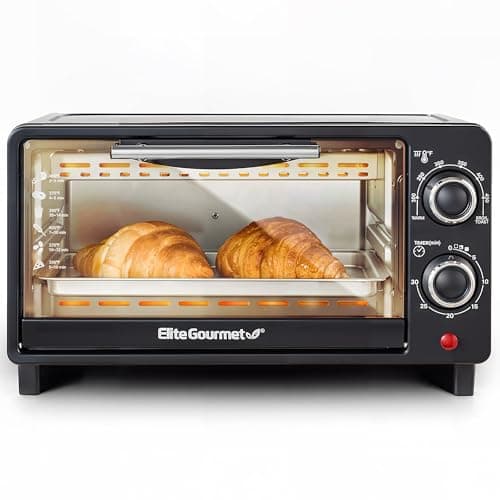
The ETO490 is third, and it is third for a specific and slightly awkward reason: it is five dollars morethan the ETO449X for an identical published specification — same 800 watts, same range, same 30-minute timer, same four slices — minus the quartz disclosure. What it has instead is the shallowest chassis in the band on Amazon's own item data, 11.65 inches against the ETO449X's 14.37, and if an upper cabinet is your constraint that is worth five dollars. If it is not, buy the cheaper one.

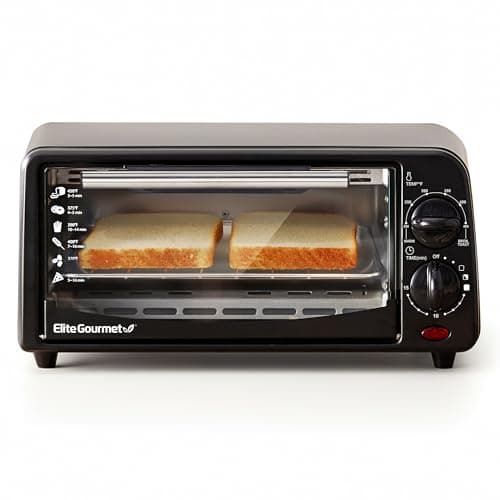
The ETO236 is fourth at about thirty dollars and is the floor of the category. Two slices, 650 watts, a fifteen-minute timer and one rack position. It is on this page because its specification is published and therefore honest, not because we think most people should buy it.

What 650 to 800 watts actually costs you

Two things, in opposite directions. The cheap direction first: at the US average residential rate of 18.34¢ per kWh, an hour of oven-on time costs 11.9¢ at 650 watts, 14.7¢ at 800, 20.2¢ at 1,100 and 33.0¢ at 1,800. So the 650-watt ETO236 is the cheapest oven on this site to run per hour, by a wide margin, and at about 5.4 amps it is also the least likely thing in this category to trouble a shared or elderly circuit.

The expensive direction is that per houris the wrong unit for a kitchen. What you care about is per job, and a lower-wattage oven takes longer to reach temperature and longer to recover after you open the door. Elite Gourmet is unusually candid about this: its own page for the ETO449X tells you to preheat at 450°F for about ten minutes before baking. Ten minutes of published preheat is not a flaw in that oven, it is what 800 watts means. If a 1,800-watt oven gets there in four, the 800-watt one has spent most of its hourly saving on the preheat alone.

The practical reading: buy on watts if you will bake in it, and buy on amps if your constraint is the circuit. Our toaster-oven electricity page runs the same arithmetic out to a yearly figure, and watts by model lists every oven here whose maker publishes the number at all.

What nobody in this band publishes

Three things, and they are the same three for all four ovens. No interior dimension.Not one of these makers publishes the inside of the cavity, so whether a particular dish fits cannot be checked before it arrives — the ETO449X's eight-inch pizza claim is the only proxy on the page. Our pan-fit guide lists the ovens whose makers do publish an interior, and all of them cost more than this.

No thermostat tolerance.No manufacturer in this category publishes one at any price, and in this band that gap matters more because the control is a bimetallic dial rather than a thermistor and a board. The only brand anywhere on this site that has committed anything to paper about it is BLACK+DECKER, which states in its own manual that temperatures inside its ovens “will be lower than your set point” by design. That sentence explains most complaints about cheap ovens, and it is almost certainly not unique to the brand that wrote it down.

No convection.There is no fan in this band at any price. The fan is the single biggest improvement available in the category and it arrives at about sixty dollars, not fifty — which is the strongest argument on this page for spending more. Where the fan starts covers that step.

The Prop 65 disclosure, stated plainly

All three Elite Gourmet product pages carry a California Proposition 65 warning naming lead. We put that in the cons of all three entries above because a buyer is entitled to see it before they buy rather than on the carton, and because this site's rule is that a published disclosure gets reported whether or not it is convenient.

What it is not: a test result, a measurement, or a statement that the oven will expose you to anything. Prop 65 warnings are a California labelling requirement with a very low threshold, they appear on an enormous range of consumer goods, and a brand that publishes one has in a narrow sense disclosed more than a brand that publishes nothing. We are not going to characterize the risk, because we have no measurement to characterize it with. We are going to tell you it is there.

When to spend more, and exactly how much more

Fifteen dollars. The BLACK+DECKER TO1785SG at about sixty-five dollars publishes 1,150 watts, 120 volts, its exterior dimensions and a two-year limited warranty on BLACK+DECKER's own site, and it has an air-fry fan. That is a complete published specification plus convection for fifteen to thirty dollars more than anything on this page, and it is more documentation than several ovens on this site costing three hundred. If your fifty-dollar ceiling is a preference rather than a constraint, that is where the money goes.

The BLACK+DECKER TO1313SBD at about sixty is the other exit, and a worse one on paper: BLACK+DECKER publishes no wattage for that SKU at all, so you give up the one figure this entire page is ranked on in exchange for a brand name. It is ranked fourth on the under-$100 page for exactly that reason.

And one case where the right answer is to spend less than any of this: if the job is literally toast and reheating, a two-slice pop-up toaster does the first job better and the second job not at all. We settled that one separately.

In detail

The picks, in full

01
Proctor Silex Proctor Silex 4 Slice Countertop Toaster Oven (31260)

A backup oven

Proctor Silex 4 Slice Countertop Toaster Oven (31260)

Wattage published in the listingNo published interior volume
6.6/10

Fifty dollars, four slices, three manual controls — and, unusually for the price, a published wattage and a three-year warranty. It does the same three things the ovens at four times the money do; what you give up is the fan, the evenness and the interior.

Power
4.5
Usable space
4.5
Footprint
9
Documentation
6
Value
9

What it gets right

  • 1,100 watts is published for this SKU, so the running cost is checkable rather than guessed
  • Three functions behind manual controls, with a 30-minute timer, a ready bell and an auto shutoff
  • A three-year limited warranty, which is longer than the rest of this band offers

What it doesn't

  • Proctor Silex publishes no wattage on its own product page — the 1,100 W figure comes from the Amazon listing data, not a brand spec sheet
  • The brand's own page contradicts itself on temperature: the feature list says 200–450°F, the detail block says 150–450°F
  • No fan, no published interior volume, and four slices is the honest ceiling

What it costs to run

About 20.2¢ an hour at full draw, or $36.82 a year at 30 minutes a day, 365 days a year and 18.34¢ per kWh.

1,100 W ÷ 1000 × 182.5 h × 18.34¢ = $36.82

1100 watts as published in the Amazon product-details table for the 31260 — brand-supplied listing data. Proctor Silex's own product page for this model publishes a temperature range, a timer and a warranty term, but no wattage. This is an upper bound: the elements cycle off once the cavity is at temperature, and no manufacturer publishes a duty cycle, so we compute at full rated draw rather than invent a correction factor. The full method is published.

Skip this if…

…you want convection, digital control, or anything larger than four slices. This is a 1,100-watt radiant box with three knobs, and it preheats slower than every 1,800-watt oven above it.

$49.95on Amazon

Price last checked October 23, 2026. Prices move constantly — Amazon's at checkout is the one that counts.

#ad · we may earn a commission from this link to Proctor Silex 4 Slice Countertop Toaster Oven (31260)

02
Elite Gourmet Elite Gourmet ETO449X 4-Slice Toaster Oven (9.5 Qt, 800 W quartz)

The most documented oven under $40

Elite Gourmet ETO449X 4-Slice Toaster Oven (9.5 Qt, 800 W quartz)

Wattage, range and timer all published800 W — about half the cheap-oven normProp 65 lead warning published
6.2/10

Thirty-five dollars for an oven whose maker publishes a rated wattage, a temperature range and a timer on its own website — which is three more published figures than you get from several ovens on this site at ten times the money. It is also an 800-watt oven, and that is not a detail: it is roughly half the power of the cheap ovens one price step up, so everything takes longer.

Power
3
Usable space
3.5
Footprint
9.5
Documentation
6
Value
9

What it gets right

  • Elite Gourmet publishes a rated wattage, a 200-450°F range and a 30-minute timer in a Specifications list on its own site — not a retailer's — which is more than Cuisinart publishes for its $108 oven
  • The only oven under $50 here whose maker names the element technology: dual quartz, which heats faster from cold than a comparable sheathed element
  • A stated pizza fit (8 inches) and a stated slice count, so the capacity claim is measurable rather than adjectival
  • At 5.31 lb and under 15 inches on its longest side it is genuinely liftable and storable, which is the real argument for this band
  • Cheaper than the ETO490 directly above it while publishing more and holding the same 9-ish-quart cavity

What it doesn't

  • 800 watts is the headline limitation: a 1,100 W oven one price step up has nearly 40% more power, and an 1,800 W oven more than twice, so preheats and bakes here are measurably longer
  • Elite Gourmet's own page tells you to preheat at 450°F for about ten minutes before baking, which is an unusual amount of preheat to publish and a direct consequence of the low wattage
  • No interior dimension, no interior volume and no warranty term published anywhere Elite Gourmet controls
  • The product page's description text reads "The attractive White finish" on a listing sold in black — the same paragraph appears on all three of its small ovens, so the copy is not model-specific
  • A California Prop 65 warning naming lead is published on the product page
  • No convection fan, and the 30-minute timer is also the auto shut-off, so anything longer than half an hour needs restarting by hand

What it costs to run

About 14.7¢ an hour at full draw, or $26.78 a year at 30 minutes a day, 365 days a year and 18.34¢ per kWh.

800 W ÷ 1000 × 182.5 h × 18.34¢ = $26.78

800 W is the figure in the Specifications list on Elite Gourmet's own product page for this oven, repeated verbatim in its Amazon listing copy. Elite Gourmet publishes no voltage and no amperage for it, so the 6.7 A at 120 V implied by that figure is our arithmetic rather than a published rating. This is an upper bound: the elements cycle off once the cavity is at temperature, and no manufacturer publishes a duty cycle, so we compute at full rated draw rather than invent a correction factor. The full method is published.

Skip this if…

…this will be your main oven. At 800 watts it is a competent toaster and a slow baker, and if you will cook dinner in it more than occasionally the 1,100-watt Proctor Silex at fifty dollars is worth the extra fifteen.

$34.99on Amazon

Price last checked October 23, 2026. Prices move constantly — Amazon's at checkout is the one that counts.

#ad · we may earn a commission from this link to Elite Gourmet ETO449X 4-Slice Toaster Oven (9.5 Qt, 800 W quartz)

03
Elite Gourmet Elite Gourmet ETO490 4-Slice Toaster Oven (9 L)

The shallowest box in the band

Elite Gourmet ETO490 4-Slice Toaster Oven (9 L)

Wattage, range and timer all publishedCosts more than the ETO449X for the same figuresProp 65 lead warning published
5.7/10

The same 800 watts, the same 200-450°F range and the same 30-minute timer as the ETO449X for five dollars more, in a noticeably shallower chassis. If the binding constraint is how far your oven sticks out from the wall rather than what it draws, that is the whole argument for it — and it is a real one.

Power
3
Usable space
3.5
Footprint
9.5
Documentation
5
Value
7.5

What it gets right

  • On Amazon's own item data this is the shallowest oven in the band on its smallest horizontal figure — 11.65 inches against the ETO449X's 14.37 — which is the difference between fitting under a wall cabinet and not
  • Elite Gourmet publishes the wattage, the range and the timer for it, same as the ETO449X, on its own site
  • 9 litres and four slices in a box this small is a sensible ratio; nothing is wasted on a fan housing it does not have
  • Two rack positions, a baking pan, a wire rack and a removable crumb tray are published as included

What it doesn't

  • Five dollars more than the ETO449X for an identical published specification, minus the ETO449X's quartz-element disclosure
  • 800 watts, with the same consequence as its sibling: this is a slow oven by the standards of even the $60 shelf above it
  • Elite Gourmet's URL for this oven is literally the ETO236's with '-copy' appended, and its page title says 4-Slice while the slug says 2-slice — a documentation smell on a page you are relying on for the wattage
  • No interior dimension, no interior volume, no warranty term published
  • A California Prop 65 warning naming lead is published on the product page
  • No convection fan and no published element type

What it costs to run

About 14.7¢ an hour at full draw, or $26.78 a year at 30 minutes a day, 365 days a year and 18.34¢ per kWh.

800 W ÷ 1000 × 182.5 h × 18.34¢ = $26.78

800 W is the figure in the Specifications list on Elite Gourmet's own product page for the ETO490. As with the rest of this band Elite Gourmet publishes no voltage and no amperage, so nothing here is a rating-plate reproduction. This is an upper bound: the elements cycle off once the cavity is at temperature, and no manufacturer publishes a duty cycle, so we compute at full rated draw rather than invent a correction factor. The full method is published.

Skip this if…

…depth is not your constraint. Everything you are paying the extra five dollars for is the shallower chassis; on power, range, timer and capacity this is the ETO449X.

$39.99on Amazon

Price last checked October 23, 2026. Prices move constantly — Amazon's at checkout is the one that counts.

#ad · we may earn a commission from this link to Elite Gourmet ETO490 4-Slice Toaster Oven (9 L)

04
Elite Gourmet Elite Gourmet ETO236 Compact 2-Slice Toaster Oven

The actual floor of the category

Elite Gourmet ETO236 Compact 2-Slice Toaster Oven

Lowest published wattage on the site15-minute timer, two slicesProp 65 lead warning published
5.3/10

Thirty dollars, two slices, 650 watts and a fifteen-minute timer. This is the bottom of the market, and the useful thing about it is that Elite Gourmet still publishes all three of those numbers — so you can tell before you buy that it is a toast-and-reheat appliance and not a small oven.

Power
2
Usable space
2
Footprint
10
Documentation
5
Value
7.5

What it gets right

  • 650 watts is the lowest published rated power anywhere on this site, which makes it the cheapest oven here to run per hour and the least likely to trouble an old shared circuit at about 5.4 A
  • Elite Gourmet publishes the wattage, the range and the timer for it, so the ceiling on what it can do is visible before you spend anything
  • At 4.45 lb and 13.25 inches on its longest horizontal figure it is a put-away appliance in a way that no other oven here is
  • A baking pan and a wire rack are published as included, and the single rack position is honestly described as one position

What it doesn't

  • The 15-minute timer is the hard limit and it is also the auto shut-off, so anything that needs twenty minutes needs you standing there to restart it
  • 650 watts and two slices put most actual baking out of reach; the published 450°F ceiling does not change how long it takes to get there
  • One rack position, so no height adjustment at all
  • No interior dimension, no interior volume, no warranty term published
  • The product page's description says "The attractive White finish" on a black oven, and the same paragraph appears on Elite Gourmet's other small ovens
  • A California Prop 65 warning naming lead is published on the product page

What it costs to run

About 11.9¢ an hour at full draw, or $21.76 a year at 30 minutes a day, 365 days a year and 18.34¢ per kWh.

650 W ÷ 1000 × 182.5 h × 18.34¢ = $21.76

650 W is the figure in the Specifications list on Elite Gourmet's own product page for the ETO236 — the lowest published rated power of any oven on this site. No voltage or amperage is published alongside it. This is an upper bound: the elements cycle off once the cavity is at temperature, and no manufacturer publishes a duty cycle, so we compute at full rated draw rather than invent a correction factor. The full method is published.

Skip this if…

…you will ever bake in it. Fifteen minutes and 650 watts is a toast, bagel and reheat specification, and the four-slice ovens five dollars up give you double the timer and 23% more power.

$29.99on Amazon

Price last checked October 23, 2026. Prices move constantly — Amazon's at checkout is the one that counts.

#ad · we may earn a commission from this link to Elite Gourmet ETO236 Compact 2-Slice Toaster Oven

How to tell a $35 oven from a $50 one before you buy

Read the wattage, and if there is no wattage, treat the listing as a refusal rather than an omission. Within this band 650, 800 and 1,100 watts are three genuinely different appliances, and the number is the only published figure that predicts how any of them behave. Everything else on a cheap oven's listing — slice counts, function counts, “even toast”, finish names — is either unverifiable or identical across the band.

The second thing to read is the timer, because on a mechanical oven the timer and the automatic shut-off are the same component. A fifteen-minute timer is not a shorter convenience than a thirty-minute one; it is a fifteen-minute ceiling on anything you intend to walk away from.

The third is the warranty, and specifically whether a term is published at all. In this band one maker in four publishes one. A three-year term on a fifty-dollar appliance is a commercial decision that tells you something about the expected return rate, and it is available at the bottom of the market and frequently not at the top — our brand-by-brand warranty audit found eleven of thirty-five ovens publish a term, and the longest is on one of the cheapest.

Quartz against sheathed elements, without the marketing

The ETO449X is the only oven here whose maker names its element type: dual quartz. A quartz element is a resistance coil inside a quartz tube; it reaches visible red heat faster than a metal-sheathed rod of the same rating and radiates a larger share of its output as infrared. Practically, that means a faster start from cold and more of the heat arriving at the surface of the food rather than in the air around it.

What it does not mean is more power. Eight hundred quartz watts and eight hundred sheathed watts are eight hundred watts; the difference is how quickly and in what form they are delivered, which matters for toast and browning and matters much less for a casserole. No manufacturer in this band publishes a per-element wattage or a preheat time, so the advantage is a mechanism rather than a measurement, and we are not going to grade it as though we had measured it.

The circuit arithmetic, which is the real argument for low wattage

A standard US kitchen branch circuit is 15 or 20 amps at 120 volts, and the continuous-load convention is to plan on about 80% of that. An 1,800-watt oven draws 15 amps — the whole of a 15-amp circuit, before the kettle. An 1,100-watt oven draws about 9.2 amps. The 800-watt ovens here draw about 6.7, and the 650-watt ETO236 about 5.4.

In an older building, a shared kitchen, a dorm, an office breakroom or an RV, that spread is the difference between an appliance that works and one that trips a breaker whenever something else is on. Our dedicated-circuit guide works through the code basis. Two cautions, though: residence halls generally prohibit the toaster-oven category by name rather than by wattage, so a low-wattage oven does not make a banned oven permitted — we read three universities' own policies on that — and the amperage figures above are our arithmetic from the published wattage, not a published rating, because none of these makers publishes an amperage.

What this band is actually for

A second oven. The clearest-headed purchase in this price range is not somebody's only cooking appliance; it is the oven in the garage workshop, the one at the office, the one in the camper, the one that lives in a cupboard and comes out for a tray of nachos. For that job the 800-watt ovens here are correct and spending more would be waste.

For a primary cooking appliance the honest advice is the one this hub keeps giving: the sixty-to-a-hundred-dollar shelf buys a fan, more power and a complete published specification, and those three things change what you can cook rather than just how much you paid.
How we picked

Ovens we claim to have cooked in: 0

Everyone in this category tells you they roasted forty chickens. We have roasted none, and we say so. Here is what we do instead: read the manufacturer's manual and spec sheet, record the published wattage, interior volume, temperature range and warranty term, work out what the oven costs to run for an hour and for a year, show the arithmetic so you can redo it with your own electricity rate, and cite all of it. Where a brand publishes no wattage, we print no running cost rather than borrowing a number from a similar model. Prices come live from Amazon's API and disappear rather than go stale.

The scores above are judgments from that documented research — not test results. One of the five metrics is Documentation: whether the manufacturer will tell you what its oven draws at all. The full rubric, including what disqualifies an oven, is published in full.

Questions

Frequently asked

What is the best toaster oven under $50?
On published specifications, the Proctor Silex 31260— it publishes 1,100 watts, a 200–450°F range, a 30-minute timer with an auto shut-off and a three-year limited warranty, which is the longest published term of any oven on this site. It sits right at the top of the band, so check the live price above before you count on it clearing fifty dollars. If the ceiling is firm and lower, the Elite Gourmet ETO449Xat about thirty-five is the best-documented oven under forty dollars we could find: 800 watts, 200–450°F, a 30-minute timer and dual quartz elements, all published by Elite Gourmet itself.
Is a $35 toaster oven worth buying?
For a second oven, yes. For your only oven, usually not. At $35 you get 800 watts, four slices, a 30-minute mechanical timer and no fan -- which is a competent toaster, a decent reheater and a slow baker. The specification that gives it away is the published preheat advice: Elite Gourmet's own page tells you to preheat at 450°F for about ten minutes before baking. That is honest, and it is what 800 watts costs you. Fifteen dollars more buys 1,150 published watts, a convection fan, published dimensions and a two-year warranty, which is a different appliance rather than a nicer version of the same one.
How much does a cheap toaster oven cost to run?
Less than a powerful one per hour, and not necessarily less per meal. At the US average residential rate of 18.34¢ per kWh an hour of oven-on time is 11.9¢ at 650 watts, 14.7¢ at 800 and 20.2¢ at 1,100 — so the cheapest oven here is also the cheapest to run, by about a third against the Proctor Silex. The catch is that lower wattage means longer preheats and longer cooks, so the per-hour saving partly evaporates per job. The arithmetic is written out in full on our toaster-oven electricity page.
Do any toaster ovens under $50 have an air fryer or convection fan?
None that we could find, and we looked. The fan arrives at about sixty dollars — the BLACK+DECKER TO1785SG at sixty-five and the Hamilton Beach Sure-Crisp 31403 at about sixty are the cheapest ovens on this site with one, and both publish a wattage as well. A fifty-dollar ceiling and a convection fan are not currently compatible. If the fan is the reason you are shopping, start here instead.
Why do these ovens have a California Proposition 65 lead warning?
Because Elite Gourmet publishes one on each of these three product pages, and we report published disclosures whether or not they help the pick. Prop 65 is a California labelling law with a very low threshold that applies to a wide range of consumer products; a warning is a disclosure about the presence of a listed chemical, not a measurement of exposure and not a test result. We have no measurement, so we are not going to characterize the risk in either direction -- we are telling you the warning exists and where to read it.
How big are the ovens in this band inside?
Nobody publishes it. Not one of these four manufacturers publishes an interior dimension or an interior volume, so a specific pan, dish or tray cannot be checked against them in advance. The published stand-ins are a slice count for all four (four slices, except the two-slice ETO236) and a stated eight-inch pizza fit for the ETO449X, which is the only dimensional claim in the band. Our pan-fit guide lists the ovens whose makers do publish an interior.

Keep reading

Receipts

Sources

We have not cooked in these ovens and we do not pretend to have. Specifications come from the manufacturer's own published documents; electricity rates come from the US Energy Information Administration; prices come from the live Amazon API. Where a figure is not published, the page says “not published” rather than guessing. Read the full method.