HUB 06
Guides & Answers
The questions that decide a purchase — and a few that decide whether someone buys at all. Answered in the first sixty words, then properly, with the evidence linked rather than characterized. Where the honest answer is "it depends, and here is on what", we say that instead of picking a side.
We earn a commission if you buy through our links. It does not change the price you pay, and it does not decide our picks — the scoring rubric is published in full, including what disqualifies an oven. How this works.

The questions people actually type
Two of the three most-searched questions in this entire category are not about which oven to buy. They are are air fryers toxic and are air fryers healthy — people asking whether they should own one at all. A category that answers only the buying question is ignoring most of its own audience, and answering the worry badly is worse than not answering it.
So these pages lead with the answer in the first sixty words, then earn it. Where the evidence is genuinely mixed we say that rather than picking whichever side makes a better headline, and where a claim is overstated in either direction — by the marketing or by the scare pieces — we say which direction.
What we will and will not tell you
We will explain mechanisms, cite published research and standards, and show arithmetic. We will not tell you an air fryer is “100% safe”, because that is not a statement anyone can support, and we will not tell you it causes cancer, because that is not what the evidence says either. The honest shape of most of these answers is: the effect is real, it is modest, it applies to high-heat dry cooking generally rather than to air fryers specifically, and here is what changes it.
On materials and coatings, the same discipline applies. There is a genuine question about non-stick coatings at high temperature and there is a great deal of nonsense written around it. The useful version separates what the coating is, what temperature it degrades at, what the published guidance says, and which ovens use what — and that last part is checkable, because manufacturers publish it. That page is here.
Mechanism first, always
Most confusion in this category dissolves the moment somebody explains how the thing works. How air fryers work is the page most of the others depend on, because once you know that an air fryer is a small convection oven, you already know why it is faster than your wall oven, why it does not fry, why the basket has holes, and why your existing convection oven can do the same job.
The same is true of the conversion question. Convection cooks faster because moving air strips the insulating boundary layer off wet food; therefore a conventional recipe needs about 25°F less or about a fifth less time. That is one sentence of physics that replaces a great deal of trial and error, and the table that follows from it is the most-used page in any oven guide.
Where guides point
Every guide here links to the roundup it supports, because a guide that answers your question and then leaves you nowhere is a dead end. If you have just read that the coating question is real and you want the ovens that address it, the link to those ovens is on the page, with a live price attached. That is not a trick; it is the obvious next step, and hiding it would be the affectation.
What we do not do is write a guide whose only purpose is to reach a product. If the honest answer to “can an air fryer replace my oven?” is mostly no, the page says mostly no, and it says which specific jobs it genuinely does replace. A guide that talks you into something is worth nothing the second time you read the site.
The guides that come out of the manuals
A growing group of these pages exists because we read the instruction books and found that the manufacturers publish detailed, checkable, and flatly contradictory instructions that almost nobody repeats. Every manual permits aluminum foil with the same two restrictions — and one brand bans parchment paper outright. Every manual has something to say about glass and ceramic cookware, including a lid warning three of them print independently. The published clearance requirement ranges from one inch to six depending on whose oven you bought.
The same is true of the instructions that come with a function rather than with the appliance. Every brand publishes a rack position per function, bake belongs on the bottom rather than the middle, and rack position 1 is the top of one brand's oven and the bottom of another's. Breville names the functions that preheat and the ones that do not, BLACK+DECKER publishes a figure in minutes, and Panasonic claims the question does not apply to its oven at all. And on the one question everybody asks about durability, nobody publishes a service life — so we report the warranty, which is the only number they have to honor.
Two older pages sit in the same tradition and are easy to miss: whether an air fryer really cooks faster than an oven (yes, and most of the saving is preheat rather than cooking), and the times and temperatures page, which publishes the conversion arithmetic and the three manufacturers' own temperature bands rather than invented cooking times.
The practical questions, added October 2026
Four guides here answer questions people type before they buy anything, and all four are built from published documents rather than opinion. What you can cook in one is answered from the objects manufacturers state will fit; whether you can bake cookies turns on the pan and on the one brand candid enough to publish that its dial reads low; whether any of them needs a vent hood is answered out of three installation sections (none of them does, and one bans a location outright); and why an oven will not heat has the same first cause in three separate manuals. The worry questions are here too, and we answer them the same way — the cancer question goes through the actual evidence rather than the headlines.
Four more, answered the same way
How hot one of these actually gets is a table rather than an opinion: a 450°F market convention, a 500°F maximum, a 50°F minimum, and twenty-three ovens that publish no range at all. Whether a toaster oven uses radiation is yes — infrared, which is non-ionizing and is simply radiant heat — and the page stays on the mechanism rather than wandering into the health pages above. The burning-plastic smell is addressed in three manuals and only one of them publishes a procedure: no food, 400°F, ten minutes, ventilated. And whether a toaster oven is a convection oven is the one question on this hub where a manufacturer's own product name actively misleads — “natural convection” means there is no fan.
The machine, the rules and the paperwork
Five more questions whose answers only exist once somebody has read the documents. How a toaster oven actually works is the shortest explanation on this hub — resistance elements, a thermostat that cycles them, a timer that ends the job — and it includes the one manufacturer sentence that explains most complaints about these ovens: BLACK+DECKER publishes, in its own manual, that temperatures inside “will be lower than your set point” by design. Whether they turn off automatically is yes, with a catch worth knowing: the shut-off is the cooking timer rather than a safety sensor, and almost every oven here publishes a Stay On setting that removes it.
Whether you can have one in a dorm is answered from three universities' own published housing policies, and the finding is the opposite of what the shopping advice assumes: toaster ovens are prohibited by name as an exposed-element fire risk while microwaves are permitted with a 900-watt cap, so buying a lower-wattage oven does not address the rule. Stacking one on a microwave is ruled out by both appliances' own documentation independently — the microwave publishes a mandatory air gap above its own cabinet, and the oven publishes a warning against anything sitting on or under it in operation. And the warranty records, brand by brand invert the price order completely: eleven of thirty-five ovens publish a term at all, the longest is three years on the cheapest oven here, and the most expensive brand's own warranty page declines to state a length.
Everything in this section
All of Guides & Answers
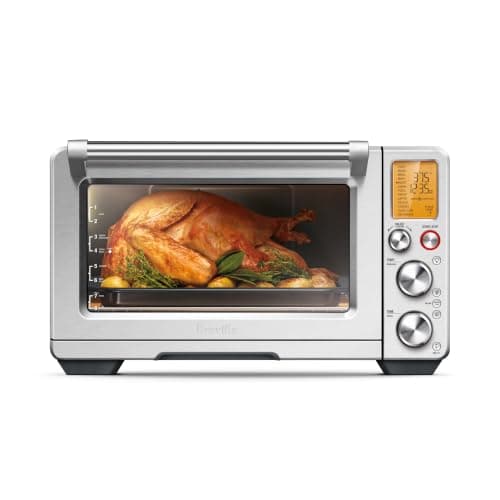
Guide
Are Air Fryers Toxic?
No — with two real caveats (acrylamide and coatings), both modest and both about high-heat cooking generally, not air fryers specifically.
Covered here: Breville Smart Oven Air Fryer Pro (BOV900BSS)
$399.95on Amazon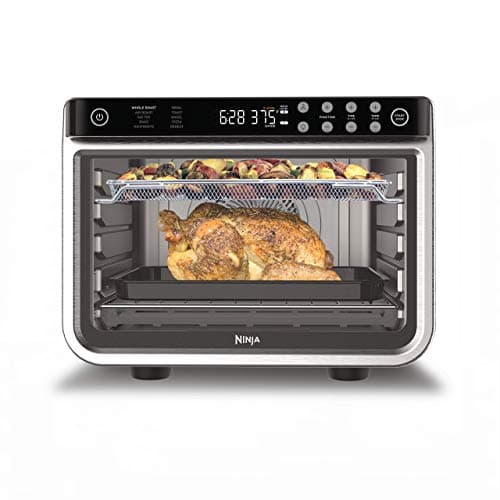
Guide
How Do Air Fryers Actually Work?
A heating element plus a fan circulating hot air. No oil, no frying. The one page most of the others depend on.
Covered here: Ninja Foodi 10-in-1 XL Pro Air Fry Oven (DT201)
$379.99on AmazonGuide
Are Air Fryers Healthy?
Yes, for the oil reduction vs deep-frying — but they don't transform the food itself. The honest, undramatic version.
Covered here: Ninja Foodi 10-in-1 XL Pro Air Fry Oven (DT201)
$379.99on AmazonGuide
Air Fryer Materials, Without the Panic
PTFE, ceramic, stainless — what each is, what it degrades at, and the ovens that keep coated surface area to a minimum.
Covered here: Breville Smart Oven Air Fryer Pro (BOV900BSS)
$399.95on Amazon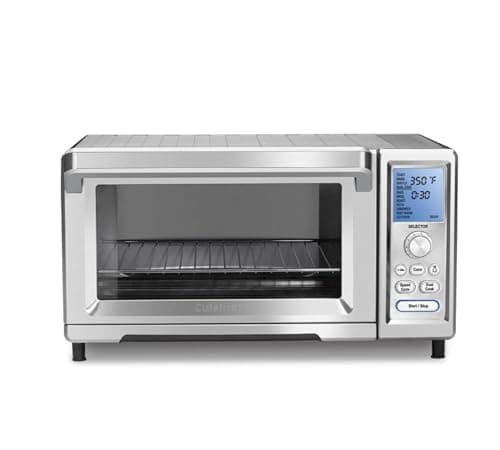
Guide
Convection Oven Conversion Chart
Drop ~25°F or cut time ~20%. The full temperature table, and the one reason 'my convection oven burns everything'.
Covered here: Cuisinart Chef's Convection Toaster Oven (TOB-260N1)
$299.95on AmazonGuide
Can an Air Fryer Replace Your Oven?
Mostly yes for weeknight jobs on a single tray, and cheaper to run — no for large or delicate ones. The honest job-by-job split.
Covered here: Ninja Foodi 10-in-1 XL Pro Air Fry Oven (DT201)
$379.99on Amazon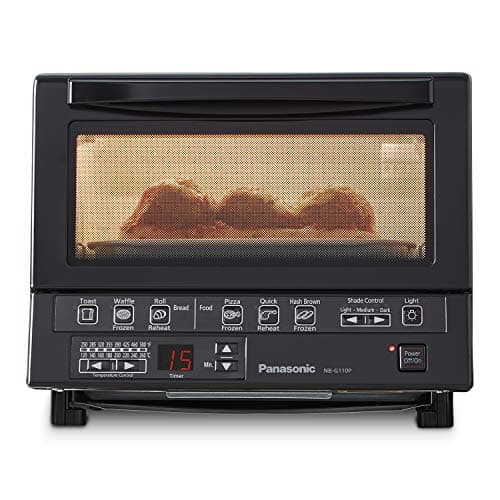
Guide
What Size Air Fryer or Countertop Oven Do You Need?
Size by people fed, by what you cook, and by counter depth -- not by the 'XL' sticker. A decision tool with a real pick at each size, small to extra large.
Covered here: Panasonic FlashXpress Toaster Oven (NB-G110P)
$149.99on AmazonGuide
How to Clean an Air Fryer Toaster Oven
The daily wipe, the weekly deep clean, what is dishwasher-safe, and the two mistakes that ruin the coating and the element. A maintenance routine, not a chemistry lecture.
Covered here: Breville Smart Oven Air Fryer Pro (BOV900BSS)
$399.95on AmazonGuide
Do Air Fryers Cause Cancer?
No evidence air fryers cause cancer. The real subject is acrylamide from browning starchy foods -- a general high-heat-cooking matter, not an air-fryer one, and one air frying makes easier to control.
Covered here: Breville Smart Oven Air Fryer Pro (BOV900BSS)
$399.95on AmazonGuide
Convection vs Air Fry Setting: What's the Difference?
Both settings are a fan moving hot air. Air fry usually just runs the fan faster and hotter than convection. What matters more is the tray you use -- perforated for air fry, solid for convection.
Covered here: Breville Smart Oven Air Fryer Pro (BOV900BSS)
$399.95on Amazon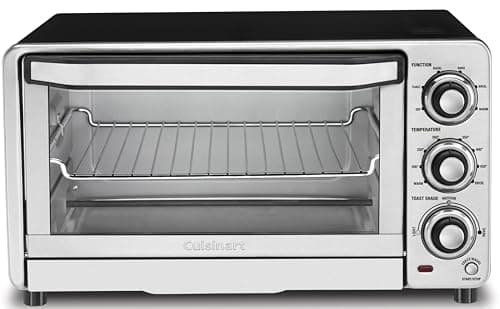
Guide
Toaster Oven Recalls and Safety
How to check the CPSC recall database in two minutes, plus the placement and use habits that matter more than any single recall. Cited to the CPSC; no scare tactics.
Covered here: Cuisinart Custom Classic Toaster Oven Broiler (TOB-40N)
$108.22on AmazonGuide
Do Air Fryer Ovens Need a Dedicated Circuit?
An 1,800-watt oven draws about 15 amps -- the full rating of a standard kitchen circuit. Why that trips breakers when something else shares the line, and when a 1,150-watt oven is the smarter buy. Cited to NEC basics.
Covered here: Breville Smart Oven Air Fryer Pro (BOV900BSS)
$399.95on AmazonGuide
Air Fryer Basket vs Air Fryer Oven
A basket crisps one thing brilliantly in a small drawer; an oven does more at once and replaces a toaster oven too. The real trade is intensity and cleanup versus capacity and versatility.
Covered here: Ninja Foodi 10-in-1 XL Pro Air Fry Oven (DT201)
$379.99on Amazon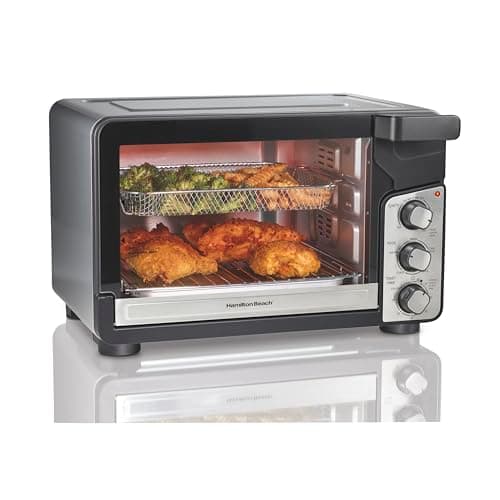
Guide
Why Does My Air Fryer Oven Smoke?
Usually grease -- from fatty food dripping onto the element or buildup you never cleaned. How to tell harmless smoke from a warning sign, and how to prevent both.
Covered here: Hamilton Beach Easy View XL Toaster Oven with Sure-Crisp Air Fry, 6 Slice
$69.99on AmazonGuide
True Convection vs Fan Convection
True convection adds a third heating element around the fan; fan convection just moves air the existing elements heated; 'natural convection' means no fan whatsoever. How to tell which you have, and what actually changes.
Covered here: Breville Smart Oven Air Fryer Pro (BOV900BSS)
$399.95on AmazonGuide
What Pans Fit in a Toaster Oven?
Quarter sheet fits nearly everything; half sheet fits almost nothing. The clearance rule, the 9x13 question answered against published interiors, and why a pizza stone is the one thing to be careful with.
Covered here: Breville Smart Oven Air Fryer Pro (BOV900BSS)
$399.95on AmazonGuide
Does an Air Fryer Cook Faster Than an Oven?
Yes -- and the saving is mostly preheat, not cooking. Why one cubic foot beats five, what the fan is worth in minutes, and the loads where the advantage vanishes entirely.
Covered here: Breville Smart Oven Air Fryer Pro (BOV900BSS)
$399.95on Amazon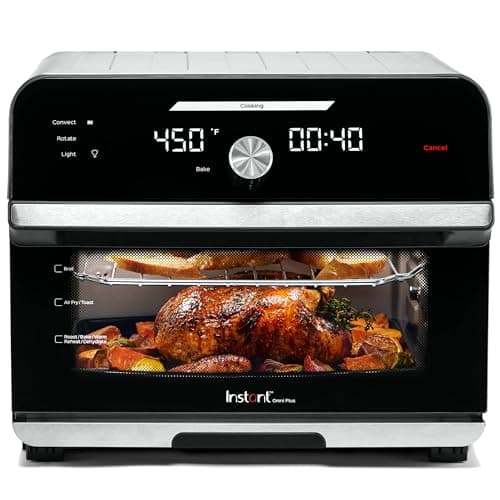
Guide
Air Fryer Oven Times and Temperatures
The conversion method for your first cooks, the published temperature ranges of the ovens that actually state one, and the four habits that fix uneven results. No invented cooking times.
Covered here: Instant Pot Omni Plus 19QT/18L Toaster Oven Air Fryer, 10-in-1
$249.99on AmazonGuide
Baking Sourdough in a Countertop Oven
Sourdough wants 450-500°F, steam and headroom; a countertop cavity gives you all three grudgingly. What to change, which shapes fit, and when to use the big oven instead.
Covered here: Breville Smart Oven Air Fryer Pro (BOV900BSS)
$399.95on Amazon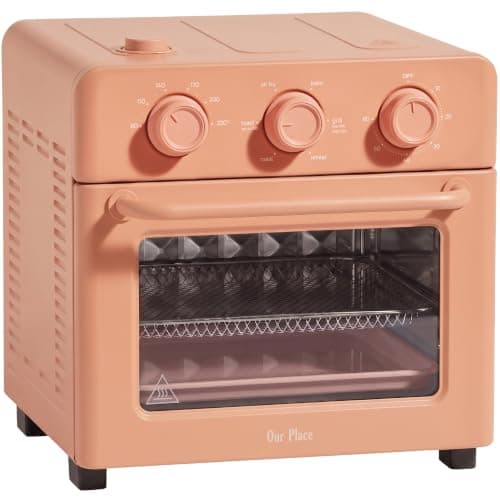
Guide
Can You Put Foil in an Air Fryer Oven?
Yes, with two restrictions the manuals all agree on: never against an element, and never lining the crumb tray or the cavity. Parchment is a separate question — Our Place bans it outright, and we quote all six manuals.
Covered here: Our Place Wonder Oven (6-in-1, 13 Qt)
$185.00on Amazon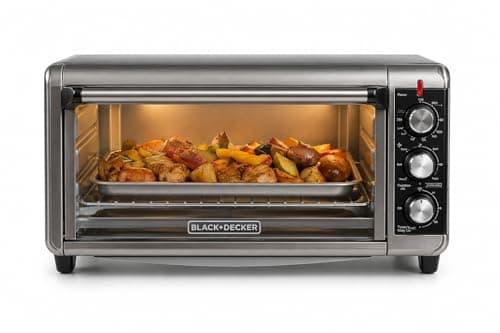
Guide
Can You Put Glass or Ceramic in an Air Fryer Oven?
Oven-safe glass and ceramic are permitted by every manual we read, with a published clearance to the top element and a lid warning all of them print. Plastic and silicone are banned outright by one brand.
Covered here: BLACK+DECKER 8-Slice Extra Wide Convection Toaster Oven (TO3250XSB)
$86.87on AmazonGuide
How Much Clearance Does an Air Fryer Oven Need?
The published figures collected: Breville 4 inches at the sides and 6 above, Nuwave 5 inches behind, beside and on top, Our Place 1 inch all round. A factor of six between brands, and most ovens publish nothing at all.
Covered here: Our Place Wonder Oven (6-in-1, 13 Qt)
$185.00on AmazonGuide
Which Rack Position Should You Use in an Air Fryer Oven?
The published rack position for every function across six ovens and five brands. Bake goes low, broil goes high, and the numbering runs top-down on a Breville and bottom-up on a Nuwave.
Covered here: Breville Smart Oven Air Fryer Pro (BOV900BSS)
$399.95on AmazonGuide
Do Air Fryer Ovens Need to Preheat?
Not always, and the manuals say exactly when. Breville names the functions that preheat and the ones that do not, BLACK+DECKER publishes 10 minutes for baking and broiling, and Panasonic publishes no preheat at all.
Covered here: Panasonic FlashXpress Toaster Oven (NB-G110P)
$149.99on Amazon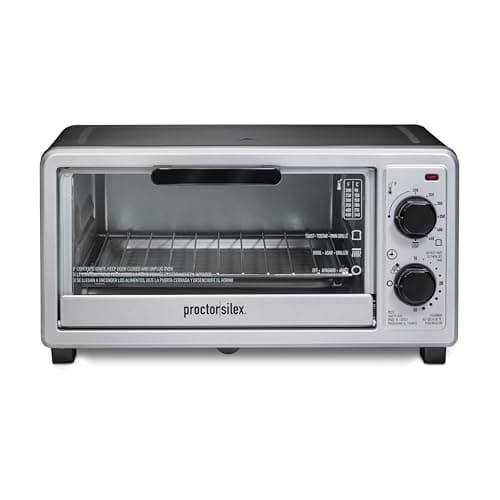
Guide
How Long Do Toaster Ovens Last?
Nobody publishes a service life. The warranty is the only durability figure any maker commits to, and across this catalog it runs one to three years -- with the cheapest oven here carrying the longest term.
Covered here: Proctor Silex 4 Slice Countertop Toaster Oven (31260)
$49.95on AmazonGuide
Why Is My Toaster Oven Not Heating Up?
What BLACK+DECKER, Nuwave and Our Place actually publish about an oven that will not heat: the timer, the breaker, the auto shut-off, and the one brand that admits its dial reads high by design.
Covered here: BLACK+DECKER 8-Slice Extra Wide Convection Toaster Oven (TO3250XSB)
$86.87on AmazonGuide
What Can You Cook in a Toaster Oven?
The honest answer from published data: the function list tells you what the oven is willing to do, and the published fit claim tells you how much of it. Both tabulated, with no invented cooking times.
Covered here: Cuisinart Chef's Convection Toaster Oven (TOB-260N1)
$299.95on AmazonGuide
Can You Bake Cookies in a Toaster Oven?
The published pan claims, the one maker that states a cookie count, what the fan does to the bake, and the only candid statement about thermostat accuracy in this whole category.
Covered here: Cuisinart Chef's Convection Toaster Oven (TOB-260N1)
$299.95on AmazonGuide
Air Fryer Oven Disadvantages
The honest list, built only from published specifications: the pan ceiling nothing exceeds, the temperature ceilings, the warranty spread, the missing wattages, the placement bans, and what a function count is really worth.
Covered here: Instant Pot Omni Plus 19QT/18L Toaster Oven Air Fryer, 10-in-1
$249.99on Amazon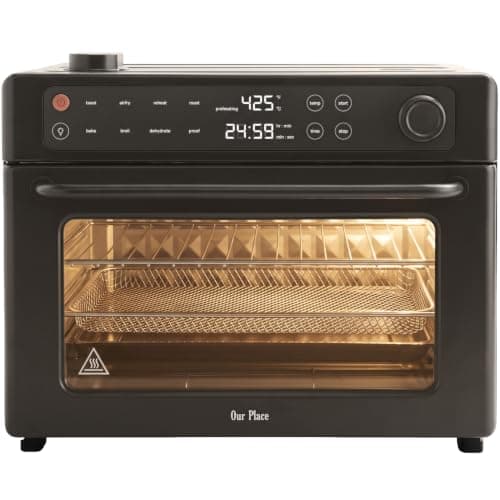
Guide
How to Use a Countertop Oven as a Dehydrator
The two published specifications that decide whether an oven can dry anything — the temperature floor and the timer ceiling — against the ovens that carry a Dehydrate label. Includes what a 10-hour low cook costs.
Covered here: Our Place Wonder Oven Pro (8-in-1, 28 L)
$325.00on AmazonGuide
Do Countertop Ovens Need a Vent Hood?
What the manuals require about venting and placement: no hood in any of them, clearance figures that differ sixfold, an outright ban on operating under a wall cabinet, and the separate-circuit instruction.
Covered here: Our Place Wonder Oven (6-in-1, 13 Qt)
$185.00on AmazonGuide
How Hot Does a Toaster Oven Get?
Every published temperature band in our catalog in one table: a 450F market ceiling, a 500F maximum, a 50F minimum, and twenty-three ovens that publish nothing at all.
Covered here: Panasonic FlashXpress Toaster Oven (NB-G110P)
$149.99on AmazonGuide
Does a Toaster Oven Use Radiation?
Yes: infrared, which is non-ionizing and is simply radiant heat. The mechanism, where it sits on the spectrum, how it differs from a microwave, and which maker is the only one to name it.
Covered here: Panasonic FlashXpress Toaster Oven (NB-G110P)
$149.99on AmazonGuide
Why Does My Toaster Oven Smell Like Burning Plastic?
New oven: factory burn-off, and Our Place publishes the only real procedure in this catalog (no food, 400F, 10 minutes, ventilated). Not-new oven: four other causes, in the order to check them.
Covered here: BLACK+DECKER 8-Slice Extra Wide Convection Toaster Oven (TO3250XSB)
$86.87on AmazonGuide
Is a Countertop Convection Oven Worth It?
Three honest cases for yes, four things you give up, and the arithmetic on both -- including why the electricity saving is real but is not where the value is.
Covered here: Cuisinart Chef's Convection Toaster Oven (TOB-260N1)
$299.95on AmazonGuide
Do Countertop Ovens Heat Up the Kitchen?
Computable, not guesswork: 1 kWh = 3,412 Btu (EIA), so a 30-minute run is 1,877 Btu at 1,100 W and 3,071 Btu at 1,800 W. Where the heat goes, and why a wall oven is several times worse.
Covered here: Proctor Silex 4 Slice Countertop Toaster Oven (31260)
$49.95on Amazon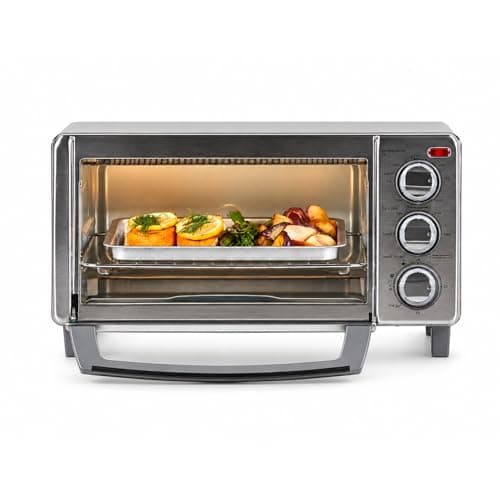
Guide
Is a Toaster Oven a Convection Oven?
The word "convection" is not a guarantee of a fan -- "natural convection" means there isn't one. The three kinds of heat movement, the naming trap in both directions, and the one reliable test.
Covered here: BLACK+DECKER 4-Slice Toaster Oven with Natural Convection (TO1785SG)
$64.99on AmazonGuide
Do Toaster Ovens Turn Off Automatically?
The answer is the timer, not a sensor. One manual states the oven will not function at all unless a timer is set; the same manual publishes the Stay On position that switches the shut-off off. What each maker commits to, quoted.
Covered here: BLACK+DECKER 8-Slice Extra Wide Convection Toaster Oven (TO3250XSB)
$86.87on AmazonGuide
Toaster Oven Warranties by Brand
Every published warranty term in the catalog, by brand, with what the terms exclude. The pattern is not the one price would predict: the three-year term is on a forty-dollar oven and the premium brands publish one year or nothing.
Covered here: Proctor Silex 4 Slice Countertop Toaster Oven (31260)
$49.95on Amazon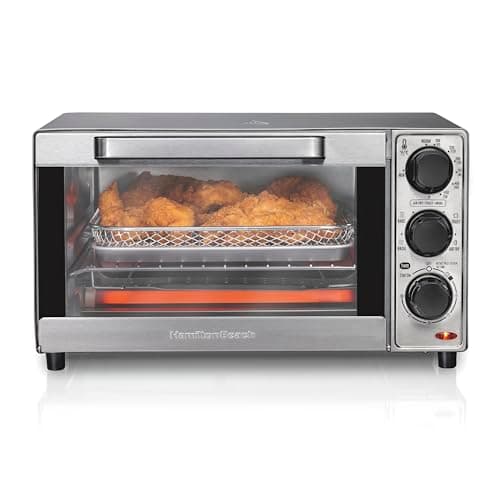
Guide
Can You Have a Toaster Oven in a Dorm?
Three published university housing policies, quoted. Toaster ovens are named in the prohibited list; microwaves get a wattage cap instead. What that distinction means, and what to buy for an apartment or a shared kitchen where they are allowed.
Covered here: Hamilton Beach Sure-Crisp 4 Slice Air Fryer Toaster Oven Combo (31403)
$59.95on AmazonGuide
How Does a Toaster Oven Work?
The mechanism, from the manuals rather than from first principles: how the elements, the thermostat and the timer interact, why the dial reads high, and which brands publish what their heating actually does.
Covered here: Panasonic FlashXpress Toaster Oven (NB-G110P)
$149.99on AmazonGuide
Can You Put a Toaster Oven on Top of a Microwave?
Two manufacturers' published requirements, read together: a countertop microwave needs 20 cm of clear air above it, and a toaster oven needs heat to flow freely around it. Stacking them breaks both rules at once. What to do instead.
Covered here: Our Place Wonder Oven (6-in-1, 13 Qt)
$185.00on Amazon
Filed elsewhere, written for you
Also worth reading
These live under a different section of the site but answer the same question a guides & answers buyer is actually asking.
Comparisons
Air Fryer vs Convection Oven
Same technology, different cavity size. The decision rule: buy the oven if you cook on trays; you may already own the air fryer.
Top pick: Ninja Foodi 10-in-1 XL Pro Air Fry Oven (DT201) · 2 ranked, 2 with live prices
$379.99on AmazonAir Fryer Toaster Ovens
Air Fryer Toaster Ovens With the Least Coating
For coating-conscious buyers: stainless interiors and steel racks, plus a plain explanation of what the worry actually is.
Top pick: Breville Smart Oven Air Fryer Pro (BOV900BSS) · 3 ranked, 3 with live prices
$399.95on AmazonRunning Costs & Power
How Much Electricity Does a Toaster Oven Use?
A few cents an hour, with the sum written out. The method page every other running-cost page on the site links back to.
Covered here: Panasonic FlashXpress Toaster Oven (NB-G110P)
$149.99on Amazon