Why this page is ranked differently
A toaster oven is a small radiant oven with a toast setting bolted to the front of it, and the toast setting is the part nobody specifies. Manufacturers will give you a wattage, a function count and a pizza diameter, and then describe toasting with a single number of slices that may or may not appear in any document you can check. So the ranking here is built on four things a manufacturer either publishes or does not: how many slices it commits to, how many darkness steps the control has, which rack position the manual names for toasting, and whether the manual says toasting needs a preheat.
That last one matters more than it sounds. A toaster oven that has to come up to temperature before it browns bread is a slow toaster, whatever its element count. Only one manual on this entire site states the rule outright, and it is not the expensive one.
Reading the order
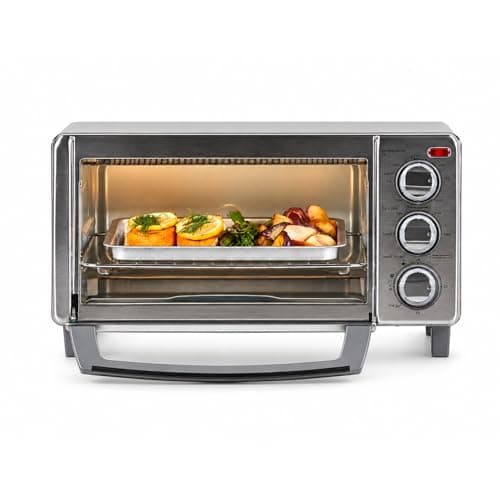
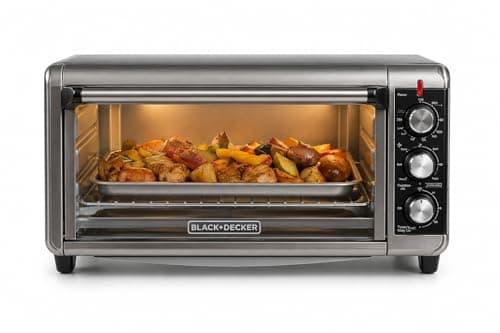
The BLACK+DECKER 8-Slice Extra Wide (TO3250XSB)leads because BLACK+DECKER's own use and care manual is the only document in this price band that treats toasting as a specified operation. It states that it is not necessary to preheat the oven for toasting, that for optimal results use middle rack position, and that the toast shade selector knob must be set before the oven will begin toasting at all. Eight slices, a physical shade dial rather than a menu, and the wattage — 1,500 W, 120 V, 60 Hz — printed on the rating line in the same book. Under a hundred dollars. Our full review is here.
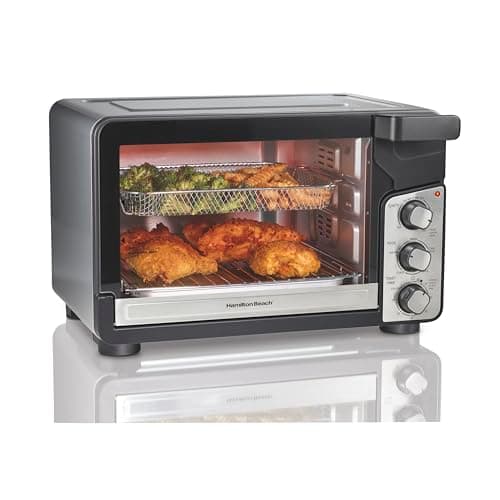
The Hamilton Beach Easy View XL with Sure-Crisp, 6 Slice is second for one reason that is genuinely about toast: you can see it. A glass door lets you watch bread brown without opening the door and dumping the heat, and toast is the one thing in a countertop oven that goes from pale to ruined inside forty seconds. Six slices published, at a price where four is normal. The honest limitation is documentation — Hamilton Beach publishes no wattage for this SKU in any document we could find, so it gets no running-cost figure from us.
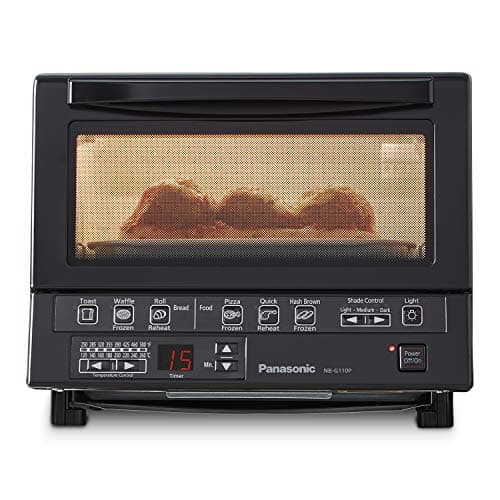
The Panasonic FlashXpress (NB-G110P)is third and is the fastest published route to toast on this site. Panasonic states it outright on its own product page: the double infrared heater gives “instant heat that eliminates the need for preheating”, with the heaters positioned at the front and back rather than above and below. The same page states the capacity as four slices of bread and publishes the full electrical specification — 1,300 W at 120 V, 60 Hz — which almost nobody in this category manages. The review goes through the whole spec. It is third rather than first because four slices is four slices, and because it costs more than twice the top pick.
The BLACK+DECKER TO1785SGis fourth and is the budget pick that still has a checkable specification: four slices and a 9-inch pizza published by BLACK+DECKER, 1,150 W at 120 V, exact dimensions and a two-year warranty. It has no fan — the listing calls it “natural convection”, which is the physics term for hot air rising and describes the absence of the feature — but toasting is radiant work, so for this specific job the missing fan costs you very little. The five convection names are untangled here.
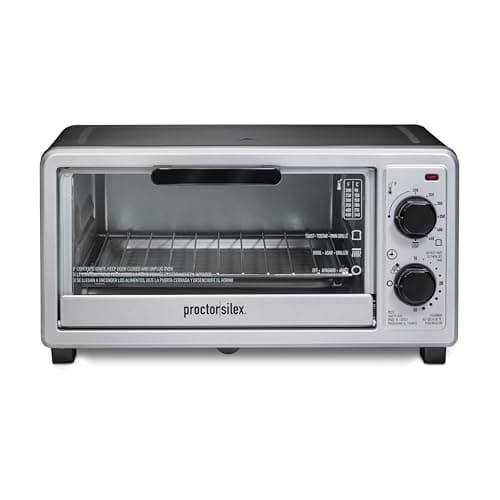
The Proctor Silex 31260 is fifth and is the floor: fifty dollars, four slices, three manual controls, 1,100 W and 200–450°F in the listing data, and a three-year limited warranty from Proctor Silex — the longest published term of any oven on this site. It does the three things and it does not pretend to do eleven.
What nobody in this band publishes
A darkness scale with a stated number of steps. Every oven above has a shade control and not one of their makers prints what the range is or what the steps mean — you get a knob with tick marks and a suggestion to experiment. That is not a small omission, because “medium” on a four-step dial and “medium” on a seven-step dial are not the same request.
If a published darkness scale is what you want, the honest recommendation points out of this price band. Breville prints the whole thing in its instruction books: a scale of one to seven with the key stated — Light: 1 or 2. Medium: 3, 4 or 5. Dark: 6 or 7 — a slice range for each model, and a named rack position for the TOAST function. The Smart Oven Air Fryer Pro (BOV900) publishes one to nine slices with the rack in position 4; the Smart Oven Pro (BOV845) publishes one to six with the rack in the middle position; the compact BOV680 publishes one to four. Those ovens cost three to six times the picks above, and what you are buying for toast specifically is a documented control rather than a better element.
The other thing nobody publishes is evenness. There is no standard for it, no manufacturer states a tolerance, and we have not cooked in these ovens — so there is no toast-quality score anywhere on this site and there will not be one. What we can tell you is which machines their makers were willing to make checkable claims about, and that is what the order above is.
The one thing that is free
Use the rack position the manual names. It is the cheapest improvement available and almost nobody does it, because most people assume a toaster oven has one sensible shelf height. BLACK+DECKER says middle for toasting and top for broiling. Breville says middle on the three-position ovens and position 4 of 8 on the BOV900 — and, on the Smart Oven Air Fryer, the top position for bagels specifically, because that function drives more heat into the upper elements. We tabulated every published rack position across six ovens and five brands, and the brands do not even agree on which end of the oven position 1 is.
How to buy for toast without being sold a preset count
Count the slices the maker will commit to, not the ones in the photograph. A six-slice oven that publishes six slices is a better bet than an eight-slice oven whose number appears only in a marketing bullet, because the published figure is the one the manufacturer has to stand behind. Where a figure comes from brand-supplied listing copy rather than a manual or a spec page, we say so on the card.
Prefer a physical shade dial to a menu.Toast is the one thing in a countertop oven you adjust by feel over weeks, and a knob with tick marks lets you reproduce last week's setting without reading a screen. It is also one fewer control board between you and a heating element, which is the component that usually ends one of these ovens.
Check for a glass door you can actually see through. Several ovens in this band have a smoked or heavily gridded door. Being able to watch the crust without opening the oven is worth more day to day than three extra functions, and it is the specific reason the Hamilton Beach sits where it does.
Do not pay for a fan you are buying for toast. Convection browns evenly and crisps, and both are genuine — but they are benefits for roasting and air frying, not for bread. If toast is the main job, spend the money on capacity and on documentation instead. If crisping is also on the list, the cheapest ovens here that genuinely have a fan is the page you want, and the full entry-band ranking puts all of it in one order.