The short answer
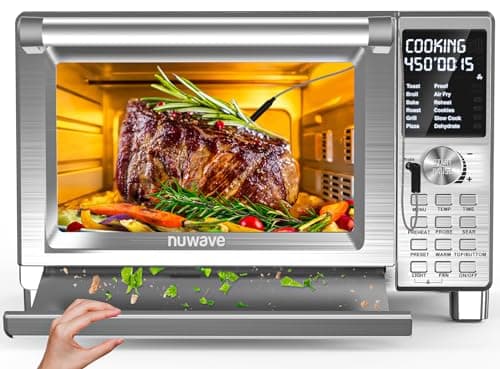
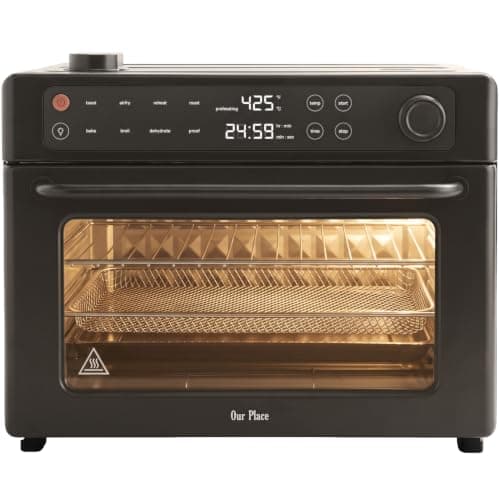
The Our Place Wonder Oven Prois the only oven in our catalog whose maker publishes both halves of what annealing needs: a temperature floor of 80°F, which is well under the 140°F pre-hold Polymaker specifies for thick parts, and a timer that runs from thirty seconds to twenty-four hours, which is the only published timer here that reaches a six-hour hold. If that is more oven than you want for the job, the Nuwave Bravo XL Propublishes the lowest floor and the finest temperature step on the site — 50 to 500°F in 5°F increments — and it publishes its interior dimensions, so you can check whether the part fits before you buy.
Before any of that: read the two paragraphs below about what Polymaker says about kitchen ovens, because the manufacturer whose figures this page is built on does not recommend one. We think the honest version of this page has to lead with that rather than bury it.
What the filament maker actually publishes
Almost every answer to this question online is somebody's oven settings. Polymaker publishes a table, and it is the document this page is ranked against.
For its HT-PLA-GF, Polymaker states: “Anneal at 80–100°C for 30 minutes (we recommend 100°C)”. That is 176 to 212°F, with 212°F the recommended figure. For thicker parts it publishes a two-stage method — first hold the part at 60°C (140°F) until its internal temperature is uniform, then raise quickly to 100°C — and a hold-time table by wall thickness: under 4 mm, 30–60 minutes; 6 mm, one to two hours; 8 mm, two to four hours; 10 mm, three to six hours. It also publishes an expected dimensional change after annealing of 0.3–0.6%, which is the part of annealing that surprises people who thought they were only adding strength.
Three consequences fall straight out of those numbers, and they are what the ranking is built on. The temperature is low.176–212°F is below where a great many countertop ovens even start. The hold is long. Up to six hours, on an appliance class whose mechanical timers typically stop at thirty minutes. The heat has to be even, because 0.3–0.6% of dimensional change is what you get when it is even and warping is what you get when it is not.
Polymaker's own position on using a kitchen oven
It is not an endorsement, and we are not going to present it as one. Polymaker writes: “Use a heating oven with even temperature distribution whenever possible, ideally a forced-air drying oven.” On household ovens specifically it says they “can create hot spots, especially near the heating elements” and “often do not hold the exact temperature you are setting very well — with some varying up to 5-10°C”.
It then says the thing that makes this page legitimate rather than reckless: if no other option is available, “it will be safe to use a kitchen oven since we are not heating the material above its melting temperature”. So the manufacturer's position is that a kitchen oven is a fallback, the failure mode is a worse result rather than a hazard, and the two things to engineer around are hot spots and thermostat drift.
That drift figure is the most useful number on this page, because it is the one nobody else publishes. Polymaker says a household oven may sit 5–10°C away from its setting. The annealing window is 20°C wide. A dedicated filament dryer or lab oven removes that problem; a countertop oven does not, and no manufacturer in this entire catalog publishes a thermostat tolerance at any price, so you cannot select one on that basis. What you can select on is how finely the oven lets you ask, whether it moves the air, and whether it will hold the setting for as long as the part needs. Those three are published, and that is the ranking.
The criteria, in the order they decided the ranking
1. A published temperature floor at or below 140°F.Not 176°F — 140°F, because Polymaker's two-stage method for thick parts starts at 60°C and the thick parts are exactly the ones worth annealing. This single criterion eliminates most of our catalog outright: both the standard and the Large Our Place Wonder Ovens publish a 200°F floor, and so do the sub-$50 band, the Proctor Silex and the Hamilton Beach ovens. A 200°F floor cannot reach 176°F, let alone 140°F, whatever the dial is labeled.
2. A published temperature increment.With a 20°C window and a possible 5–10°C drift, the resolution of the control is not a luxury. Two ovens here publish one: Nuwave at 5°F steps and Midea at 5°F steps. A knob marked at 50°F intervals makes the difference between 176 and 212°F a guess.
3. A published timer that reaches the hold. Thirty minutes covers a 4 mm wall. Six hours covers a 10 mm one. One oven in this catalog publishes a timer that long.
4. Convection, and how the heat is driven. Polymaker asks for even distribution and warns about the elements specifically. Every pick here has a fan; what separates them is how the elements are controlled.
5. A published interior dimension. Annealing is the one application where you know the exact size of the thing you are putting in, because you printed it. An oven that publishes its cavity lets you check. Exactly one pick here does.
Reading the order
The Our Place Wonder Oven Prowins on the two criteria that matter most and it is not close. Our Place publishes an 80–450°F range and a 30-second-to-24-hour timer on its own specification block, which means it is the only oven on this site whose published figures permit the 140°F pre-hold, the 212°F anneal and a six-hour unattended run without a single inference on our part. That it also has a fan and steam hardware is irrelevant here; the 80°F and the 24 hours are the whole case. Our full review is here, and it is candid about the oven's real problem: its stated 28-liter capacity does not agree with the interior dimensions printed beside it.
The Nuwave Bravo XL Prois second and is the control pick. 50 to 500°F in 5°F increments is the lowest published floor and the finest published step in our catalog, and Nuwave publishes both outer and inner dimensions — 14.50 by 13 by 7.625 inches inside — so you can check a printed part against the cavity before you spend anything. Four rack levels in 30 quarts is also the most usable annealing volume here. What it does not publish is a timer ceiling, which is why it is second rather than first.
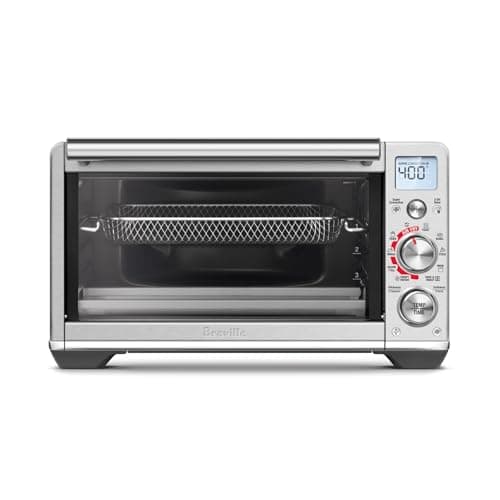
The Breville Smart Oven Air Fryer Compact (BOV680)is third and is the documentation pick. Breville's own instruction book publishes a 120–445°F Bake and Roast band and a rating-plate 120 V ~ 60 Hz 1800 W line, so the floor clears both of Polymaker's stages with margin and you can read the whole specification before buying. Breville also drives its elements individually rather than switching them in banks, which is the most direct available answer to Polymaker's hot-spot warning — though “most direct available answer” is not the same as a published uniformity figure, and no such figure exists.
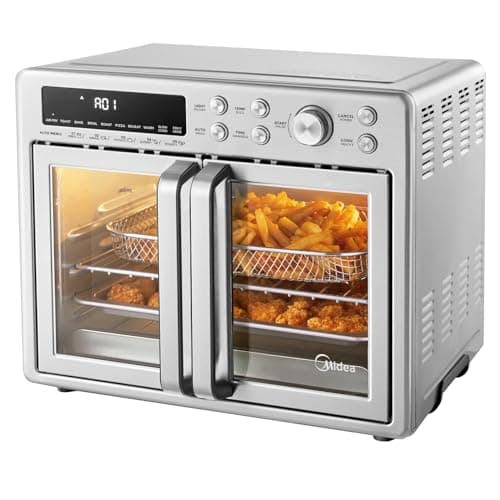
The Midea Flexifyis fourth and is the budget entry. Its published 100–450°F band in 5°F steps clears the 176–212°F window comfortably and misses the 140°F pre-hold by nothing that matters, at roughly a third of the Wonder Oven Pro's price. It is fourth because Midea publishes no rated wattage and no interior dimension, so neither the running cost nor the fit can be checked. Its review explains what else that spec block gets wrong.
The timer is the specification that actually fails
This is the finding of the page, and it is the opposite of what the shopping advice for this query assumes. People shop for annealing on temperature, and nearly every countertop oven can reach 212°F. What almost none of them can do is stayat 212°F for four hours, because on most of them the timer is also the automatic shut-off — we worked that mechanism through in full — and the published ceiling is thirty, sixty or a hundred and twenty minutes.
The obvious workaround is a Stay On setting, and most of this catalog publishes one. The obvious second workaround is a smart plug, and that one is specifically closed off: Breville's own instruction book states that its ovens are “not intended to be operated by means of an external timer or separate remote-control system”. So on a Breville the only compliant way to hold a four-hour anneal is to be there, and the published 20-minute broil cap and 10-minute standby behavior in the same book are a reminder that these machines are designed around short attended cooks.
Which is why the Wonder Oven Pro's 24-hour published timer is worth as much as it is here. A timer that long is not a convenience feature for annealing; it is the difference between a documented unattended hold and a bypassed shut-off.
What this page refuses to tell you
A setting for your filament.Polymaker's table is Polymaker's, for an HT-PLA-GF. Standard PLA, PETG, ASA and nylon all anneal differently and the glass transition temperature varies between suppliers of nominally the same material. 3DFuel publishes its own window for its high-temperature PLA and it is higher than Polymaker's — but its support article returns 403 to automated requests, so we could not read it directly and it is not cited here. Read your own filament maker's document, not ours and not a forum's.
A uniformity or accuracy claim for any oven on this page.No manufacturer in this category publishes a thermostat tolerance, a cavity uniformity figure or a recovery time. Polymaker's 5–10°C warning is about household ovens generally; nothing here contradicts it or confirms it for a particular model. If you need to know what your cavity is actually doing, an independent oven thermometer costs about ten dollars and is the highest-value purchase on this entire page.
That any of these ovens is approved for the job. None of the manufacturers here publishes a non-food use for its appliance, and we are not going to imply one. Our polymer-clay ranking takes the same position for the same reason, and the practical conclusion is the same one makers have reached independently: if an oven is going to be used for materials, dedicate it to materials. An oven costs less than the argument.
Where annealing sits next to the other maker jobs
Three different temperature bands, three different binding specifications, and that is why this is three pages rather than one. Annealing PLAis 176–212°F held for hours: the floor and the clock decide it. Curing polymer clayis 265–275°F held for fifteen to thirty minutes per quarter inch: accuracy near a single set point decides it, because the band between underbaked and scorched is narrow. Reflow solderingruns to 350–480°F and is decided by how fast the oven can ramp, which is a ceiling and a wattage question. An oven that is excellent at one of the three is not automatically good at the others, and the specification that tells you which is almost never the one on the front of the box.
The conversions, so you are not doing them at the dial
Filament makers publish in Celsius and countertop ovens in the US are marked in Fahrenheit, which is most of why this question gets answered badly. 60°C is 140°F. 80°C is 176°F. 90°C is 194°F. 100°C is 212°F — boiling point, which is a useful thing to remember, because it means Polymaker's recommended anneal is the lowest setting many ovens have. 110°C, which some makers specify for high-temperature PLA blends, is 230°F.
The width of that span in Fahrenheit is why the published increment matters: 176 to 212°F is seven steps on a 5°F control and roughly one notch on a knob marked every 50 degrees.
Why a 200°F published floor is disqualifying rather than marginal
Because the number on a dial is a request, not a floor the thermostat can honor below its designed range. An oven whose published range starts at 200°F has a thermostat calibrated from 200°F up; asking it for 176°F is asking for a setting it does not have. You can of course set it to its minimum and let it run, but then you are annealing at whatever the minimum turns out to be, plus or minus Polymaker's 5–10°C — which for a 0.3–0.6% dimensional-change process on a part you spent eight hours printing is a poor trade.
This is also the cleanest example on the whole site of why we score Documentation at all. The ovens eliminated by this criterion are not necessarily worse ovens. They are ovens whose makers have published a figure that rules them out, which is more than the ovens that publish no range at all have done — and those are not candidates either, because an unpublished floor cannot be checked.
Preheat first, and never from cold
Polymaker is explicit on both: “Preheat the oven to the target material temperature before placing the part inside”, and starting in a cold oven “increases the chance of uneven softening and distortion”. That rules out the intuitive approach of putting the part in and letting it come up with the oven, which is how most people would do it.
It also makes a published preheat behavior worth something. Breville publishes a standby behavior and a dedicated-circuit recommendation in its instruction book; Our Place publishes a timer that starts at thirty seconds, which is the only published control fine enough to manage a staged hold without arithmetic. And Polymaker's closing instruction is the easiest one to get wrong in a hurry: let the part cool naturally, because “sudden cooling can reintroduce stress and increase the chance of distortion”. An oven you can leave shut is therefore worth more than one you have to open to stop.
Thin walls, and the part you should not anneal in a countertop oven
Polymaker's warning is specific: “Thin-walled prints need the most care because they can deform quickly when heat is applied unevenly”, and it suggests keeping the part on the build plate, printing a brim and leaving supports attached. Its guidance for HT-PLA Pro goes further — be very cautious about warping, and prefer a sand or salt anneal.
Read against the hot-spot warning, that is a real limit on what a countertop oven should be asked to do. A chunky functional bracket is a good candidate. A tall thin-walled cosmetic print, in a cavity whose uniformity nobody publishes, is the case where the answer is a forced-air dryer or a packed-medium anneal rather than a better toaster oven, and we would rather say so than sell you one.