The short version
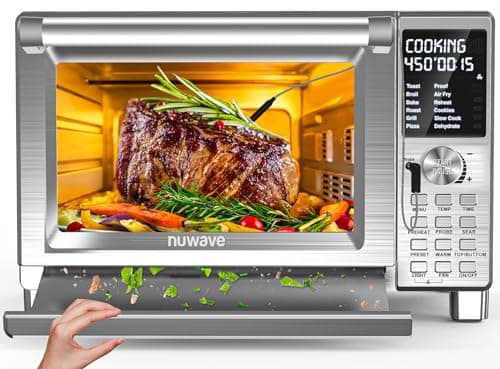
The pick is the Nuwave Bravo XL Pro, and it wins on a single published number nobody else in this category prints: Nuwave states an interior of 14.50 by 13 by 7.625 inches, and its own FAQ states that a standard 13 by 9 by 3-inch pan fits. Those are the only two figures on this entire site that tell a cake baker what they need to know before paying — how much clear air sits above a filled pan. It also publishes a 50 to 500°F band in 5°F steps, which is the finest published set-point resolution in our catalog. It is for the baker who wants to verify clearance rather than guess at it.
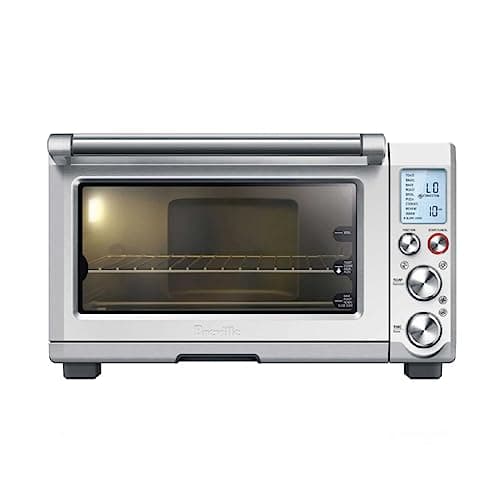
If you bake often and want the better-documented machine, the Breville Smart Oven Pro (BOV845)is second: 1,800 watts published on Breville's own page, a published 120°F floor on Bake and Roast, ten functions, and deliberately no air-fry mode — so the fan in it is there for convection baking rather than for crisping frozen food. The honest cost of choosing it is that Breville publishes no interior dimension for this model at all, so you cannot check a tube pan against it on paper.
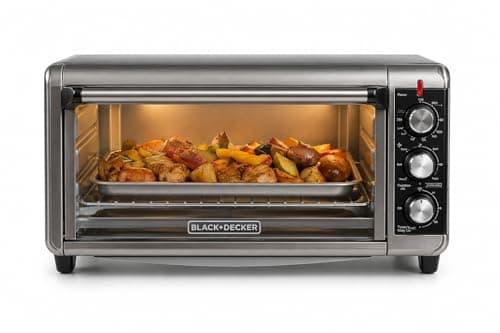
Spend under a hundred dollars and the answer is the BLACK+DECKER 8-Slice Extra Wide (TO3250XSB), with the sharpest caution on the page attached: BLACK+DECKER is the only brand here that publishes anything about thermostat accuracy, and what it publishes is that its ovens read below the set point by design. For a roast that is a shrug. For a cake it is the difference between risen and sunken, and you will want an oven thermometer.
We have baked no cakes in any of these ovens, and there is no test kitchen behind this site — the rubric says so in those words. Everything ranked below is a figure a manufacturer published and we read.
Why a cake ranks differently from everything else we rank
Every other ordering of this category is horizontal. A sheet pan is a footprint problem; a pizza is a diameter problem; a turkey is a weight problem. A cake is the one job in a countertop oven that is decided by height — and specifically by the gap between the top of the batter and the upper heating element.
The arithmetic is unforgiving in a box this size. A standard 9-inch round cake pan is two inches deep. Fill it two-thirds and the batter rises to roughly the rim or just over, so call the loaded pan two and a half inches tall at its peak. Add the rack it sits on. In a cavity with a published interior height of 7.625 inches you have something like four and a half to five inches of clear air above the dome, which is comfortable. A 9 or 10-inch tube or bundt pan is a different story: those run four to four and a half inches tall empty, so once you add the rack and the rise you are down to roughly two inches of clearance in the best case — barely past the inch and a half BLACK+DECKER publishes as a minimum, and unknowable in the ovens that publish no height at all. That is where cakes brown on top and stay raw in the middle, and it is a geometry problem rather than a thermostat problem.
One manufacturer puts a number on exactly that gap, and it is the most useful single line we found writing this page. BLACK+DECKER's own use and care manual instructs: “Be sure food or baking dish does not come within 1½ inches of the top heating elements.” So the requirement is not just “does the pan fit” — it is the loaded pan plus an inch and a half of mandated clearance, published by the only brand here willing to state it. Apply that rule to a 7.625-inch cavity and a 2-inch pan on a rack and the headroom stops being generous.
None of that is checkable unless the manufacturer tells you the interior height. Which, overwhelmingly, it does not.
The finding: three ovens out of the whole catalog publish a height
We hold thirty-four ovens. Here is every published interior-height figure we have been able to read off a manufacturer document or spec block, anywhere in the catalog:
| Oven | Published interior | Interior height | Published by |
|---|
| Nuwave Bravo XL Pro | 14.50 x 13 x 7.625 in | 7.625 in | Nuwave spec table |
|---|
| Our Place Large Wonder Oven | 13.75 x 13 x 7.75 in | 7.75 in | Our Place spec block |
|---|
| Our Place Wonder Oven Pro | 13.75 x 13 x 7.75 in | 7.75 in | Our Place spec block |
|---|
| Our Place Wonder Oven (standard) | 10 x 10.3 x 7.6 in | 7.6 in | Our Place spec block |
|---|
| Breville BOV900 / BOV950 | 1 cubic ft (volume only) | Not published | — |
|---|
| Cuisinart TOB-260N1 | 0.95 cubic ft (volume only) | Not published | — |
|---|
| Breville BOV845 / BOV860 / BOV680 | Nothing published | Not published | — |
|---|
| Every Ninja in our catalog | Nothing published | Not published | — |
|---|
Two brands out of the fifteen we cover. That is the whole published evidence base for the one dimension a cake depends on, and it is why a $150 Nuwave outranks a $400 Breville on this page and only on this page.
A cubic-foot figure does not substitute. “One cubic foot” is compatible with a tall narrow cavity and a wide shallow one, and the Brevilles that publish it are visibly the second kind. The pan geometry behind all of this is worked through in full here, and the published-footprint finding — that not one oven in this catalog admits an 18 by 13 half-sheet — sits on the home-bakery page.
The second finding: one published pan-depth claim exists
Pan-fit claims in this category describe flat objects. “Fits a 9 x 13 pan”, “fits a 12-inch pizza”, “eight slices” — all two-dimensional. The single exception we have found is Nuwave's own answer that a standard 13 x 9 x 3 inch pan fits the Bravo XL Pro. That third number is the one a cake baker needs, because a 9 x 13 sheet cake goes in a pan that deep and comes out of the oven taller than it went in.
BLACK+DECKER's claim is the next most useful and for a different reason: it is the one fit claim in our catalog stated with the pan handles included — a 13 by 9 pan, handles and all, in the TO3250XSB. Handles are about an inch and a half of width that nobody else accounts for. Neither brand tells you both depth and handles, so there is no oven here you can fully verify. Two partial answers is still better than the twelve ovens that publish nothing.
The third finding: the only accuracy disclosure in the category is an admission
A cake is the most set-point-sensitive thing a home baker makes. Twenty-five degrees low and the structure sets before the leavening finishes; twenty-five high and the crust forms over a wet middle. So the obvious question is which of these ovens holds the number you dial.
Nobody publishes a thermostat tolerance. Not one of the thirty-four. What one brand does publish is worse than silence and more useful than it — and it is in the manual, not a marketing bullet. BLACK+DECKER's use and care manual for the TO3250XSB states: “Temperatures in the oven will be lower than your set point. This is due to advanced heating elements used in this oven. Temperature dial settings have been calibrated to provide expected results for most recipes taking into account the advanced heating elements.” That is a real, checkable statement a manufacturer made about its own product in its own documentation, and it is the only data point of its kind on this site. It does not make the TO3250XSB a bad oven — it makes it the only oven here whose error direction you know in advance, which is arguably the opposite.
The practical consequence for every oven on this page, including the expensive ones: buy a separate oven thermometer, run it empty at 350°F, and find out. That is a ten-dollar purchase that tells you more about cake outcomes than the difference between any two ovens below.
The fourth thing, and nobody publishes it: can you turn the fan off?
Most cake recipes are written for still air. The standard convection adjustment is to drop the set point about 25°F and expect a shorter bake — our conversion chart sets out the arithmetic — because moving air transfers heat faster and dries the surface sooner. For a roast that is the entire point. For a delicate crumb it is often why the top domes and cracks.
So the useful question is whether a given oven lets you bake with the fan off, and here is the honest state of the evidence: not one function list in this catalog states whether the convection fan can be switched off independently of the cooking mode. Breville publishes ten functions for the BOV845 and lists Bake and Roast separately; Cuisinart publishes fifteen for the TOB-260N1 including a dual-cook that runs two temperatures in sequence; Nuwave publishes twelve menu functions. None of the three says, in any document we read, what the fan is doing during each one.
We are not going to infer it. If a fan-free bake matters to you, the ovens worth looking at are the fanless ones, and we rank those separately — the ovens with no air-fry mode at all are here, three of which have no fan whatsoever, and whether the fan is worth paying for is settled here.
Why the order is the order
1. Nuwave Bravo XL Pro. First because it is the only oven on this page you can check against your own cake pan before buying: a published 7.625-inch interior height, a published 13 x 9 x 3-inch pan claim, four rack levels and a 50 to 500°F band in 5°F steps. Nuwave also publishes outer dimensions, weight, capacity and the warranty term. The honest objections, all of which we state on its own page: the 1,800-watt figure comes from a Nuwave support answer on the product page rather than a rating line in the manual, twelve functions plus a hundred recipe presets is marketing, and the warranty is one year and original-purchaser only. Head to head against the Breville flagship.
2. Breville Smart Oven Pro (BOV845).The baker's machine in the range and the one without an air fryer bolted on: 1,800 watts published on Breville's own page, a published 120°F floor on Bake and Roast, a real slow-cook function, ten functions total. A published low end matters more than it looks — holding a low set point is harder than getting hot, and a brand that prints its floor has told you something about its thermostat. Against it: no published interior dimension of any kind, no air fry at all if you wanted one, and it is several times the price of the oven below it. Full review here, and against the BOV900 here.
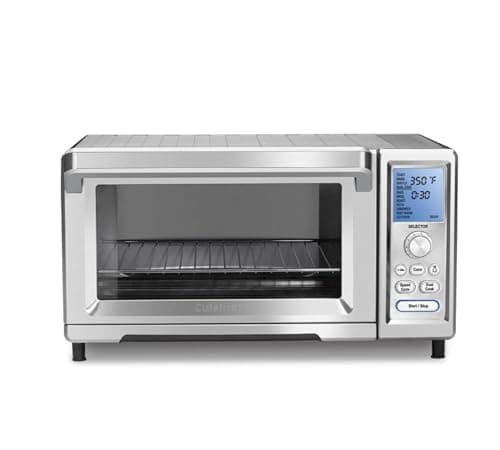
3. Cuisinart Chef's Convection (TOB-260N1). The best-documented interior volume in the category — 0.95 cubic feet published in the same place as the 1,800-watt rating, with a stated fit list of a 13-inch pizza, a 9 x 13 pan and nine slices. Third rather than higher because volume is not height: that 0.95 cubic feet could be any shape, and Cuisinart does not say which. Fifteen functions including a dual-cook mode that is genuinely useful for a cake that needs a hot start and a cooler finish. The costs: it is the deepest oven on this site at 530 mm, and Cuisinart lists the model as discontinued on its own site so availability moves. Full review here.
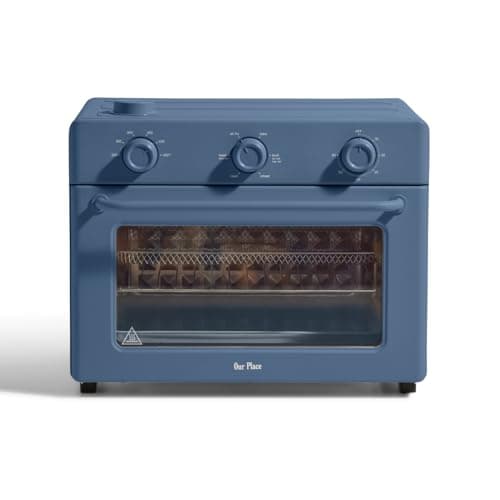
4. Our Place Large Wonder Oven.The highest published interior height in our catalog at 7.75 inches, across three rack levels, in a box 16.75 inches wide — and Our Place publishes more of the spec sheet than almost anyone: wattage, voltage, temperature range, timer range, interior and exterior dimensions, weight, rack count and a six-slices-per-rack toast figure. Fourth, not higher, for two published reasons that bite a baker specifically: the timer stops at 60 minutes, which rules out a long low bake and some larger cakes outright, and it draws 1,700 watts to deliver a 200°F floor — the Pro's power with the standard oven's controls. Full review here.
5. BLACK+DECKER 8-Slice Extra Wide (TO3250XSB). The value pick and the most honest oven on the page. BLACK+DECKER prints the rating line in its own manual at 1,500 W, 120 V, 60 Hz, publishes dimensions, weight and a two-year warranty, and states a 13 by 9 pan fit with handles. It is also the only oven here that tells you its thermostat reads low, which is exactly the thing a cake punishes. Dials rather than a capacitive panel, so there is no control board to retire the oven while the elements are fine. Twenty-two inches wide is the widest in its band — measure first. Full review here.
What each one costs to bake in
At the US average residential rate this site uses throughout — 18.34¢ per kWh, EIA Table 5.3, June 2026 — full rated draw works out at roughly 33.0 cents an hour for the three 1,800-watt ovens (Nuwave, Breville, Cuisinart), 31.2 cents for the 1,700-watt Our Place Large and 27.5 cents for the 1,500-watt BLACK+DECKER. A 35-minute cake is therefore between about 16 and 19 cents of electricity in any of them, which is not a reason to pick one over another.
Every one of those is a ceiling and we label it as such: an oven draws its rated wattage only while the elements are energized, and the thermostat cycles them off once the cavity is at temperature. Nobody publishes duty cycles, so we compute at full draw rather than invent a correction factor. Where the real saving is — not heating five cubic feet for one cake, and every published wattage we hold.
Who should not buy any of these for cakes
Anyone baking two layers at once in matched pans. Every oven on this page is a single usable baking level for a 9-inch round — the Our Place Large and the Nuwave have multiple racks, but stacking two cake pans in a cavity under eight inches tall puts the top one inside a couple of inches of the element, and neither brand publishes a rack-spacing figure that would let you check. Bake them in sequence or use the full-size oven.
Anyone whose cakes are tall. A 10-inch angel food tube pan is roughly four and a quarter inches empty and the batter climbs. In a 7.6 to 7.75-inch cavity that is a near-miss at best, and in the ovens that publish no height at all it is a gamble. This is the clearest case on the site for keeping the big oven for one job.
And anyone who wanted us to tell them which of these browns most evenly. We cannot: we have cooked in none of them, nobody publishes an evenness figure, and the same limit applies to the cookie question. What we can do is tell you which manufacturers will commit to a number in writing, and on this page that is a much shorter list than the price tags suggest.