What a household oven has to do
Cook more than one thing, at once, without a queue. That translates into two published properties: a capacity stated as objects — two 12-inch pizzas, a sheet pan, six pounds of wings — rather than an adjective, and a second cooking level or a second cavity. A probe thermometer earns its place if the recipient roasts, because cooking to internal temperature is the single biggest improvement available to a home cook. Everything else on the box is a preset.
The honest caveat for the whole page: the biggest ovens are the worst documented. Most of these publish no wattage, so we print no running cost for them rather than borrow a figure. Our large-capacity ranking says the same for a buyer.
The order
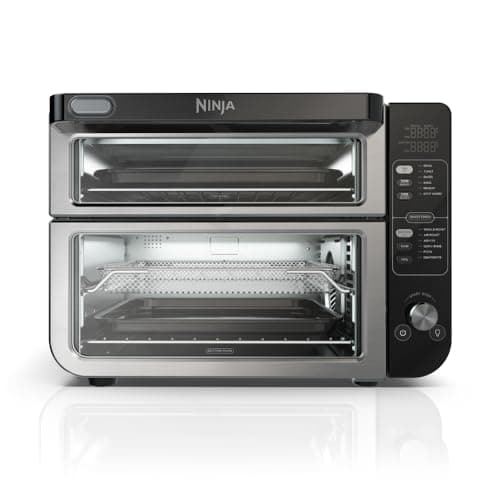
The Ninja Double Oven with FlexDoor (DCT401) leads. Its extra number is a mechanism: the door splits the box into two independently controlled ovens, six functions each, so a tray of wings can air fry below while a pizza bakes above. Ninja states the capacity as things that fit — six pounds of wings and a 12-inch pizza at once. It publishes no wattage, the warranty is one year, and splitting one cavity into two costs headroom in each. For a household that runs two dishes at dinner every night, it is the most useful gift on this site.
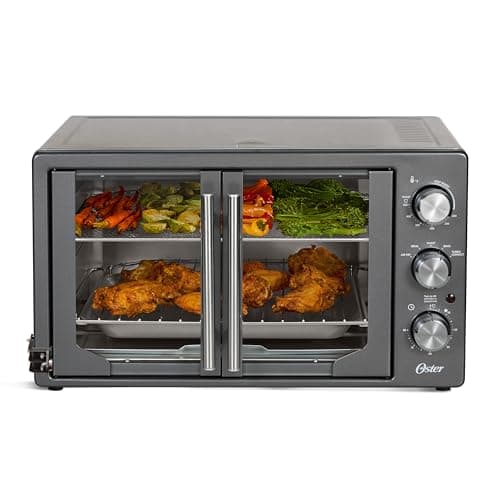
The Oster 42 L French Door is second: 42 liters stated as a number, roughly 1.5 cubic feet, behind doors that open outward and need almost no clearance in front. Air fry is included without the price jumping into Breville territory. No published wattage, and 42 liters takes longer to reach temperature than a smaller box. The review is here.
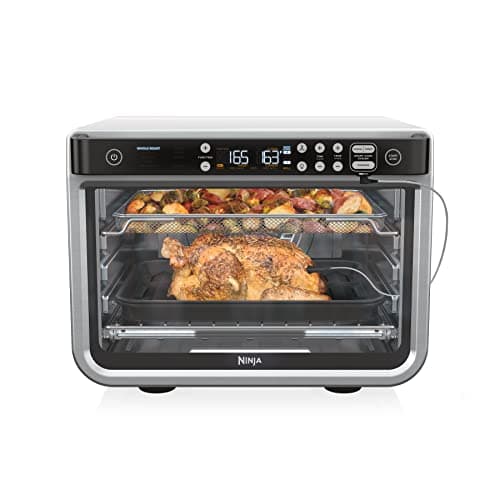
The Ninja Foodi 10-in-1 Smart XL Air Fry Oven (DT251) is third and is the gift for the family cook who roasts: the same two-level XL cavity as the DT201 with a smart thermometer that the presets are mapped to. It costs well over the DT201 for one added sensor, so if the recipient cooks things without an internal temperature worth measuring, the DT201 is the same oven for less. The two are compared here.
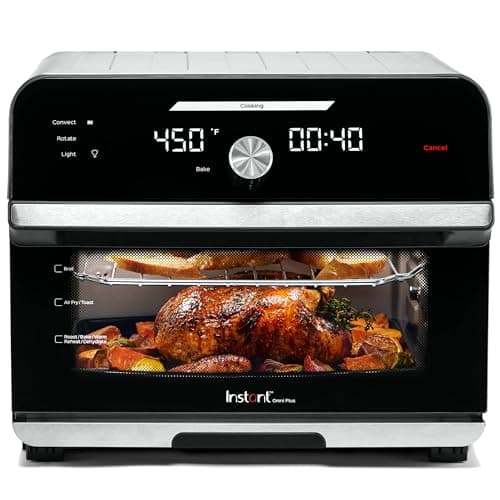
The Instant Pot Omni Plus is fourth: 19 quarts stated in liters as well, a published 170–450°F range, and a rotisserie spit that is real hardware. The 450°F ceiling is low for pizza, and Instant publishes no wattage. Rotisserie is the kind of feature that gets used twice — unless the recipient is the kind of cook who will use it every Sunday, in which case it is the reason to give this one.
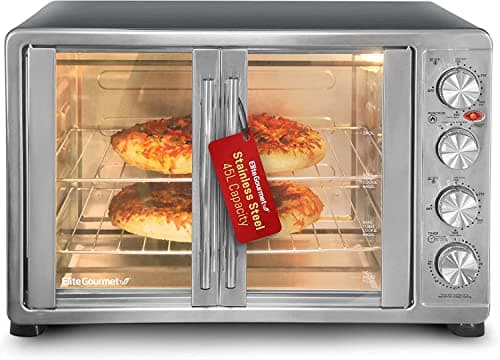
The Elite Gourmet ETO4510MX is fifth on volume alone: 47.5 quarts, eighteen slices, French doors, a rotisserie, at a price nothing that size approaches. It fits a turkey breast or two sheet pans. It is also a very large footprint with no published wattage and two sets of hinges. It is the gift for a host, not for a family of three.
Who each one is for
- Two dishes at dinner, every night: the Ninja DCT401.
- Sheet-pan dinners and batch cooking: the Oster.
- Someone who roasts meat weekly: the Ninja DT251.
- A Sunday-rotisserie household: the Instant Omni Plus.
- A host who feeds twelve: the Elite Gourmet.
What to check before you buy it for them
The counter, twice. These are the largest boxes we cover. Width matters for the cabinet above and depth for the door swing — French doors on the Oster and Elite Gourmet need far less in front than a drop-down door does. Our sizing guide has the numbers.
The circuit. None of these publishes a wattage, and a large oven on a circuit shared with a microwave is the classic trip. Here is how to check without an electrician.
Whether a Breville is the better gift. If the household is two or three people and the recipient values a maker that publishes everything, the no-ceiling guide is the one to read instead.
How we picked
Ovens we claim to have cooked in: 0
Everyone in this category tells you they roasted forty chickens. We have roasted none, and we say so. Here is what we do instead: read the manufacturer's manual and spec sheet, record the published wattage, interior volume, temperature range and warranty term, work out what the oven costs to run for an hour and for a year, show the arithmetic so you can redo it with your own electricity rate, and cite all of it. Where a brand publishes no wattage, we print no running cost rather than borrowing a number from a similar model. Prices come live from Amazon's API and disappear rather than go stale.
The scores above are judgments from that documented research — not test results. One of the five metrics is Documentation: whether the manufacturer will tell you what its oven draws at all. The full rubric, including what disqualifies an oven, is published in full.