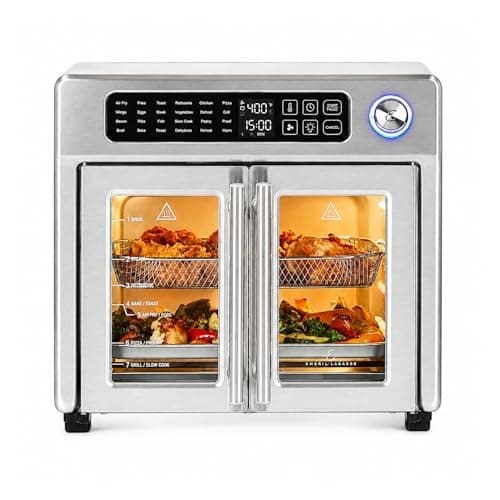
The short answer
Buy it if the rotisserie and the breadth of the function list are specifically what you want, you are comfortable not knowing what the oven draws or what temperatures it reaches, and you will read the rating plate yourself when it arrives. On every criterion this site actually scores — published power, published capacity detail, published documentation — it is near the bottom of our catalog, and it costs about fifty dollars more than the Midea Flexify, which holds the same volume and publishes far more.
We have not cooked in this oven, and our rubric says so in those words. That matters more than usual here, because with this product there is unusually little published to reason from either — and saying so plainly is the most useful thing a review of it can do.
What is actually published
The complete list, from the manufacturer-supplied listing copy, which is the only manufacturer source we could reach for this model:
- A capacity of 26 quarts — about 24.6 liters
- Twenty-four cooking functions
- A dual-speed fan with 360° superheated air circulation
- A rotisserie
- An automatic toast shut-off: the oven switches itself off when the toast countdown ends, with the indicator light red while toasting and blue once the timer ends
- French doors that open with a single pull, and an interior light
- A stainless steel exterior
- Exterior dimensions of 15.8 inches wide by 16.9 deep by 14.8 high, from Amazon's own item data
And the complete list of what is not published anywhere we could find:
- A rated wattage. Not on a spec sheet, not in listing copy, not in a manual.
- A temperature range. No floor, no ceiling.
- A timer range.
- Any interior dimension— and no published fit, either: no pizza diameter, no toast-slice count, no pan size.
- A warranty term, on a box containing a convection fan motor, a rotisserie motor and two door hinges.
- Any thermostat tolerance, which nobody in this category publishes.
We also could not reach a manufacturer spec sheet or manual for this model at all. The model field on its own listing reads 4-00675-02X-VN, which is a vendor SKU rather than a model number a buyer can take to a manual or a parts list. Third-party retailers list this oven under an ELFD-360 model number and quote 1,700 W for it; we are not repeating either as a specification, because a retailer is not the manufacturer and the retailer listings for this product disagree with each other on weight and dimensions.
Twenty-four functions, and what a function count is worth
Almost nothing, on its own, and this oven is the clearest demonstration of that in our catalog. A “function” on a countertop oven is a stored time-and-temperature pair plus a fan state. Naming one does not commit the manufacturer to publishing the temperature it uses, and twenty-four of them on an oven with no published temperature range is twenty-four words on a control panel.
The test is specific: several functions in a list that long will be low-and-slow jobs — dehydrate, proof, slow cook, warm, yogurt in some product lines. Every one of those depends on a published low temperature and a long timer, and Emeril publishes neither for this oven. So a buyer cannot establish, before purchase, that the dehydrate function can reach dehydrating temperature or that the timer runs long enough to use it. By contrast the Midea Flexify publishes a 100–450°F band, which is what makes its much shorter ten-preset list checkable, and the Our Place Wonder Oven Pro publishes an 80°F floor and a 24-hour timer, which is what a genuine dehydrate claim looks like when a maker stands behind it.
For comparison inside the same catalog: Breville's BOV900 publishes thirteen functions and a per-function temperature table. This oven publishes twenty-four functions and no temperatures. The larger number is the less informative one.
The one thing it publishes that nobody else does
It is worth being fair about this, and it is the reason our French-door rankingplaces this oven third rather than last. Emeril publishes a mechanism claim that no other manufacturer on this entire site publishes: an automatic toast shut-off, described in behavioral detail — the oven turns itself off when the toast countdown timer ends, and the indicator light is red while toasting and blue when the timer has ended and the oven has switched off.
That is a specific, falsifiable statement about how the appliance behaves, of the kind this category almost never makes. Burnt toast from a toaster oven is a genuine, common complaint — a toaster oven has no bread-sensing mechanism the way a pop-up toaster does, so the timer is the only protection — and an oven that cuts its own power at the end of the count rather than merely beeping is a real design answer to it. It is also the only published feature here that bears on how the thing actually performs rather than on how many names are on the panel.
The dual-speed fan is the second-most-useful published detail: two fan speeds is a mechanically meaningful distinction, since air-fry modes generally differ from convection modes by fan speed as much as by basket. Our convection-versus-air-fry guide covers that mechanism. No fan wattage, RPM or air-flow figure is published, so the two speeds cannot be compared with anything.
Not the same oven as the Everyday 360
Worth stating clearly, because the names are close and the listings look similar. We also cover the Emeril Lagasse Everyday 360, which is a different product: a single full-glass-front door rather than French doors, a different ASIN, a different capacity and a longer production history. If you are choosing between them, the French-door model is the newer design with the higher function count and the better door for a tight counter; the Everyday 360 has been on sale long enough that parts and accessories are easy to find, which for a countertop appliance counts for something. Neither publishes a wattage, and both score 2.5 for Documentation.
Size and footprint
Twenty-six quarts is about 24.6 liters, effectively the same cavity as the Midea Flexify and a little over half the Oster 42 L or the Elite Gourmet 47.5 qt. It is the mainstream countertop-oven size, which is a sensible size — but with no published interior dimension and no published fit, there is nothing to check a pan, a dish or a sheet tray against. On an oven advertising twenty-four functions, that is the gap that matters most: the functions are about what you cook, and you cannot establish what will physically go in.
At 16.9 inches deep and 14.8 inches tall it is the deepest and second-tallest of the four French-door ovens we cover, so measure the height to your upper cabinets before buying. What the French doors do buy you is clearance in front — they swing to the sides rather than dropping down and sweeping the counter, which is the real ergonomic case for this door design and the reason these ovens exist.
Who should buy it
Someone who wants a rotisserie and French doors in one box at around two hundred dollars, and who treats the function list as a bonus rather than as the reason to buy. It is sold and shipped by Amazon rather than a third-party seller, which makes returns straightforward — and on an appliance with no published warranty term, a clean return path is worth more than usual.
Skip it if you intend to use more than a handful of those twenty-four functions, because the published specification does not exist to tell you whether the low-temperature ones work. Skip it if the running cost is part of the decision. And if what drew you here was simply wanting French doors at a fair price, buy the Midea Flexify instead: same volume, fifty dollars less, and a maker that publishes what temperatures it reaches.