The short version
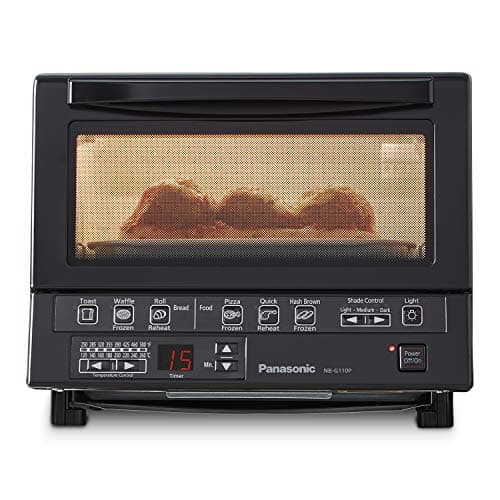
The pick is the Panasonic FlashXpress (NB-G110P), and the reason is mechanical rather than clever: it has no convection fan at all, and Panasonic publishes a temperature band of 250–500°Fthat brackets every cure temperature Polyform prints for Sculpey. Polyform's own FAQ says to turn convection off when baking liquid clay — “to avoid ripples in liquid from the fan” — and an oven with no fan is the only oven where that instruction cannot be got wrong. It is for the clay worker who wants a small, fully specified, dedicated oven and does not need the box to do anything else.
One thing we are not going to tell you: how any of these ovens cures clay. We have cured none, there is no test kitchen behind this site, and nobody publishes a thermostat tolerance you could compare. What is checkable is the band each maker publishes, whether there is a fan, and how finely the set point can be entered — and those three facts sort the field.
What Polyform actually publishes
All of the clay figures on this page come from one document: the Sculpey FAQ on Polyform's own site. It publishes a cure table per clay, and the whole table lives inside a fifty-degree window.
| Clay | Published cure temperature | Published time |
|---|
| Original Sculpey | 275°F (130°C) | 15 min per 1/4 in (6 mm) |
| Sculpey Premo | 275°F (130°C) | 30 min per 1/4 in (6 mm) |
| Sculpey Bake Shop | 275°F (130°C) | 15 min per 1/4 in (6 mm) |
| Bake Shop Bendy | 285°F (140°C) | 20 min per 1/4 in (6 mm) |
| Bake Shop Eraser Clay | 250°F (121°C) | 20 min per 1/4 in (6 mm) |
| Liquid Sculpey | 275–300°F (135–149°C) | 15–30 min |
Three sentences from that FAQ matter more than any spec on any oven, so here they are in Polyform's own terms. First: “We always suggest that an oven thermometer be used when curing our clay. We have found that our ovens are not as accurate as we would like them to be.” Second, on liquid clay: “make sure your oven Convection feature is turned off to avoid ripples in liquid from the fan.” Third, on overheating: above the package temperature the clay “starts to degrade and break down and generate noxious fumes, while not acutely toxic, they are an irritant to the eyes, nose and mouth”, and the instruction is to “use good ventilation while baking”. Polyform also says plainly: do not use a microwave oven.
Notice what is notin there. Polyform does not tell you to buy a separate oven, and we are not going to put words in its mouth. What it asks for is an accurate temperature, good ventilation, and a glass or metal baking surface — its FAQ specifically allows cardboard, index cards, card stock and parchment under a piece, on the grounds that paper will not catch fire at these temperatures.
How the ovens line up against that window
| Oven | Published temperature band | Covers 250–300°F? | Convection fan | Set point |
|---|
| Panasonic FlashXpress | 250–500°F | Yes, 250°F is the exact floor | None — double infrared | Digital |
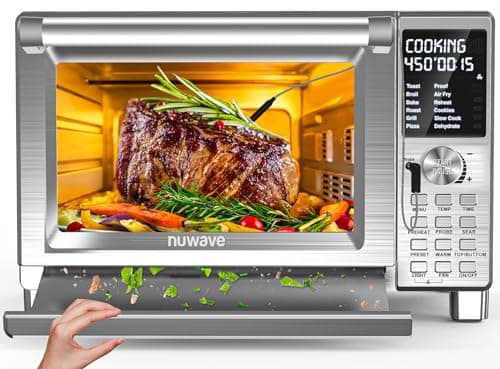
| Nuwave Bravo XL Pro | 50–500°F, in 5°F increments | Yes, with room either side | Yes | Digital, 5°F steps |
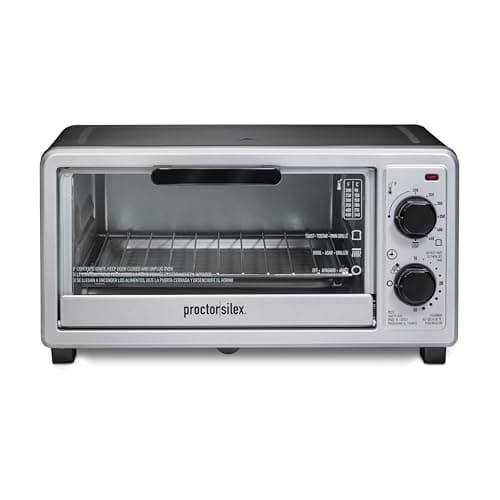
| Proctor Silex 31260 | 200–450°F (brand page contradicts itself: 150–450°F in the detail block) | Yes | None | Dial |
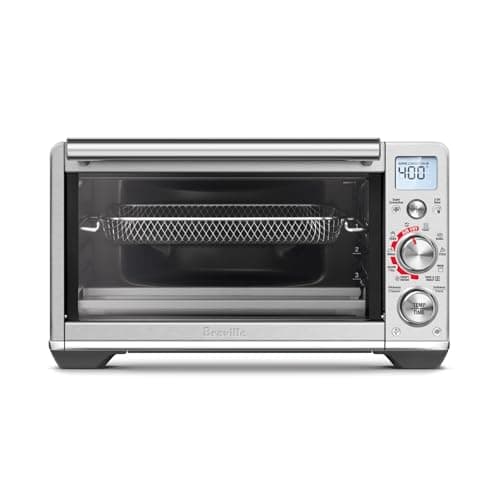
| Breville BOV680 | 120–445°F (Bake & Roast) | Yes, with room below | Yes | Digital |
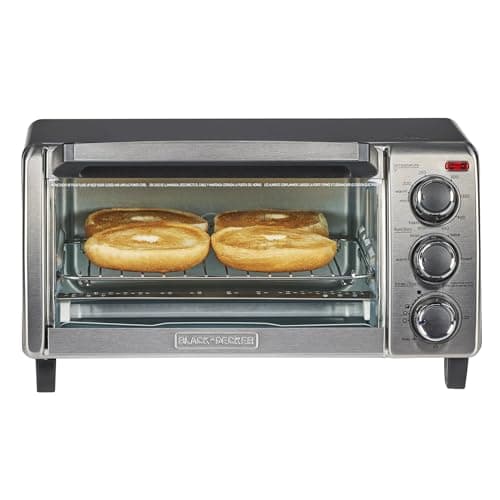
| BLACK+DECKER TO1313SBD | None published | Unknown — no band published | None | Dial |
Reading the order
The Panasonic FlashXpressis first because it is the only oven here where Polyform's fan instruction is satisfied by the hardware rather than by remembering. Panasonic's double infrared heaters sit at the front and back of the cavity rather than above and below, there is no convection fan to switch off, and Panasonic publishes the complete electrical specification — 1,300 W, 120 V, 60 Hz, 7.2 quarts, 250–500°F, exact millimeter dimensions. The honest marks against it: 250°F is the exact floor, so Eraser Clay at 250°F sits on the very bottom of the dial with nothing underneath, and 7.2 quarts is a small cavity — fine for beads and small tiles, tight for a tray. The full review is here.
The Nuwave Bravo XL Pro is second and is the pick if entering the number exactly matters more to you than the fan does. Nuwave publishes a band of 50–500°F in 5°F increments, which makes it the only oven on this site where 275°F and 285°F are both set points you can type rather than dial positions you can approximate. It also publishes the interior — 14.50 x 13 x 7.625 inches — so a work tray is a measurement rather than a gamble. It has a fan, which per Polyform you want off for liquid clay, and Nuwave publishes no control for defeating it on any mode, so we cannot tell you that you can.
The Proctor Silex 31260is third and is the cheap dedicated-oven answer: three manual knobs, no fan, a published 1,100 W, a thirty-minute timer and a three-year limited warranty — the longest published term of any oven on this site. The caution is in the documentation rather than the hardware: Proctor Silex's own page contradicts itself on the range, with the feature list saying 200–450°F and the detail block saying 150–450°F. For a dial oven at this price the cure window is well inside either figure; what it is not is a precise instrument, which is where Polyform's thermometer advice earns its keep.
The Breville Smart Oven Air Fryer Compact (BOV680)is fourth and is here because it is the best-documented low end in the catalog: Breville prints a Bake and Roast band of 120–445°F in its own instruction book, along with the 1,800 W rating line. A published 120°F floor means the whole cure window sits in the middle of the oven's range rather than at its edge, which is the most defensible argument on this page for a premium oven. It has a fan and costs several times what the Proctor Silex does.
The BLACK+DECKER TO1313SBDis fifth and is the floor: four slices, three knobs, nothing electronic to fail, and BLACK+DECKER publishes no wattage and no temperature band for this SKU at all. It is on the page because a great many clay workers want the cheapest box that will hold a set point, and this is it — but you are buying an unspecified thermostat, and we will not pretend otherwise.
The one published warning worth repeating
BLACK+DECKER is the only manufacturer in this entire catalog that publishes anything about whether its dial tells the truth, and what it publishes is this, in its own use and care manual: temperatures in the oven will be lower than your set point, because the dial has been calibrated around the heating elements rather than around a thermometer.
Put that next to Polyform saying its own ovens “are not as accurate as we would like them to be” and the conclusion writes itself: whichever oven you buy, the instrument that decides your result is a separate oven thermometer, not the dial. Polyform even publishes a pre-bake calibration test — a half-inch disc of clay, baked at the package temperature and time, then checked for darkening, with the oven turned down 10°F and the test repeated if it darkens. That test costs nothing and it is the only oven-accuracy check on this page that anyone has actually published.
How to buy an oven for clay
Read the bottom of the band, not the top. Every oven in this category advertises its ceiling, because 500°F sells pizza. Clay lives between 250 and 300°F, and an oven whose published floor is 250°F is running at the very edge of its own specification when it cures Eraser Clay. An oven with a published floor well below the window has margin; an oven that publishes no band at all has nothing you can check.
Prefer a set point you can enter over one you can aim at.The difference between 275°F and 285°F is a real difference in Polyform's own table, and it is not a distinction a knob with four tick marks can make. If you work across clays, a digital oven with small increments is the hardware answer; if you work in one clay, a dial plus a thermometer gets you there for a quarter of the money.
Account for the fan.Polyform's instruction for liquid clay is explicit, and it is a constraint on the oven rather than on the technique. If liquid clay is on your list, buy either an oven with no fan, or an oven whose maker publishes a way to cook without it. We have not found a catalog entry here that publishes a fan-off control, which is why the fanless ovens rank where they do.
Ventilate, and read the placement rules. Polyform asks for good ventilation while baking. The ovens have published placement rules of their own that point the same way: Our Place prints a one-inch minimum around its oven and bans operating it under a wall cabinet, and BLACK+DECKER asks for room behind the unit for heat to flow. What the manuals require about venting is here, and the clearance figures are tabulated here.
Buy for the tray you work on. The published interiors run from 7.2 quarts on the Panasonic to 14.50 x 13 inches on the Nuwave. The size chart puts them all in one order, and the pan-fit guide covers which trays go in.