The short answer
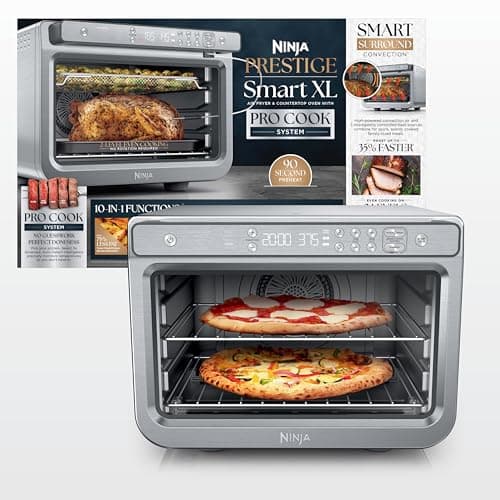
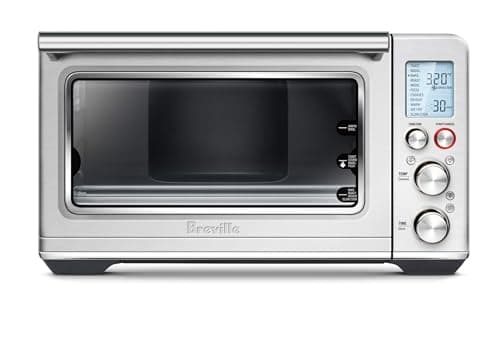
Buy the Breville Smart Oven Air Fryer (BOV860). Breville reproduces the rating plate in its own downloadable instruction book — 120 V ~ 60 Hz 1800 W — publishes eleven functions and a full exterior, and at 18.9 inches wide it clears the depth problem that makes the step-up Pro awkward on a standard counter. If you roast to internal temperature often, the Ninja Prestige Smart XL (DT551) puts an integrated probe inside a two-level XL cavity and is the only Ninja oven still on sale that does. The budget pick is the Breville Smart Oven Air Fryer Compact (BOV680): the cheaper of the two ovens here whose maker reproduces a rating plate, and the one with the lowest published temperature floor of the five, at 120°F. The cheapest oven on the page is the Toshiba, and the reason it is not the budget pick is at number four.
Band check. As of November 22, 2026, 5 of the 5 picks here with a live Amazon price sat at or under $300 — Breville Smart Oven Air Fryer (BOV860BSS) at $279.95; Ninja Prestige Smart XL with Pro Cook System, 10-in-1 (DT551) at $249.95; Instant Pot Omni Plus 19QT/18L Toaster Oven Air Fryer, 10-in-1 at $153.12; TOSHIBA ChefFry Air Fryer Toaster Oven Combo, 12-in-1 at $144.34; Breville Smart Oven Air Fryer Compact (BOV680BSS) at $199.95.
We have not cooked in any of these. Our rubric says so in those words — there is no test kitchen behind this site, and the authority claim is that every number traces to a document you can open yourself.
This page is about the third hundred dollars, not the first two
If your budget is two hundred, read the under-$200 ranking; if it is a hundred and fifty, read the under-$150 ranking, which is ordered on paperwork and names the one oven in that band publishing both a rating-plate wattage and its interior dimensions. Those pages exist and this one does not re-rank them. The question here is narrower and more useful: what does the third hundred dollars actually add?
The answer is not power. Air-fry ovens in this catalog reach a rated 1,800 watts well below two hundred dollars, and at 18.34¢ per kWh the difference between 1,500 W and 1,800 W is about 5.5¢ an hour. The answer is not capacity either — the largest cavities on this page are not the most expensive ovens on it.
What changes in this band is what the maker will tell you, and the fact that Breville becomes comfortably reachable inside it. Breville is the only brand in our catalog that reproduces a rating plate in a manual you can download before spending anything, and both of its entries here do that. Three of the five Brevilles we cover sit under this ceiling; none of the cheaper brands reproduces a rating plate at all.
The uncomfortable finding: the money does not buy the document
Two of the five ovens below publish no wattage at all. Instant Brands prints no figure on its Omni Plus product page; no Toshiba document for the ChefFry gives one either. That means this site publishes no running cost for either oven — not because we did not look, but because inventing a number is the one thing we will not do.
Hold that against the $150 band, where Our Place publishes a rating line of 120V 60Hz 1400W on the cover of its own manual, an interior in inches, a temperature range and a warranty term. A $149 oven on this site publishes more than two of the ovens on this $300 page. Price and documentation are only loosely correlated in this category, and the correlation that does exist is with the brand, not the number. The band where that is laid out in full.
| Oven | Rated power | Where the figure comes from | Per hour | Published range | Interior published? |
|---|
| Breville BOV860 | 1800 W | Rating plate in Breville's manual | 33.0¢ | Not published as a band | No — exterior only |
|---|
| Ninja Prestige Smart XL (DT551) | 1800W (listing copy) | Amazon listing title; no SharkNinja document | — | Not published | No — capacity in objects |
|---|
| Instant Pot Omni Plus | Not published | — | — | 170–450°F | Volume: 19 QT / 18 L |
|---|
| Toshiba ChefFry | Not published | — | — | Not published | No |
|---|
| Breville BOV680 Compact | 1800 W | Rating plate in Breville's manual | 33.0¢ | 120–445°F | No — 11" pizza pan stated |
|---|
Per-hour figures are the published wattage times 18.34¢ per kWh, the US average residential rate for June 2026, and they are a ceiling rather than a bill — an oven draws its rated power only while the elements are energized. Three rows have no figure because no manufacturer document supplies one. Every published wattage on this site, with its source document.
1. Breville Smart Oven Air Fryer (BOV860) — the reason the band exists
Who it is for: the buyer who wants the thing documented. Breville's instruction book reproduces the rating plate line — 120 V ~ 60 Hz 1800 W — which is rarer in this category than it should be and is the difference between an oven you can compute a running cost for and one you cannot. Eleven functions, an Element iQ system that drives the elements independently rather than cycling them together, and an exterior of 18.9 x 15.9 x 10.9 inches: two and a half inches narrower than the step-up Pro, which is the figure that decides whether it fits under a cabinet on a 24-inch counter.
The cons. Breville's own product page quotes a relative claim — “up to 35% less power compared to a built-in oven” — and no absolute wattage, so you have to open the manual to find the number, which most buyers will not. No interior volume is published for this model, so you cannot compare its usable space to the Pro's stated cubic foot on paper. And it is several times the price of an oven that toasts and bakes to the same temperatures: the premium is documentation, build and element control, not heat. Our full review of this oven.
2. Ninja Prestige Smart XL (DT551) — the probe, in the only Ninja cavity left
Who it is for: anyone who cooks meat to an internal temperature. A probe that stops the cook at a target is the single biggest improvement available to a home cook, and Ninja maps its presets to the sensor rather than leaving it as an accessory. The cavity is a genuine two-level XL and Ninja states the capacity in objects you can check: two 9x9 trays, nine slices, a twelve-pound turkey. It is also the only two-level XL Ninja oven still on sale, which is what the money buys against the field rather than against a stablemate.
The cons. SharkNinja publishes no wattage and no interior volume for this SKU in any document of its own, so we print no running cost. The listing title now ends “1800W”, which is the manufacturer's own copy and worth knowing — but listing copy is a rung below a spec sheet and we will not promote it into our running-cost arithmetic. The footprint is large: Ninja states 20.2 x 17.1 x 13.3 inches and 33.75 lb. And the thermometer is the entire premium, which is useless on most of what these ovens actually cook. Our full review.
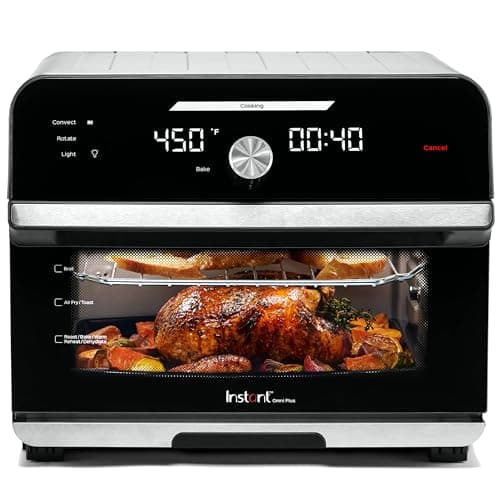
3. Instant Pot Omni Plus — the interior you can compare on paper
Who it is for: the shopper who is tired of quart claims. Instant Brands publishes 19 QT / 18 L plainly, which makes this one of the easiest ovens in the category to hold against a Breville's cubic foot without converting a marketing claim, and it publishes a 170–450°F range — a real temperature floor, which most of this band does not give you. The rotisserie is actual hardware with a spit, not a relabeled fan setting.
The cons. No wattage on the product page, so no running-cost figure from us and no way to check the load on your circuit. 450°F is a low ceiling — several cheaper ovens here reach 500°F, and that fifty degrees is the difference for a thin crust and for a hard finish on roast vegetables. And the rotisserie is the kind of feature that gets used twice, so do not let it carry the decision. Our full review.
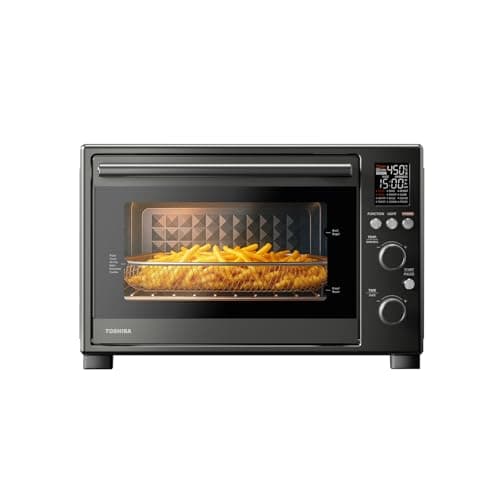
4. Toshiba ChefFry — the biggest cavity, the thinnest paper trail
Who it is for: the household that needs room above all and will accept not knowing much. It is a genuinely large twelve-function oven with a stainless exterior at a price where painted finishes are normal, and the twelve functions include the two that actually matter on a spec sheet — dehydrate and proof — rather than four variations on “bake”.
The cons, and they are the reason it is fourth rather than second. No manufacturer wattage we could find, no published interior volume and no published temperature range: almost everything we can tell you about this oven comes from listing copy, and for an oven at this price that is a fair thing to want more of. It scores 2.5 out of 10 on documentation, which is among the lowest in our catalog and is a statement about the paperwork rather than about the appliance. It is also a newer SKU, so there is little field history behind it. It is typically the cheapest oven on this page, and we have still not made it the budget pick: on this site the budget slot goes to the cheapest oven we can actually describe, and this is the one we can describe least. Our full review.
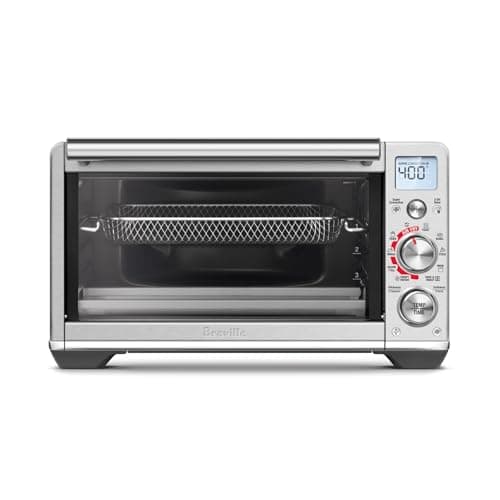
5. Breville Smart Oven Air Fryer Compact (BOV680) — the budget pick
Who it is for: one or two people with a small counter who still want the documentation. It is the cheaper of the two ovens on this page whose maker reproduces a rating plate, and the smallest oven anywhere on this site whose maker publishes a rating-plate wattage, a temperature range and a stated toast and pizza-pan capacity in a manual you can read first. The published 120°F Bake & Roast floor is the lowest on this page and is what makes slow work and proofing possible in a cavity this size — holding a low set point is harder for an oven than getting hot.
The cons. It is genuinely small and Breville does not hide it: the manual states one to four slices of toast and an 11-inch pizza pan, with a 12-inch pan going in only with the rack reversed. No interior volume is published, so you compare it by pan rather than by number. The 445°F ceiling is below the 500°F several cheaper ovens reach. And it draws the same 1,800 W as the full-size BOV860 above it, so a smaller oven is not a cheaper one to run. Our full review.
The honest summary
Three hundred dollars is a real line in this category, but not for the reason the search query implies. It does not buy more watts, it does not reliably buy a bigger cavity, and it certainly does not guarantee a spec sheet — two ovens on this page publish no wattage at all while a $149 oven elsewhere on this site publishes four figures we score. What it buys is comfortable access to the one brand in our catalog that will show you the rating plate before you pay, plus the probe hardware, and those are both worth money if they are what you wanted.
If they are not, spend less. The $150 band contains the best-documented small oven on this site, and the $500 page contains the finding that the most expensive oven in the whole category publishes the same wattage, interior, weight and temperature range as one costing far less. Spending more is rarely the answer in this category, and we would rather say so on a page named after a budget.
In this band, ask for the rating plate by name
A marketing wattage on a box is not a rating plate. A rating plate is the compliance label on the appliance itself, and a manufacturer that reproduces it in a downloadable manual is telling you the number is the real one. In our catalog, that behavior is essentially Breville's alone, and both ovens here from the brand do it. If a maker will only give you a relative claim — “up to 35% less power than a built-in oven” — the absolute figure is usually in the manual, and downloading it before you buy is free. When a countertop oven needs its own circuit.
A probe changes outcomes; a preset count does not
Of everything that costs money in this band, an integrated thermometer is the one with the clearest mechanism: it removes the guess from the single decision that ruins a roast. The test for whether it is worth it is simply what you cook. If the honest answer is trays of vegetables, reheated pizza and toast, the probe is a premium you will never collect, and the money is better spent on a published floor or a wider cavity. The ovens with a probe, ranked separately.
Compare interiors in one unit or not at all
This band publishes capacity in cubic feet, liters, quarts and objects, and three of the five ovens here publish no interior figure of any kind. Convert before you compare: one cubic foot is 1,728 cubic inches, which is 29.9 US quarts or about 28.3 liters. An oven quoting 19 quarts is roughly 0.64 cubic feet. When a maker publishes nothing, the stated pizza diameter or pan fit is the only check available, and it is a weaker one. How much interior you actually need, by household size.
Measure depth, then height, then width
Width is the figure everyone checks and the one that rarely bites. Depth decides whether the door clears the edge of the counter; height decides whether the oven fits under the cabinet with the clearance the manual asks for. Two ovens on this page are published at roughly seventeen inches deep — the Ninja at 17.1 and Breville's Compact at 16.9 — and the Toshiba publishes no dimension at all. The clearance each maker actually asks for.