The short answer
Buy the Our Place Large Wonder Oven. It is for the household that wants a big cavity it can verify: Our Place publishes a 13.75 x 13 x 7.75 inch interior alongside a 28-litre volume, a 16.75 x 13.25 x 13 inch exterior, 17.5 lbs, three rack levels, six slices per wire rack, a 12-inch pizza and a rating line of 1700w / 120V — the only oven in this band whose capacity claim can be checked against its own dimensions. If raw interior is the only thing that matters, the Elite Gourmet ETO4510B publishes 47.5 quarts, the largest figure in this catalog. The budget pick is the BLACK+DECKER TO3250XSB at well under half the ceiling: eight slices, a published 12-inch pizza and 9 x 13 pan, a 1500 W rating line in its own manual, and a two-year warranty.
Band check. As of November 22, 2026, 3 of the 3 picks here with a live Amazon price sat at or under $200 — Our Place Large Wonder Oven (6-in-1, 28 L) at $175.00; Nuwave Bravo XL Pro Air Fryer Toaster Oven (30 Qt, with probe) at $167.96; TOSHIBA ChefFry Air Fryer Toaster Oven Combo, 12-in-1 at $144.34. 2 picks had no verified live price at that check and so is counted in neither column.
We have not cooked in any of these. Our rubric says so in those words.
Convert everything into one unit, then look again
This page alone publishes capacity in quarts, litres, inches, slices and pizza diameters. Before you can rank anything you have to put them on one scale, so here it is in full: one cubic foot is 1,728 cubic inches, which is 29.9 US quarts or about 28.3 litres. An oven quoting 42 litres is roughly 1.48 cubic feet; one quoting 30 quarts is about one cubic foot; one quoting 47.5 quarts is about 1.59 cubic feet.
Do that and a second problem appears. The three largest published figures in this band come from the three makers who publish the least about anything else. Elite Gourmet prints 47.5 quarts and no wattage, no band and no warranty. Toshiba prints a function count and no capacity at all. Meanwhile the smallest-sounding oven here — eight slices — publishes a rating plate, exact exterior dimensions, a weight, a pan fit and a two-year term.
| Oven | Published interior | Roughly, in cubic feet | Rated power | Per hour | Price |
|---|
| Our Place Large Wonder Oven | 28 L, and 13.75 x 13 x 7.75 in. | About 0.99 | 1700 W | 31.2¢ | $175.00·on Amazon |
|---|
| Elite Gourmet ETO4510B | 47.5 Qt / 18 slice | About 1.59 | Not published | — | Check price on Amazon → |
|---|
| Nuwave Bravo XL Pro | 30 QT, and 14.50 x 13 x 7.625 in. | About 1.00 | 1800 W (brand Q&A) | 33.0¢ | $167.96·on Amazon |
|---|
| Toshiba ChefFry | Not published | — | Not published | — | $144.34·on Amazon |
|---|
| BLACK+DECKER TO3250XSB | 8 slice; 12" pizza; 9 x 13 pan | Not published as a volume | 1500 W (rating plate) | 27.5¢ | Check price on Amazon → |
|---|
Every price in the table above and on every card below was last checked November 22, 2026, read from the same live price layer the buy buttons read. Two of the five rows publish interior dimensions in inches, which is the only figure you can check a pan against. Amazon moves these daily and the price at checkout is the one that counts — where a row says “Check price”, we had no verified offer at that check and we would rather show a gap than a number we cannot stand behind.
Per-hour figures are the published wattage times 18.34¢ per kWh, the US average residential rate for June 2026, and they are an upper bound rather than a bill. A bigger cavity costs more to heat for a simple reason — there is more air in it — but the wattage is what the meter sees. When a big countertop oven stops being cheaper than the wall oven.
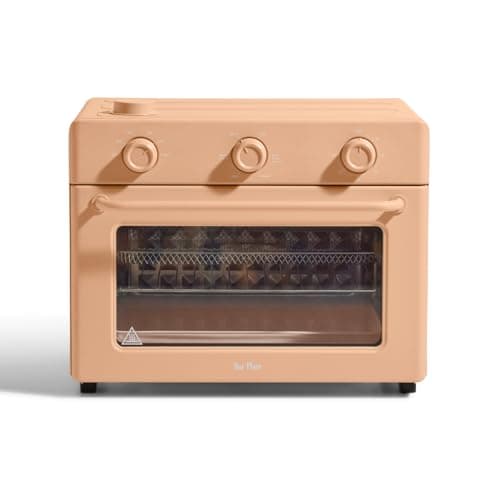
1. Our Place Large Wonder Oven — the only checkable big cavity
Who it is for: the household of three or four that wants a published interior it can measure a dish against. Our Place publishes the interior AND the exterior in inches, the volume in litres, the rack count, the toast capacity per rack and a 12-inch pizza — and the dimensions multiply out to roughly the volume claimed, which is not true of every oven in this line. It also keeps the steam function, which nothing else in this catalog publishes.
The cons. Its published floor is 200°F and the timer stops at 60 minutes, so no proofing, dehydrating or long cooks — only the Pro publishes the 80°F floor and the 24-hour timer, and it draws the same 1,700 W to do less. At about 0.99 cubic feet it is the smallest published interior on this page despite the name, which is exactly why the conversion table above exists. Our full review.
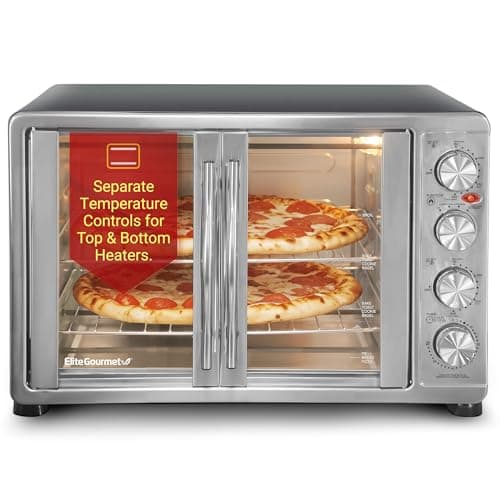
2. Elite Gourmet ETO4510B — the biggest number in the catalog
Who it is for: the household that genuinely needs 47.5 quarts — eighteen slices, a rotisserie, French doors — and will accept knobs and no paperwork to get it. Nothing else on this site publishes an interior this large at any price, and it costs less than four of the five ovens on the convection hub's premium page.
The cons. No published wattage, no published temperature band, no published interior dimensions, no published warranty term. Four manual control knobs, and a knob thermostat at this price is an approximation rather than a set point — which for bread matters more than volume does. And 47.5 quarts is a very large volume of air to heat for a weeknight tray of vegetables.
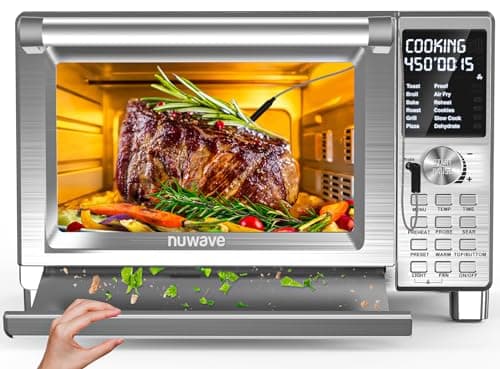
3. Nuwave Bravo XL Pro — the big cavity with the specification sheet
Who it is for: the cook who wants the room and the numbers. Thirty quarts and four rack levels, with interior and exterior dimensions, a weight, a 50–500°F band in 5°F steps, a probe that stops the oven at target, and Nuwave's own FAQ stating a standard 13 x 9 x 3 inch pan fits and the oven takes two 13-inch pizzas or a 10 lb chicken. On documentation it beats everything above it here.
The cons. The 1,800 W figure is a Nuwave Q&A answer rather than a rating line, and it is the highest draw on this page. Four rack levels in a one-cubic-foot cavity means each level is shallow. One-year warranty, original purchaser only. And twelve functions plus a hundred presets is marketing depth rather than capability. Our full review.
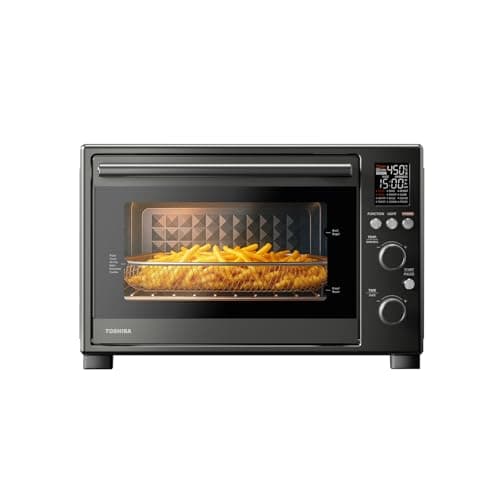
4. Toshiba ChefFry — room, on trust
Who it is for: the household that wants a large stainless twelve-function oven at a mid-field price and will accept not knowing much. The twelve functions include the two that actually matter on a spec sheet — dehydrate and proof — rather than four variations on bake, and the stainless exterior is unusual at a price where painted finishes are normal.
The cons, and they are why it is fourth. No Toshiba document publishes a wattage, an interior volume or a temperature range for this SKU, so almost everything we can tell you comes from listing copy and there is no running cost on this site for it. On a page ranked by published interior, an oven that publishes no interior cannot rank above one that does. It is also a newer SKU with little field history. Our full review.
5. BLACK+DECKER TO3250XSB — the budget pick
Who it is for: anyone who wants extra width rather than extra volume, for well under half this ceiling. BLACK+DECKER publishes 1500 W / 120 V~ / 60 Hz as a rating line in its own manual, a 22 x 14.5 x 11.5 inch exterior, 12.1 lb, a two-year limited warranty, eight slices, a 12-inch pizza and a 9 x 13 pan with handles. For the money that is a more complete specification than three ovens above it on this page.
The cons. It is a convection baker, not an air fryer: no basket, no air-fry setting, and the crisping the rest of this site discusses needs both. It publishes no interior volume, so it cannot be ranked on this page's own headline metric — only on its published pan fit. The controls are dials. And at 22 inches it is the widest footprint here, which is the point and also the problem. Our full review.
The honest summary
Extra large is not one decision, it is two: how much air you want to heat, and in what shape. If you want volume, the biggest published figure on this site sits in the middle of this price band and comes with almost no other specification. If you want a cavity you can verify a dish against, two ovens here publish their interiors in inches and one of them costs under a hundred dollars.
The thing to resist is buying volume you will not use. The efficiency argument for a countertop oven is that you heat less air than a wall oven does, and at 47.5 quarts you are a third of the way to a small wall oven's cavity. How these cavities compare, by published volume, and the French-door ovens at this same ceiling if reaching into the big cavity is the real problem.
Slices, quarts and litres are not interchangeable
A slice count describes the width of the rack. A quart or litre figure describes the volume of the cavity. An oven can take eight slices and still refuse a 9x13 roasting pan, because the pan needs depth the rack does not. Where both are published, use whichever matches what you actually cook. The ovens with a published pan fit, ranked.
Interior dimensions beat every volume claim
Two makers on this page publish the inside of the oven in inches. That single figure answers every fit question a quart number cannot: whether a round pan clears the walls, whether a stone leaves headroom, whether a chicken fits upright. When it is absent, the stated pizza diameter is the only check available, and it is a weaker one.
A bigger cavity costs more to run, even at the same wattage
Rated power tells you the draw; cavity volume tells you how long the elements stay energized to get there and stay there. Two ovens on this page draw a published 1,700 and 1,800 W into roughly one cubic foot. An oven with 1.59 cubic feet and no published wattage will take longer to preheat and hold, and we cannot tell you by how much because nobody publishes the figure. The running-cost arithmetic, written out.
Measure the counter, including the backsplash
The widest oven here is 22 inches across and the deepest published exterior is 14.75. Width is the figure everyone checks; depth is the one that stops the door clearing the counter edge, and height is the one that collides with the cabinet. The clearance each maker asks for.