The short answer
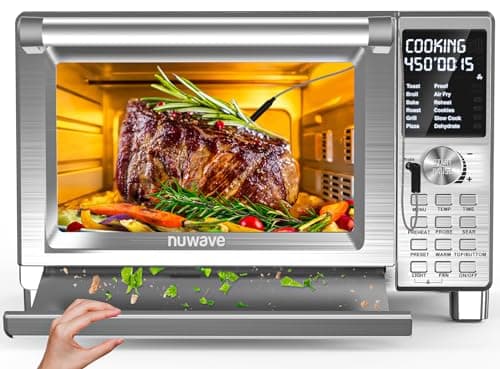
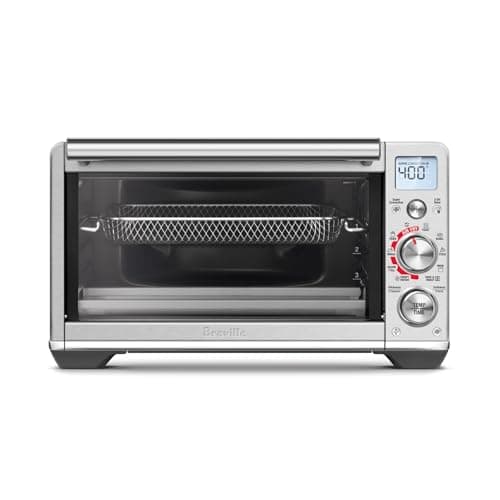
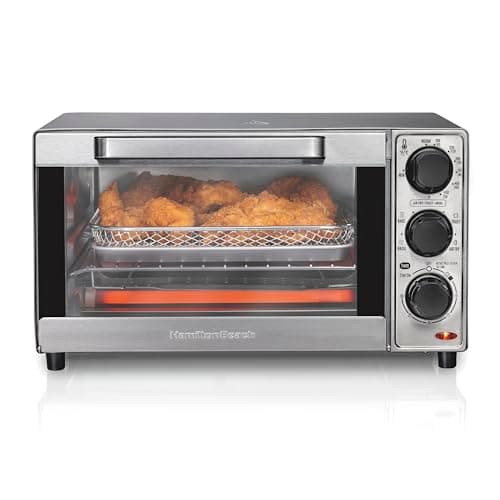
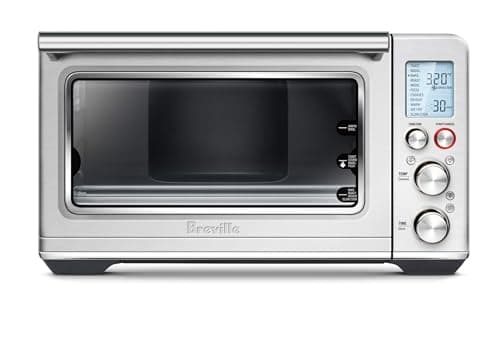
Buy the Breville Smart Oven Air Fryer (BOV860). It is for the buyer who wants the convection hardware documented before paying for it: Breville reproduces the rating plate in its own downloadable instruction book — 120 V ~ 60 Hz 1800 W — publishes eleven functions with Air Fry among them, and states an 18.9 x 15.9 x 10.9 inch exterior, which is the figure that decides whether it fits. If you roast to an internal temperature, the Nuwave Bravo XL Pro is the better buy at well under half the money: it publishes a 50–500°F band in 5°F steps, an integrated probe that stops the oven at target, and both interior and exterior dimensions, which Breville does not do for this model. The budget pick is the Hamilton Beach Sure-Crisp 4 Slice (31403) — the cheapest oven on this site with a real fan and a manufacturer-published wattage, at a printed 1,120 W.
We have not cooked in any of these. Our rubric says so in those words — there is no test kitchen behind this site, and the authority claim is that every number traces to a document you can open yourself.
What “air fry” actually is on a convection oven
A basket air fryer is a small, tall cavity with a fan directly above the food. A countertop convection oven with an air-fry function is a wide cavity with a fan at the back, a perforated basket to lift food into the moving air, and a preset that runs the fan at its top speed with the upper element biased hot. It is the same fan the Bake and Roast settings use, running faster, with better airflow under the food. That is a real mechanism and it does crisp. It is also the reason a preset count tells you almost nothing: adding the word “air fry” to a menu costs a manufacturer nothing, while adding fan speed, a sealed cavity and a published rating plate costs money. What separates the convection setting from the air-fry setting, mechanically.
So this page ranks on three published things and ignores everything else: whether the maker prints a rated wattage (the fan and elements have to be fed), whether it prints a temperature band with a real floor, and whether it prints the cavity in a unit you can compare. On that test, the field splits in a way the price tags do not predict.
The five, on published figures
| Oven | Rated power | Where the figure comes from | Per hour | Published range | Published cavity | Price |
|---|
| Breville BOV860 | 1800 W | Rating plate in Breville's manual | 33.0¢ | Not published as a band | No — exterior only | $279.95·on Amazon |
|---|
| Nuwave Bravo XL Pro | 1800 W | Nuwave Q&A answer, not the manual | 33.0¢ | 50–500°F, 5°F steps | 30 QT; 14.50 x 13 x 7.625 in. | $167.96·on Amazon |
|---|
| Breville BOV680 Compact | 1800 W | Rating plate in Breville's manual | 33.0¢ | 120–445°F (Bake & Roast) | No — 11" pizza pan stated | $199.95·on Amazon |
|---|
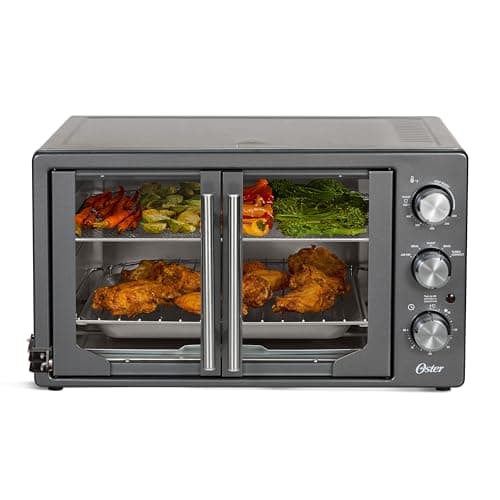
| Oster 42 L French Door | Not published | — | — | Not published | 42 L | $99.99·on Amazon |
|---|
| Hamilton Beach Sure-Crisp 31403 | 1120 watts | Hamilton Beach's own product page | 20.5¢ | 200–450°F | 4 slice; 11.5 x 14.9 x 8.7 in. exterior | $59.95·on Amazon |
|---|
Every price in the table above and on every card below was last checked November 22, 2026, read from the same live price layer the buy buttons read. Three of the five rows print a wattage because three of the five makers publish one. Amazon moves these daily and the price at checkout is the one that counts — where a row says “Check price”, we had no verified offer at that check and we would rather show a gap than a number we cannot stand behind.
Per-hour figures are the published wattage times 18.34¢ per kWh, the US average residential rate for June 2026, and they are a ceiling rather than a bill — an oven draws its rated power only while the elements are energized. Every published wattage on this site, with its source document.
The uncomfortable row is the last one. A $60 Hamilton Beach publishes a wattage, an exterior, a temperature band and a warranty term — four of the four things this site scores documentation on. The Oster, at a price several times higher, publishes a cavity volume and nothing else: no wattage, no range, no dimensions. Documentation in this category does not track price. It tracks the brand.
1. Breville Smart Oven Air Fryer (BOV860) — the documented one
Who it is for: the buyer who wants to check the specification before spending, and will keep the oven a decade. Breville is the only brand in this catalog that reproduces a compliance rating plate in a manual you can download for free, and the BOV860 does it: 120 V ~ 60 Hz 1800 W. Eleven functions with Air Fry among them, Element iQ driving the elements independently rather than cycling them together, and an exterior two and a half inches narrower than the step-up Pro — the figure that decides whether the door clears a 24-inch counter.
The cons. Breville's own product page quotes a relative claim — “up to 35% less power compared to a built-in oven” — and no absolute wattage, so the real number is in the manual, which most buyers never open. No interior volume is published for this model, so you cannot compare its usable space to the BOV900's stated cubic foot on paper. And it draws the same 1,800 W as the Pro above it and the Compact below it: nothing about the air-fry function makes it cheaper to run. Our full review of this oven.
2. Nuwave Bravo XL Pro — the most published convection per dollar
Who it is for: anyone who cooks to an internal temperature, and anyone who wants to know the cavity dimensions before the box arrives. Nuwave publishes both interior (14.50 x 13 x 7.625 in.) and exterior dimensions, a weight, a 30-quart capacity, four rack levels and a 50–500°F band in 5°F increments — the widest published range on this page by a long way. The probe is the real feature: per Nuwave's own manual it stops the oven at a target between 50°F and 212°F rather than merely displaying a reading.
The cons. The 1,800-watt figure is a Nuwave support answer on its own product page, not a rating line in the manual and not a row in the specification table, and we say so on the card rather than promoting it. Twelve menu functions plus a hundred recipe presets is deep into territory where the count is marketing. The warranty is one year, original purchaser only, continental US only. And if you never roast to temperature, the probe is the entire premium and you will not collect it. Our full review.
3. Breville Smart Oven Air Fryer Compact (BOV680) — the small documented one
Who it is for: one or two people on a shallow counter who still want the rating plate. It is the smallest oven on this site whose maker publishes a rating-plate wattage, a temperature range and a stated toast and pizza-pan capacity in one downloadable book. The published 120°F Bake & Roast floor is the lowest on this page and is what makes proofing and slow work possible in a cavity this size — holding a low set point is harder for an oven than getting hot.
The cons. It is genuinely small and Breville does not hide it: the manual states one to four slices of toast and an 11-inch pizza pan, with a 12-inch pan going in only with the rack reversed. No interior volume is published, so you compare it by pan rather than by number. The 445°F ceiling is below the 500°F two cheaper ovens on this site reach. And it draws the same 1,800 W as the full-size BOV860, so a smaller oven is not a cheaper one to run. Our full review.
4. Oster Extra Large 42 L French Door — the cavity, stated as a number
Who it is for: the household cooking for four or more that wants the interior quoted in a unit rather than an adjective. 42 litres is the second-largest published interior in this catalog, the French doors open outward from the middle so you are not reaching over a hot dropped panel, and air fry is one of the six named functions rather than a bolt-on.
The cons. No published wattage anywhere on an Oster document, so this site prints no running cost for it and you cannot check the load on a shared circuit. No published temperature range and no published exterior dimensions either — the 42 litres is essentially the whole specification. And the efficiency argument for a countertop oven is that you heat less air than a wall oven does; 42 litres is a lot of air, so if most of what you cook is for one or two, this is the wrong end of the page. Our full review.
5. Hamilton Beach Sure-Crisp 4 Slice (31403) — the budget pick
Who it is for: the buyer who wants a real fan, a real basket and a real specification for about sixty dollars, and who cooks for one or two. This is the cheapest oven on this site with both a convection fan and a published wattage: Hamilton Beach prints 1,120 watts, 11.5 x 14.9 x 8.7 inches, a 200–450°F range and a one-year warranty on its own page for model 31403 — which is the model Amazon's listing data names. At 1,120 W it costs 20.5¢ an hour as an upper bound against 33.0¢ for the 1,800 W ovens above it.
The cons. Four slices and a 9-inch pizza is the honest ceiling and no preset on the dial moves it. There is one rack position, not three. 1,120 W preheats noticeably slower than 1,800 W, which matters most on the one job — crisping — that depends on getting hot fast. And there is nothing electronic in it, which is a durability argument and a precision problem at the same time. The rest of the budget tier, ranked against each other.
The honest summary
If you are shopping this query, you are really asking whether you can have one appliance instead of two. You can, and the mechanism is sound: the fan and the basket do the work a basket fryer does, in a cavity wide enough to bake in. What you should not pay for is the word. Two ovens on this page publish no wattage at all, one publishes four of the four figures we score and costs sixty dollars, and the best of them is the one whose maker will show you the rating plate before you spend anything.
If a price ceiling is the real constraint, the under-$200 convection ranking and the under-$100 ranking order the same field by money instead. If you want the air-fry side ranked on its own terms rather than the convection side, that hub starts here.
Ask whether the basket is included, and what it is made of
An air-fry function without a perforated basket is a fan setting with a name. Every oven here ships one, but the material is published inconsistently: some baskets are bare metal, some are coated, and a coated basket is the part of these ovens most likely to be a non-stick surface you did not choose. Which ovens publish their interior and basket materials.
A published floor is worth more than a published ceiling
Nearly every oven in this category reaches 450°F, and the handful that reach 500°F publish it. Almost nobody publishes the low end, and that is the figure that decides whether you can proof dough, dehydrate, or hold a finished dish. Breville's Compact prints 120°F, Nuwave prints 50°F, and most of the field prints nothing at all. What a low published floor actually lets you do.
Convert the cavity before you compare it
This page alone publishes capacity in cubic feet, litres, quarts and slices. One cubic foot is 1,728 cubic inches, which is 29.9 US quarts or about 28.3 litres. An oven quoting 42 litres is roughly 1.48 cubic feet; one quoting 30 quarts is about one cubic foot. When a maker publishes nothing, the stated pizza diameter is the only check you have, and it is a weaker one. How much interior you actually need, by household size.
Measure depth first
Width is the figure everyone checks and the one that rarely bites. Depth decides whether the door clears the edge of the counter, and height decides whether the oven fits under the cabinet with the clearance the manual asks for. Two ovens on this page publish no dimension of any kind. The clearance each maker actually asks for.