What actually makes an oven “large”
Every oven in this band calls itself extra large, and most of them will not tell you a number. That is the problem this page exists to solve. Capacity that matters comes in two forms, and they are not the same: stated interior volume— liters or quarts you can plan a Thanksgiving around — and usable cooking levels, because an oven that holds two racks at once cooks for a family in one pass while a taller single cavity still only does one tray. We rank on those two things and on the footprint you have to give up to get them, and we say plainly where a manufacturer publishes neither.
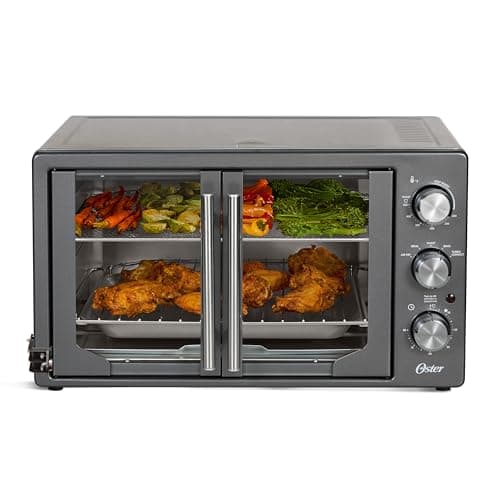
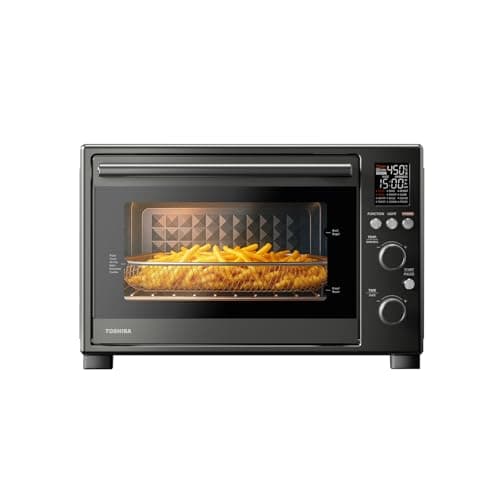
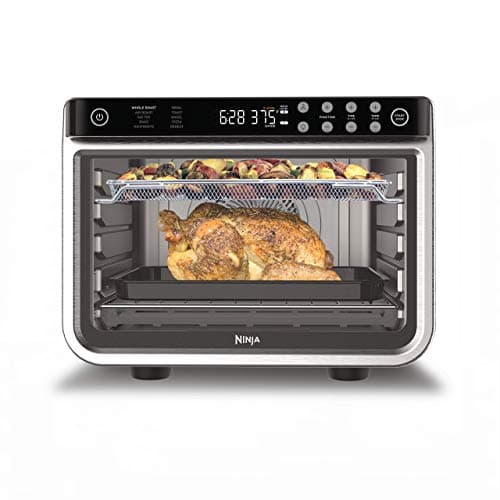
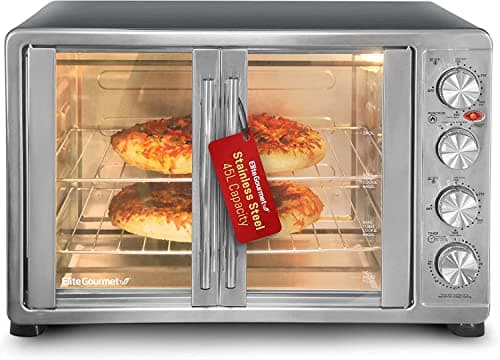
The Elite Gourmet French Doortops the list because it publishes the largest interior here by a wide margin — 47.5 quarts, stated as a figure and behind doors that barely need clearance to open. The Ninja DT201 earns its place on the other axis: two genuine cooking levels and a published 1,800-watt draw, so it cooks two trays at once and you know exactly what it costs to run. Between them sit the Oster, on a plainly published 42 liters, and the Toshiba, on a big cavity and a thin paper trail.
Reading the order
The Oster 42L French Dooris second because 42 liters published, with air fry and the same door ergonomics as the Elite Gourmet, is an enormous amount of measurable oven for well under two hundred dollars — it loses to the Elite Gourmet only on raw stated volume. The Toshiba ChefFry takes third on a genuinely large cavity in the mid price band, held back by a documentation gap: no published wattage or interior figure we could find, so everything we can tell you comes from listing copy. The Ninja DT201is fourth here and first almost everywhere else on the site, because for a big oven its footprint is the catch — it stops being a countertop appliance and starts being furniture — but its two levels and published power are exactly what a batch cook wants.
The trade nobody tells you about big ovens
Heating more air costs more time and, over the year, more money. A 42- or 47-quart cavity takes noticeably longer to reach temperature than a 25-quart one whatever the element does, and the largest ovens here publish no wattage, so we print no running cost for them rather than a guessed one. If you genuinely cook in volume, that is a fair trade for the room. If most of what you make is for one or two, it is the exact inefficiency a countertop oven is supposed to fix, and a smaller oven is the smarter buy. Our sizing guide walks through the math by household.
One more large-cavity option sits just above the two-hundred mark and is worth knowing about precisely because of what it does not publish: the Toshiba ChefFry 12-in-1 competes on interior room rather than documentation, and its review exists largely to record how much of its specification is listing copy rather than a manual.
How we picked
Ovens we claim to have cooked in: 0
Everyone in this category tells you they roasted forty chickens. We have roasted none, and we say so. Here is what we do instead: read the manufacturer's manual and spec sheet, record the published wattage, interior volume, temperature range and warranty term, work out what the oven costs to run for an hour and for a year, show the arithmetic so you can redo it with your own electricity rate, and cite all of it. Where a brand publishes no wattage, we print no running cost rather than borrowing a number from a similar model. Prices come live from Amazon's API and disappear rather than go stale.
The scores above are judgments from that documented research — not test results. One of the five metrics is Documentation: whether the manufacturer will tell you what its oven draws at all. The full rubric, including what disqualifies an oven, is published in full.