Skip to content
CC

HUB 03 · Toaster Ovens

The Best Toaster Oven Brands, Ranked by What They Publish

Fifteen brands, thirty-five ovens, and one question asked of every one of them: will the maker commit in writing to the wattage, the temperature range, the inside dimensions and the warranty term? Four brands answer all four. Five answer none.

By Stephen V.Updated How we rank
#ad

We earn a commission if you buy through our links. It does not change the price you pay, and it does not decide our picks — the scoring rubric is published in full, including what disqualifies an oven. How this works.

The short answer

Quick picks

#OvenBest forScorePrice
01
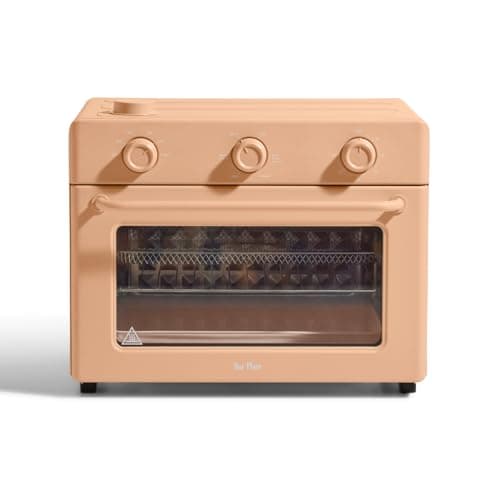
Our Place Our Place Large Wonder Oven (6-in-1, 28 L)
Our Place Large Wonder Oven (6-in-1, 28 L)

The Pro's cavity at the standard oven's controls

1,700 W
8.2
$245.00Amazon
02
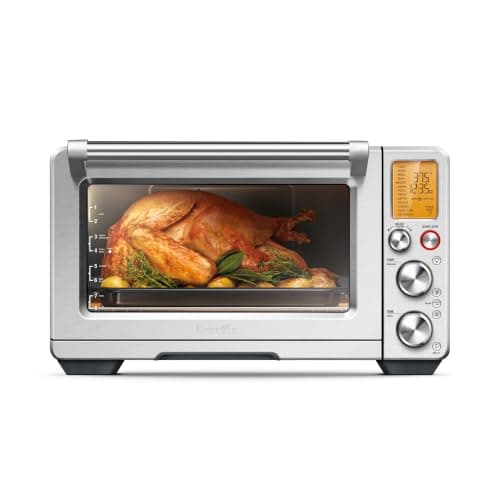
Breville Breville Smart Oven Air Fryer Pro (BOV900BSS)
Breville Smart Oven Air Fryer Pro (BOV900BSS)

The one to buy if you will keep it a decade

1,800 W
8.5
$399.95Amazon
03
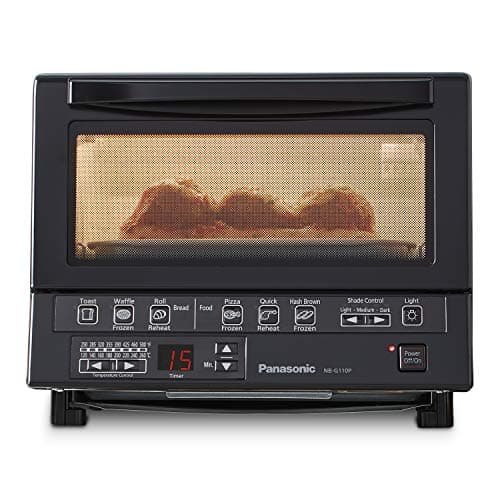
Panasonic Panasonic FlashXpress Toaster Oven (NB-G110P)
Panasonic FlashXpress Toaster Oven (NB-G110P)

The best-specified small oven here

1,300 W
7.8
$149.99Amazon
04
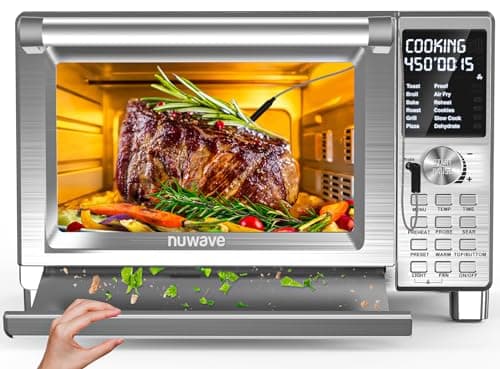
Nuwave Nuwave Bravo XL Pro Air Fryer Toaster Oven (30 Qt, with probe)
Nuwave Bravo XL Pro Air Fryer Toaster Oven (30 Qt, with probe)

The most oven around a probe for the money

1,800 W
7.7
$219.99Amazon
05
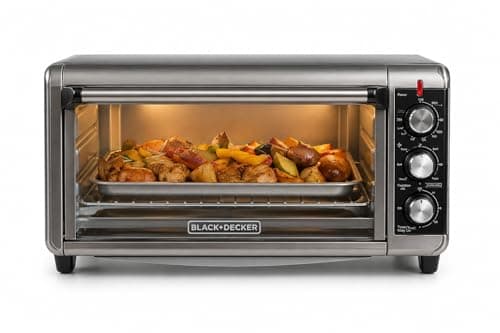
BLACK+DECKER BLACK+DECKER 8-Slice Extra Wide Convection Toaster Oven (TO3250XSB)
BLACK+DECKER 8-Slice Extra Wide Convection Toaster Oven (TO3250XSB)

Mid-size convection with dials and a published wattage

1,500 W
7.2
$86.87Amazon
06
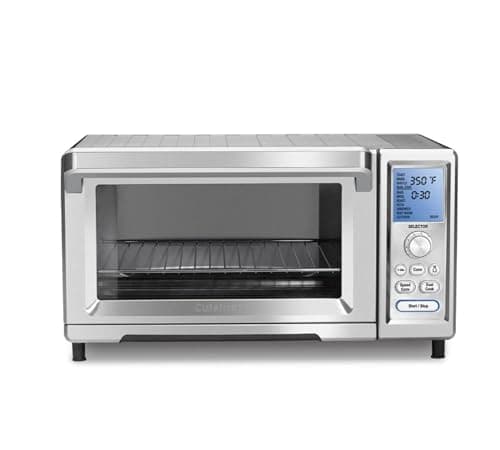
Cuisinart Cuisinart Chef's Convection Toaster Oven (TOB-260N1)
Cuisinart Chef's Convection Toaster Oven (TOB-260N1)

The best-documented interior in the category

1,800 W
8.6
$299.95Amazon

#ad · Prices pulled live from the Amazon Product API, last checked October 20, 2026. Where we have no verified live price we show none — we would rather leave a gap than print a number that has gone stale. The wattage column is what the manufacturer publishes; “not published” means exactly that, and we have not estimated one. Scores are ours, compiled from published specifications, and are not test results.

The short version

If you want to know what you are buying before you buy it, buy Our Place. Across all three of its ovens it publishes the rated power, the temperature range, the timer range, the capacity, the interior dimensions, the exterior dimensions, the weight, the rack count and the warranty term — and it publishes the limits too, including a 200°F floor and a 60-minute timer that rule out proofing and drying. No other brand in this catalog publishes a complete interior and exterior dimension set for every model it sells, and the Large Wonder Oven is the most completely documented oven on this site.

Breville is second and the gap is interesting rather than small. Breville prints a rating line in its own instruction book for every model we hold — five out of five, which no other multi-model brand here manages — and then publishes no interior dimension for a single one of them. You can calculate exactly what a Breville costs to run and you cannot find out whether your pan fits.

Panasonic has one oven in this catalog and specifies it completely, down to millimetres and a 250–500°F band that is the highest published ceiling on the site. Nuwave is the only brand that publishes innerdimensions and a probe target range, and the only one whose wattage we could find solely in its own Q&A answer rather than its manual. BLACK+DECKER earns fifth for two unique disclosures that work against its own marketing. Cuisinart is sixth and wildly inconsistent between models.

This page ranks publishers, not cooking. We have not cooked in any of these ovens, and a brand that documents well can still build an oven you dislike. What a documentation record does predict is how much of your purchase is a guess.

The four questions, asked of every brand

Every oven in this catalog was checked against four figures that a buyer can act on before purchase, and each had to come from the manufacturer's own page or manual:

  • A rated power. Without it there is no honest running cost and no amperage check for your circuit.
  • A temperature range. The floor matters more than the ceiling, because proofing, holding and dehydrating all live below 200°F.
  • An interior figure. A volume is useful; dimensions are better, because pan fit is the single most common reason one of these goes back.
  • A warranty term. The number of years the maker will stand behind it, in writing, on its own site.
BrandModels hereRated powerTemperature rangeInterior figureWarranty term
Our Place3All 3All 3All 3, dimensions and volumeAll 3
Breville5All 5, four of them in the manual2 of 52 of 5, volume only2 of 5
Panasonic1YesYes, 250–500°FYes, 7.2 quartNot published
Nuwave1Q&A answer only, not the manualYes, plus a probe target rangeYes — inner and outer dimensionsYes, in the manual
BLACK+DECKER42 of 4 for the exact SKUNot publishedPan-fit claims, including one with handles2 of 4
Cuisinart42 of 4Not published1 of 4, 0.95 cubic feetNot on the brand's own pages
Hamilton Beach41 of 41 of 4Slice counts and pan-fit claimsListing data only
Midea1Not publishedYes, 100–450°FCapacity and exteriorNot published
Proctor Silex1YesYes, but stated twice at two floorsNot publishedYes — 3 years, the longest here
SharkNinja (Ninja)62 of 6Not publishedCapacity claims, not figuresListing data only
Instant Brands1Not publishedYes, 170–450°FYes, 19 QT / 18 LNot published
Oster · Elite Gourmet · Emeril · KitchenAid · TOSHIBA1 eachNoneNoneVolume on two of the fiveNone

The finding: price does not buy documentation

The brand that publishes the most is a direct-to-consumer cookware company with three ovens. The brand that publishes the longest warranty term — three years, in writing, on its own product page — is Proctor Silex, whose oven is the cheapest thing on this site. And the most expensive brand in the catalog publishes a warranty page that declines to state a term at all: Breville's own support page says to find the length on “the product page of the website for your country”, which on the models we hold yields one year on one and two years on another.

Run the same test on the feature-led brands and it inverts completely. SharkNinja sells six of the thirty-five ovens here and publishes a rated power for two of them, no temperature range for any, and interior “capacity claims” — two 12-inch pizzas, two cooking levels — rather than a dimension you could measure a pan against. Emeril publishes twenty-four cooking functions on one oven and neither a wattage nor a temperature range, which is the finding that review exists to state: a function is a stored time-and-temperature pair, so twenty-four of them on an oven with no published range is twenty-four words on a panel.

The two disclosures that earned BLACK+DECKER its place

BLACK+DECKER publishes a rated power for only half the SKUs we hold and no temperature range for any of them, which should put it near the bottom. It places fifth because of two statements that no other brand here makes, both of which cost it something.

The first is in the TO3250XSB manual: temperatures in the oven will be lower than your set point, by design, because of the heating elements used. That is a brand telling you its dial is not a thermometer, in a category built on the opposite impression. The second is its pan-fit claim, which states a 13 by 9-inch pan fits with the handles — the only fit claim on this site that counts the part of the pan people forget.

Both are the kind of disclosure that only exists because somebody chose to write it down. That is also why the same oven wins our broiler ranking and appears in the worth-it guide.

How to use a brand ranking without overusing it

Documentation is one of the five metrics behind every score on this site, not the only one. A brand record tells you how much of the purchase is verifiable; it does not tell you the oven is good. Three ways it is genuinely decisive:

If you have a specific pan or a specific shelf, shop the brands that publish dimensions. Our Place and Nuwave publish interiors; Breville and SharkNinja do not, at any price.

If you need a temperature below 200°F— proofing, holding, drying — shop the brands that publish a floor. Nuwave publishes 50°F, Our Place's Pro publishes 80°F and a 24-hour timer, Breville publishes 120°F on two models. Everything else is silent, and a silent floor is not a low floor. Our bread ranking turns entirely on this.

If the oven will run daily for years, read the warranty before the feature list. The published terms here run from one year to three, and two thirds of this catalog publishes no term at all.

In detail

The picks, in full

01
Our Place Our Place Large Wonder Oven (6-in-1, 28 L)

The Pro's cavity at the standard oven's controls

Our Place Large Wonder Oven (6-in-1, 28 L)

Interior and exterior dimensions publishedThree rack levels and a 12-inch pizza published1,700 W with a 200°F floor and a 60-minute timer
8.2/10

Dimension for dimension this is the Wonder Oven Pro: Our Place publishes the same 13.75 x 13 x 7.75 in. interior, the same 16.75 x 13.25 x 13 in. exterior, the same 28 L and the same three rack levels for both. What it does not get is the Pro's control board — the floor stays at 200°F and the timer still stops at 60 minutes — and it draws the Pro's 1,700 W to do it. Cheapest route to the big Wonder Oven cavity, and the wrong one if a published low temperature is why you are shopping.

Power
9
Usable space
8.5
Footprint
7.5
Documentation
8
Value
8

What it gets right

  • The Wonder Oven Pro's published cavity for substantially less money: Our Place prints an identical 13.75 x 13 x 7.75 in. interior, an identical 16.75 x 13.25 x 13 in. exterior, 28 L and three rack levels for both models, and says so itself in its own comparison table
  • More than doubles the standard Wonder Oven's published fit — six slices of toast per wire rack against four, a 12-inch pizza against nine, and three levels against two — in a box 16.75 inches wide
  • Our Place publishes a wattage, a voltage, a temperature range, a timer range, a capacity, interior and exterior dimensions, a weight, a rack count, the modes, the materials and a per-accessory dimension and weight, which is more of the spec sheet than most brands print at any price

What it doesn't

  • It draws the Pro's 1,700 W to deliver the standard oven's 200°F floor and 60-minute timer, so there is no proofing, no dehydrating and no long cook — the electricity bill of the capable model without the capability
  • The stated 28 L does not follow from the interior Our Place prints beside it: 13.75 x 13 x 7.75 in. is about 1,385 cubic inches, or roughly 22.7 L, and Amazon rounds the stated figure further still to “30 Qt”
  • The same product page gives three figures two different ways — 16.75 in. and 16.7 in. of exterior width, a 4.5 lb and a 5.5 lb chicken, 4–6 and 1–2 teaspoons of steam water — and no manual is published to settle any of them
  • Hand wash only: Our Place's own care instructions say to avoid the dishwasher for the accessories, and the bake pan's release coating is ceramic rather than PTFE

What it costs to run

About 31.2¢ an hour at full draw, or $56.90 a year at 30 minutes a day, 365 days a year and 18.34¢ per kWh.

1,700 W ÷ 1000 × 182.5 h × 18.34¢ = $56.90

1700w at 120V, published by Our Place in the “Wattage & Voltage” row of the Getting Technical block on its own Large Wonder Oven product page. As with the Wonder Oven Pro, Our Place links no manual PDF for this model, so this is a product-page figure and not a rating-plate one — the standard Wonder Oven is the only model in the line whose rating line we have read. This is an upper bound: the elements cycle off once the cavity is at temperature, and no manufacturer publishes a duty cycle, so we compute at full rated draw rather than invent a correction factor. The full method is published.

Skip this if…

…you are buying a bigger Wonder Oven in order to proof dough, dehydrate or run anything past the hour mark. This model's published floor is 200°F and its timer stops at 60 minutes, exactly like the standard oven, and no mode on the dial changes either — only the Pro publishes the 80°F floor and the 24-hour timer.

$245.00on Amazon

Price last checked October 20, 2026. Prices move constantly — Amazon's at checkout is the one that counts.

#ad · we may earn a commission from this link to Our Place Large Wonder Oven (6-in-1, 28 L)

02
Breville Breville Smart Oven Air Fryer Pro (BOV900BSS)

The one to buy if you will keep it a decade

Breville Smart Oven Air Fryer Pro (BOV900BSS)

Wattage published in the manualWidest footprint here
8.5/10

The most completely documented oven in the category, and the only one at any price whose manufacturer publishes a rated wattage, an interior volume and a full element layout in the same place. You pay roughly four times the category floor for that, and about a third of the premium is the documentation itself.

Power
9.5
Usable space
9.5
Footprint
6
Documentation
10
Value
7.5

What it gets right

  • Breville publishes the rated wattage, the interior volume, the exterior dimensions and the element count — almost nobody else in this category publishes all four
  • 1 cubic foot of interior is genuinely a small oven, not a large toaster: a 14-inch pizza or a 9x13 pan fits without diagonal gymnastics
  • Element IQ drives the six elements independently rather than switching them in banks, which is the actual mechanical difference behind the price

What it doesn't

  • 21.4 inches wide is wider than most upper-cabinet clearances allow you to slide it under
  • At the current price it costs more than several full-size wall ovens' worth of countertop convection you could assemble from cheaper parts
  • Thirteen functions is nine more than most households use; the presets are the same elements at different set points

What it costs to run

About 33.0¢ an hour at full draw, or $60.25 a year at 30 minutes a day, 365 days a year and 18.34¢ per kWh.

1,800 W ÷ 1000 × 182.5 h × 18.34¢ = $60.25

1800 W is the rating plate figure in Breville's own instruction book, not a marketing headline. This is an upper bound: the elements cycle off once the cavity is at temperature, and no manufacturer publishes a duty cycle, so we compute at full rated draw rather than invent a correction factor. The full method is published.

Skip this if…

…your counter is under 24 inches deep with the backsplash, or you are buying an oven mainly to make toast and reheat pizza — nothing about this machine's price is recovered on those two jobs.

$399.95on Amazon

Price last checked October 20, 2026. Prices move constantly — Amazon's at checkout is the one that counts.

#ad · we may earn a commission from this link to Breville Smart Oven Air Fryer Pro (BOV900BSS)

03
Panasonic Panasonic FlashXpress Toaster Oven (NB-G110P)

The best-specified small oven here

Panasonic FlashXpress Toaster Oven (NB-G110P)

Fully specified by the manufacturerSmall interior
7.8/10

The most completely documented oven on this entire site relative to its size: 1,300 W, 120 V, 60 Hz, 7.2 quarts, 250–500°F, exact millimeter dimensions and a stated weight. Panasonic publishes all of it, and almost nobody else does.

Power
7
Usable space
5
Footprint
9.5
Documentation
10
Value
7.5

What it gets right

  • Panasonic publishes power, voltage, frequency, capacity, temperature range, dimensions and weight — the complete set, which no other brand here manages
  • 1,300 W and infrared elements means no preheat in the usual sense
  • 500°F ceiling in a 7.2-quart cavity is a genuinely high heat density

What it doesn't

  • 7.2 quarts is small — four slices, and a 9-inch pizza is optimistic
  • The infrared elements are not adjustable in the way a multi-element oven's are
  • Expensive for its size, and you are paying partly for the engineering discipline

What it costs to run

About 23.8¢ an hour at full draw, or $43.51 a year at 30 minutes a day, 365 days a year and 18.34¢ per kWh.

1,300 W ÷ 1000 × 182.5 h × 18.34¢ = $43.51

1300 W at 120 V / 60 Hz, published by Panasonic as a power consumption figure with the supply conditions stated — the most complete electrical specification of any oven on this site. This is an upper bound: the elements cycle off once the cavity is at temperature, and no manufacturer publishes a duty cycle, so we compute at full rated draw rather than invent a correction factor. The full method is published.

Skip this if…

…you need to cook for more than two. This is a beautifully specified small oven and it is still a small oven; no amount of documentation adds capacity.

$149.99on Amazon

Price last checked October 20, 2026. Prices move constantly — Amazon's at checkout is the one that counts.

#ad · we may earn a commission from this link to Panasonic FlashXpress Toaster Oven (NB-G110P)

04
Nuwave Nuwave Bravo XL Pro Air Fryer Toaster Oven (30 Qt, with probe)

The most oven around a probe for the money

Nuwave Bravo XL Pro Air Fryer Toaster Oven (30 Qt, with probe)

Interior dimensions publishedWattage from a brand Q&A answer, not the manual
7.7/10

A 30-quart, four-rack-level convection oven with an integrated temperature probe that stops the cook at a set internal temperature, and a maker that publishes its interior and exterior dimensions, weight, capacity, temperature range and warranty term — most of which the Ninja probe ovens do not. The 1,800-watt figure comes from a Nuwave support answer on its own product page rather than the manual's rating line, and we say so.

Power
8
Usable space
9
Footprint
6
Documentation
7
Value
8.5

What it gets right

  • An integrated probe that stops the oven at a target between 50°F and 212°F — per the manual, not a preset that merely displays a reading
  • Nuwave publishes both outer and inner dimensions, weight, capacity and a 50–500°F range; its own FAQ states a standard 13 x 9 x 3 inch pan fits
  • Four rack levels in a 30-quart cavity — Nuwave's own figures are a 10 lb chicken or two 13-inch pizzas — for well under either probe-equipped Ninja

What it doesn't

  • The 1,800 W figure is a Nuwave support answer on the product page, not a rating line in the manual or a row in the spec table
  • 12 functions plus 100 recipe presets is deep into the territory where the count is marketing
  • One-year limited warranty, valid only for the original purchaser and only in the continental US per the manual

What it costs to run

About 33.0¢ an hour at full draw, or $60.25 a year at 30 minutes a day, 365 days a year and 18.34¢ per kWh.

1,800 W ÷ 1000 × 182.5 h × 18.34¢ = $60.25

1800 watts, or 15 amps, as stated by Nuwave in its own answer (dated 06/30/2026) to a customer question on the Bravo XL Pro product page. The model 20813 owner's manual and the page's specification table give the supply as 120 V but print no wattage, so this is brand-supplied rather than a rating-plate reproduction. This is an upper bound: the elements cycle off once the cavity is at temperature, and no manufacturer publishes a duty cycle, so we compute at full rated draw rather than invent a correction factor. The full method is published.

Skip this if…

…you do not roast to an internal temperature. Everything this oven does better than a cheaper 30-quart box is the probe and the four rack levels; if you mostly air fry vegetables and reheat, a smaller oven with a rating-plate wattage is the better-documented buy.

$219.99on Amazon

Price last checked October 20, 2026. Prices move constantly — Amazon's at checkout is the one that counts.

#ad · we may earn a commission from this link to Nuwave Bravo XL Pro Air Fryer Toaster Oven (30 Qt, with probe)

05
BLACK+DECKER BLACK+DECKER 8-Slice Extra Wide Convection Toaster Oven (TO3250XSB)

Mid-size convection with dials and a published wattage

BLACK+DECKER 8-Slice Extra Wide Convection Toaster Oven (TO3250XSB)

Wattage published in the manualNo air-fry setting or basket
7.2/10

A dial-controlled convection toaster oven whose maker publishes the wattage, the dimensions, the weight and a two-year warranty on its own page, and prints the rating line in the manual — 1500 W, 120 V, 60 Hz. Eight slices, a 12-inch pizza and a 9 x 13 pan with handles, for under a hundred dollars. It is a convection baker, not an air fryer: there is no basket and no air-fry setting.

Power
7
Usable space
8
Footprint
5
Documentation
7.5
Value
8.5

What it gets right

  • BLACK+DECKER publishes the wattage, dimensions, weight and a two-year warranty on its own page, and the manual reproduces the rating line — more than the Cuisinart it replaces ever published
  • Extra-wide cavity: a 13 x 9 pan with handles goes in, which is the pan most kitchens already own
  • Dials and a mechanical timer, so there is no capacitive panel or control board to retire the oven while the elements are fine

What it doesn't

  • 22 inches wide is the widest oven in its price band — measure the counter and the cabinet clearance first
  • No air-fry basket and no air-fry mode; the fan is for convection baking, and crisping is not what this oven is built for
  • BLACK+DECKER's own listing copy warns that oven temperatures run lower than the set point by design, which is a real thing to know for bread

What it costs to run

About 27.5¢ an hour at full draw, or $50.21 a year at 30 minutes a day, 365 days a year and 18.34¢ per kWh.

1,500 W ÷ 1000 × 182.5 h × 18.34¢ = $50.21

1500 W 120 V~ 60 Hz is the rating line printed in BLACK+DECKER's own use and care manual for the TO3250XSB, and 1500W is repeated in the specifications block on its product page. This is an upper bound: the elements cycle off once the cavity is at temperature, and no manufacturer publishes a duty cycle, so we compute at full rated draw rather than invent a correction factor. The full method is published.

Skip this if…

…you want to air fry. This is a convection baker with a wide cavity and a published wattage; the crisping the rest of this site talks about needs a basket and a fast fan, and this oven has neither.

$86.87on Amazon

Price last checked October 20, 2026. Prices move constantly — Amazon's at checkout is the one that counts.

#ad · we may earn a commission from this link to BLACK+DECKER 8-Slice Extra Wide Convection Toaster Oven (TO3250XSB)

06
Cuisinart Cuisinart Chef's Convection Toaster Oven (TOB-260N1)

The best-documented interior in the category

Cuisinart Chef's Convection Toaster Oven (TOB-260N1)

Wattage and volume both publishedDeep cabinet footprint
8.6/10

The only oven here whose manufacturer publishes both a wattage and an interior volume in cubic feet on the same page. 0.95 cubic feet at 1,800 W, with a stated list of what fits — a 13-inch pizza, a 9x13 pan, nine slices.

Power
9.5
Usable space
9.5
Footprint
5.5
Documentation
10
Value
8.5

What it gets right

  • 0.95 cubic feet published in the same place as the 1,800 W rating, which makes it the easiest oven here to compare on paper
  • Within 5% of the Breville Pro's interior for a good deal less money
  • Fifteen functions including a genuine dual-cook mode that runs two temperatures in sequence

What it doesn't

  • 530 mm deep is a lot of counter — deeper than the Breville Pro
  • Fifteen functions on a backlit panel is a lot of interface between you and heat
  • Cuisinart lists this model as discontinued on its own site, so availability moves around

What it costs to run

About 33.0¢ an hour at full draw, or $60.25 a year at 30 minutes a day, 365 days a year and 18.34¢ per kWh.

1,800 W ÷ 1000 × 182.5 h × 18.34¢ = $60.25

1800 watts as published by Cuisinart on the TOB-260N1 product page, alongside the 0.95 cubic foot interior figure. This is an upper bound: the elements cycle off once the cavity is at temperature, and no manufacturer publishes a duty cycle, so we compute at full rated draw rather than invent a correction factor. The full method is published.

Skip this if…

…your counter is shallow. At 530 mm deep this is the deepest oven on the list, and depth is the dimension people forget to measure until the door will not clear the backsplash.

$299.95on Amazon

Price last checked October 20, 2026. Prices move constantly — Amazon's at checkout is the one that counts.

#ad · we may earn a commission from this link to Cuisinart Chef's Convection Toaster Oven (TOB-260N1)

How we picked

Ovens we claim to have cooked in: 0

Everyone in this category tells you they roasted forty chickens. We have roasted none, and we say so. Here is what we do instead: read the manufacturer's manual and spec sheet, record the published wattage, interior volume, temperature range and warranty term, work out what the oven costs to run for an hour and for a year, show the arithmetic so you can redo it with your own electricity rate, and cite all of it. Where a brand publishes no wattage, we print no running cost rather than borrowing a number from a similar model. Prices come live from Amazon's API and disappear rather than go stale.

The scores above are judgments from that documented research — not test results. One of the five metrics is Documentation: whether the manufacturer will tell you what its oven draws at all. The full rubric, including what disqualifies an oven, is published in full.

Questions

Frequently asked

What is the best toaster oven brand?
On documentation, Our Place — it is the only brand here that publishes the power, the range, the interior and exterior dimensions, the weight and the warranty for every model it sells. On engineering reputation the answer most people expect is Breville, and Breville does publish a rating line in its own instruction book for all five models we hold; it simply will not tell you how big the inside is. Those are different questions and this page only answers the first one honestly, because the second would require cooking we have not done.
Is Breville worth the money?
On what can be verified before purchase: you are paying for a published 1,800-watt rating line in the manual, a long function list with a per-function temperature table on the upper models, and a brand that will not state its warranty term on its warranty page. You are not paying for a published interior dimension, because Breville publishes none on any model here. The BOV900 review lays out exactly what is and is not published, and the BOV845-versus-BOV900 page covers which one to buy if it is going to be a Breville.
Which brand has the longest warranty?
Proctor Silex, with a three-year limited warranty published on its own product page — and it sells the cheapest oven on this site. BLACK+DECKER publishes two years on two of its four models here, and the only two-year term on a premium oven belongs to Breville's Joule Oven Air Fryer Pro. Everything else that publishes a term at all publishes one year. The full warranty picture, including what the terms exclude, is here.
Why isn't Cosori, KitchenAid or Cuisinart's air fryer line ranked higher?
Because of what they publish, which in these cases is very little. The KitchenAid oven we hold publishes a model number and no wattage. The Cuisinart TOA-70 has no manufacturer spec page we could find at all, while the Cuisinart TOB-260N1 publishes 1,800 watts and 0.95 cubic feet — the best-documented interior volume in the catalog. Same brand, opposite records, which is why this page scores brands per-model rather than by reputation. Cosori is not here because no Cosori listing resolved to a model we could source.
Does a published wattage actually matter?
It is the figure the most else depends on. Without it there is no running cost, no cost-per-hour comparison and no amperage check — and a third of this catalog does not publish one, which means for a third of these ovens we print no running cost rather than borrowing a number from a similar model. Every published wattage on this site is in one table here.

Keep reading

Receipts

Sources

We have not cooked in these ovens and we do not pretend to have. Specifications come from the manufacturer's own published documents; electricity rates come from the US Energy Information Administration; prices come from the live Amazon API. Where a figure is not published, the page says “not published” rather than guessing. Read the full method.