HUB 06 · Guides & Answers
Can You Bake Cookies in a Toaster Oven?
Yes. The honest constraints are the pan, the fan and the thermostat, and all three are things manufacturers either publish or conspicuously do not — so this is the published version of the answer rather than the encouraging one.
We earn a commission if you buy through our links. It does not change the price you pay, and it does not decide our picks — the scoring rubric is published in full, including what disqualifies an oven. How this works.
The short answer
Yes — and the number of cookies, not the quality, is what a countertop oven costs you. The ceiling across every brand in this catalog is a 9 x 13 inch quarter-sheet, which is around a dozen standard drop cookies with room to spread. Exactly one manufacturer publishes a cookie figure of its own: SharkNinja states up to twenty cookies for the Ninja DT551, which has a two-level cavity. Nobody else commits to a number, so nobody else gets one from us.
Three things decide whether the result is good, and all three are checkable before you buy.
1. The pan is the real constraint
A standard half-sheet is 18 by 13 inches and a quarter-sheet is 9 by 13. Every published fit claim in this catalog is a quarter-sheet or smaller: Cuisinart publishes a 9 x 13 for the TOB-260N1, Breville publishes a 9 x 13 for the BOV900, BLACK+DECKER publishes a 13 x 9 pan with handlesfor the TO3250XSB — which is the most useful version of the claim, because handles are what actually stop a pan going in — and Hamilton Beach publishes an 8 x 8 for the 31403.
So the plan for cookies in a countertop oven is batches on a quarter-sheet, and the practical question is how many batches your evening has room for rather than how many cookies the oven holds. Every published interior dimension against real pan sizes.
2. The fan changes the bake, and you may not want it
Convection strips the still-air layer off the surface of the dough, which browns the edges faster and sets the top sooner. For a chewy cookie that is usually the wrong trade, because the edge sets before the middle has spread. The published fix is the one every convection source gives: drop the set point and shorten the time rather than keeping both. The conversion chart is here with the arithmetic shown.
Worth knowing that the fan is not always optional and not always on. Most ovens in this catalog publish a function list rather than a fan control, which means you get the fan the preset gives you. What separates convection from the air-fry setting and why five different names describe two different things.
3. The thermostat is the part nobody specifies
Cookies are the most thermostat-sensitive thing most people bake — a twenty-degree error is the difference between chewy and crisp, and twelve minutes is not long enough for an oven to average out its own swings. Not one manufacturer in this catalog publishes a thermostat tolerance.
One publishes something better than a tolerance, which is a warning. BLACK+DECKER's own use and care manual states that temperatures in the oven will be lower than your set point, because the dial has been calibrated around its heating elements rather than around a thermometer. If you are baking cookies in one, that sentence is worth more than any spec sheet: put a thermometer in the cavity, learn the offset once, and bake to the thermometer afterwards.
The rack position, which is free
A countertop oven is small enough that rack height changes the result materially, and the brands do not agree on their own numbering — position 1 is the top on a Breville and the bottom on a Nuwave and an Our Place. For baking, the published guidance across this catalog points low rather than middle, because the top element is close. Every published per-function rack map, across six ovens and five brands.
One more published detail that applies directly to a cookie sheet: BLACK+DECKER's manual asks that food and baking dishes stay more than 1½ inches clear of the top elements, and that food not extend beyond the edges of the bake pan. On a tray of cookies in a small cavity, both of those are easy to get wrong and both are stated.
What we are not going to tell you
A time or a temperature for your cookies. We have baked none of these, there is no test kitchen behind this site, and the figure that matters is the one on your recipe adjusted for your oven's measured offset. What this page can tell you is which ovens publish a pan you can plan a batch around, which publish a cookie count (one), and which publishes a candid note about its own dial (also one).
If baking is the main reason you are buying, the batch-baking ranking is the page to read next — it ranks on published pan fit, element control and warranty term, and it states the half-sheet problem plainly. The bread ranking is here if the dough is yeasted rather than dropped.
Cakes are the other half of this question and they fail differently. A cookie is flat, so the constraint is the pan footprint; a cake rises, so the constraint is the clear height above it — and BLACK+DECKER is the only maker here that publishes a figure for that gap, an inch and a half from the top elements. Which ovens publish an interior height at all is a much shorter list than the price tags suggest.
What to look for if cookies are the point
A published pan claim with the handles accounted for. One maker in this catalog publishes the claim that way, and it is the only one that answers the question you will actually have while holding a tray.
Interior height, if you can get it. Cookies do not need much, but the top element does need clearance, and 1½ inches is the only published figure anybody gives.
Element control over function count. Independently driven elements are the mechanical answer to a tray that browns at the back and not the front. Six of them, driven separately, is what the premium in this category actually buys.
Budget for an oven thermometer regardless. It is a few dollars against an unspecified thermostat, and it is the single cheapest improvement available to anybody baking in a countertop oven.
The hardware
The ovens this page is about
The ovens referred to above, with prices pulled live from Amazon and dated on every card. Full rankings live in the roundups linked from this page.
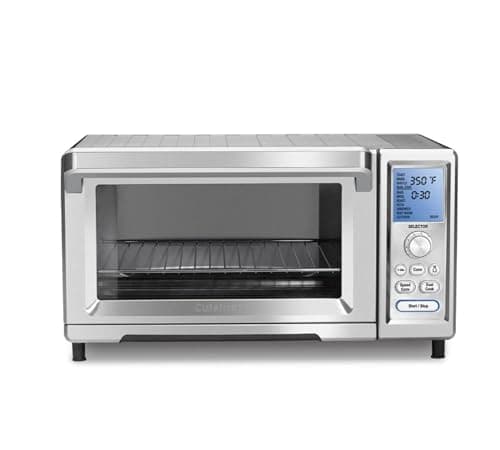
1,800 W
Cuisinart Chef's Convection Toaster Oven (TOB-260N1)
The only oven here whose manufacturer publishes both a wattage and an interior volume in cubic feet on the same page. 0.95 cubic feet at 1,800 W, with a stated list of what fits — a 13-inch pizza, a 9x13 pan, nine slices.
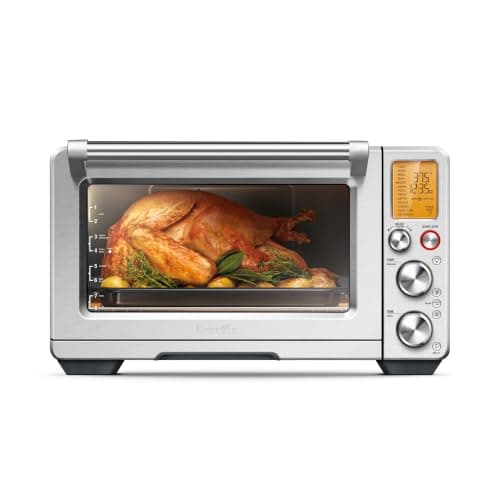
1,800 W
Breville Smart Oven Air Fryer Pro (BOV900BSS)
The most completely documented oven in the category, and the only one at any price whose manufacturer publishes a rated wattage, an interior volume and a full element layout in the same place. You pay roughly four times the category floor for that, and about a third of the premium is the documentation itself.
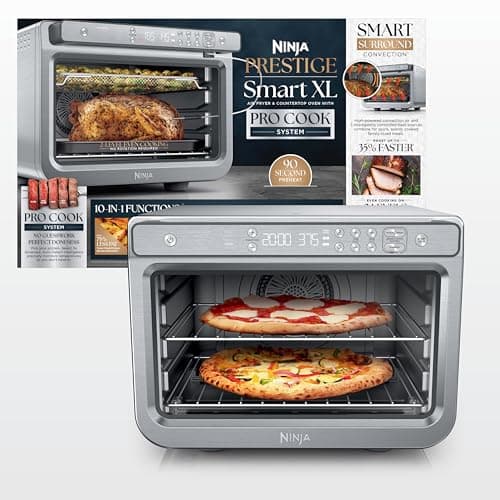
Wattage not published
Ninja Prestige Smart XL with Pro Cook System, 10-in-1 (DT551)
The only two-level XL Ninja cavity still on sale, and the one that has an integrated thermometer in it. The probe-less version of this oven is discontinued, so the question is no longer whether the sensor is worth a premium over a stablemate — it is whether it is worth paying more than a French-door Ninja or a documented Breville-adjacent box. Worth it if you roast to internal temperature often; hard to justify if you mostly cook trays.
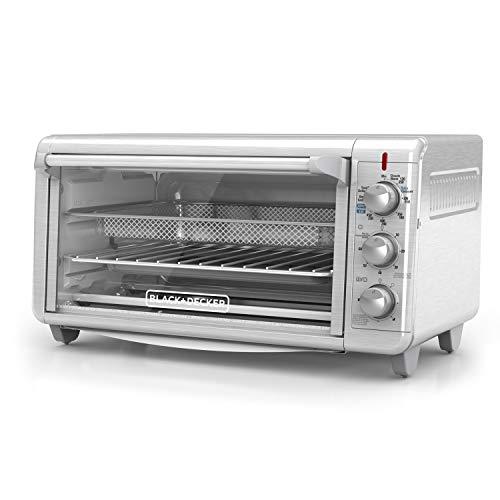
1,500 W
BLACK+DECKER Crisp 'N Bake Extra Wide 8-Slice Air Fry Toaster Oven (TO3265XSSD)
The extra-wide 8-slice BLACK+DECKER with its numbers printed: 1,500 watts, a 250–450°F band and a 17-litre interior, all in the listing's own specification block, on an oven you drive with knobs. It takes a 9 x 13 pan with handles, eight slices or a 12-inch pizza, and unlike the TO3250XSB it replaces it air fries, with the basket in the box.
#ad · As an Amazon Associate we earn from qualifying purchases.
Questions
Frequently asked
How many cookies fit in a toaster oven?
Should I use convection or bake for cookies?
Why do my cookies burn on the bottom in a toaster oven?
Can you bake cookies on foil or parchment in a toaster oven?
What is the best countertop oven for cookies?
Keep reading
Related
- The best ovens for a home bakeryRanked on published pan fit, if cookies are going to be sold.
- The convection conversion chartAdjusting a recipe for a fan, with the arithmetic shown.
- Which rack position to useThe free fix for a tray that browns unevenly.
- What pans fit in a toaster ovenWhether your existing sheet goes in at all.
- The best countertop ovens for breadIf the dough is yeasted rather than dropped.
Receipts
Sources
- Cuisinart — Chef's Convection Toaster Oven TOB-260N1 product page
- Breville — Smart Oven Air Fryer Pro (BOV900) product page, capacity claim
- BLACK+DECKER — Extra-Wide 8-Slice Toaster Oven (TO3250XSB) product page, specifications block
- BLACK+DECKER — TO3250XSB / TO3260XSBD / TO3240XSBD use and care manual [PDF]
- Amazon listing (manufacturer-supplied copy) — Ninja DT551 stated capacity
- Hamilton Beach — Sure-Crisp Air Fryer Toaster Oven, 4 Slice, model 31403 product page
We have not cooked in these ovens and we do not pretend to have. Specifications come from the manufacturer's own published documents; electricity rates come from the US Energy Information Administration; prices come from the live Amazon API. Where a figure is not published, the page says “not published” rather than guessing. Read the full method.