HUB 06 · Guides & Answers
Which Rack Position Should You Use in an Air Fryer Oven?
Manufacturers publish a rack position for every function and practically nobody reads it. Two things fall out of collecting them: bake belongs on the bottom rack in a countertop oven, and the brands number their racks in opposite directions.
We earn a commission if you buy through our links. It does not change the price you pay, and it does not decide our picks — the scoring rubric is published in full, including what disqualifies an oven. How this works.
The short answer
Use the position your manual names for the function you selected — every oven on this page publishes one, and they are not the same across brands or even across models within a brand. If you have no manual to hand, the pattern the published figures share is: broil high, toast middle, bake and roast low, air-fry basket high-to-middle. That last one surprises people, and the bake one contradicts what a full-size oven has taught you.
Breville, three positions: the map is printed on the parts diagram
The Smart Oven Pro (BOV845) has three rack heights, and Breville prints the assignment on the labeled parts diagram at the front of the book rather than making you hunt for it:
- Top: BROIL.
- Middle: TOAST, BAGEL, PIZZA and COOKIES.
- Bottom: BAKE, ROAST, REHEAT, WARM and SLOW COOK.
Bake on the bottom is the line worth stopping at. In a full-size range you are taught to bake in the middle, because the cavity is tall and the middle is where the temperature is most even. A countertop oven is not tall: the top element is a few inches from the food, and baking in the middle browns the top of a cake long before the center is done. The bottom position is the countertop equivalent of the middle of a range. Breville adds the caveat itself — some baked goods, such as brownies or pastries, may be more suited to the middle.
The Smart Oven Air Fryer (BOV860) moves two of them
Same three heights, same chassis, and two assignments differ from its sibling. The air-fry basket goes in the top position — the book says so twice, and it is counter-intuitive for anyone expecting the basket to sit low over a drip tray. And BAGEL moves from the middle to the top, because on this model the function directs more heat on the top elements in order to brown and crisp one side more than the other, where on the BOV845 it crisps the insides of your cut bagel while only lightly toasting the outside.
Two ovens, one brand, one chassis, the same button, a different element behavior and a different published rack. That is the comparison this detail came out of.
The BOV900, eight positions, published per function
The Smart Oven Air Fryer Pro has four grooves and a reversible rack, giving — as the book puts it — two rack positions for each groove, eight in total, printed on the left-hand side of the door window. The book names one for nearly every function:
- Broil: position 1 or 2.
- Air fry: basket in position 3.
- Toast and Bagel: position 4.
- Bake, Roast and Cookies: position 6.
- Pizza: position 7, including when preheating a pizza stone.
- Proof, Slow Cook and the drip tray for dehydrating: position 8.
- Warm and Reheat: whichever position best suits the food, which is the book declining to specify.
Read the list and the numbering explains itself: broil — the function that needs to be nearest the top element — is 1 or 2, and proof and slow cook, the two that want to be furthest from it, are 8. Breville numbers from the top down. That is an inference from the assignments rather than a sentence in the book, because the diagram lives on the door window rather than in the text, but it is the only reading consistent with all eleven functions.
For two-rack cooking the book is specific and useful: in most cases, rack positions 3 and 7 or 4 and 8 will give the best results, with the instruction to avoid using the top rack position due to proximity to the heating elements — and the note that when you are using the air-fry and dehydrate baskets rather than pans, you do not need to leave space between positions at all.
Nuwave numbers from the bottom — and publishes a table
The Bravo XL Pro manual gives a rack position for every menu function, with a diagram numbered 1 at the bottom and 4 at the top:
- Toast: position 3, heat split 50/50 top and bottom, default 425°F.
- Broil: position 2 or 3, heat 100 percent from the top, default 500°F.
- Air fry: positions 1 and 3 — the basket at 4 and the baking pan at 3 in the accompanying diagram, with the pan catching drippings.
- Bake: position 1, 2 or 3. Roast: position 1. Cookie: position 2. Proof: position 2. Reheat: any.
So on a Nuwave, broil is at the higher numbers and roast is at 1. On a Breville, broil is at 1 and slow cook is at 8. The numbering runs in opposite directions, and Our Place makes it two against one: its manual states that the wire rack can be used in both rack positions 1 and 2 (bottom and top) — 1 is the bottom there too. If you have ever moved between two of these ovens and found a recipe instruction nonsensical, this is why.
The brands that publish only two or three lines
BLACK+DECKER's TO3250XSB manual gives three, and they are the three that matter: for optimal results use middle rack position for toasting, use middle or lower rack position for baking, and use top rack position for broiling — alongside the instruction to keep food or the baking dish at least 1½ inches from the top elements. That last one is the constraint that quietly decides the rack for a tall dish.
Most other ovens on this site publish nothing at all, which is one of the inputs to the Documentation score behind every ranking here. The rubric is published in full.
What to do with all that
Start from the element that is doing the work. Broiling and bagels want the top element, so they go high. Baking and roasting want even, indirect heat, so they go low, because low in a small cavity is what the middle of a big one feels like. Pizza wants bottom heat into the crust, which is why Breville puts it at 7 of 8.
Put the basket where the manual says, not where the drips would be tidiest. Air-fry baskets sit high on a Breville BOV860 and at the top of the Nuwave diagram, with a pan underneath to catch what falls. Putting the basket low and nothing beneath it is the arrangement that smokes. That page is here.
On two racks, rotate. Every book that permits two-rack cooking also tells you to swap them partway — Breville builds an alert for it into the BOV900, and Nuwave prints flip food or rotate pans halfway through the cooking cycle under most of its functions. No countertop oven is even enough between two levels to skip it.
Check the number of positions before you buy, not after. Three heights is a constraint you will notice; eight is not. It is also one of the few mechanical differences that separates otherwise identical ovens in a range, and it never appears in the headline specification.
The three ovens below are the ones whose full published rack maps are quoted above.
The hardware
The ovens this page is about
The ovens referred to above, with prices pulled live from Amazon and dated on every card. Full rankings live in the roundups linked from this page.
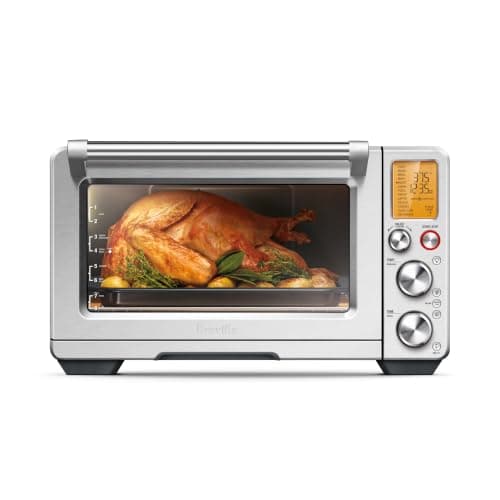
1,800 W
Breville Smart Oven Air Fryer Pro (BOV900BSS)
The most completely documented oven in the category, and the only one at any price whose manufacturer publishes a rated wattage, an interior volume and a full element layout in the same place. You pay roughly four times the category floor for that, and about a third of the premium is the documentation itself.
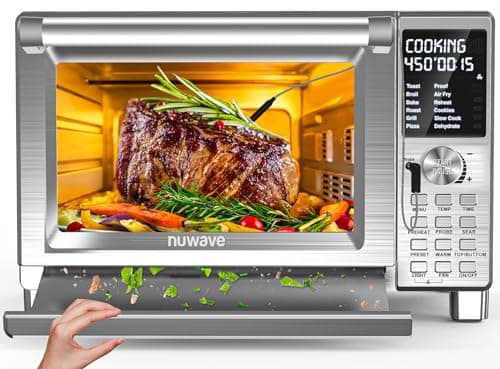
1,800 W
Nuwave Bravo XL Pro Air Fryer Toaster Oven (30 Qt, with probe)
A 30-quart, four-rack-level convection oven with an integrated temperature probe that stops the cook at a set internal temperature, and a maker that publishes its interior and exterior dimensions, weight, capacity, temperature range and warranty term — most of which the Ninja probe ovens do not. The 1,800-watt figure comes from a Nuwave support answer on its own product page rather than the manual's rating line, and we say so.
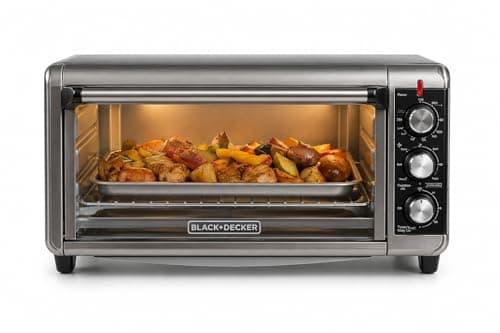
1,500 W
BLACK+DECKER 8-Slice Extra Wide Convection Toaster Oven (TO3250XSB)
A dial-controlled convection toaster oven whose maker publishes the wattage, the dimensions, the weight and a two-year warranty on its own page, and prints the rating line in the manual — 1500 W, 120 V, 60 Hz. Eight slices, a 12-inch pizza and a 9 x 13 pan with handles, for under a hundred dollars. It is a convection baker, not an air fryer: there is no basket and no air-fry setting.
#ad · As an Amazon Associate we earn from qualifying purchases.
Questions
Frequently asked
Which rack should you use to air fry in an oven?
Which rack do you bake on in a countertop oven?
Is rack position 1 the top or the bottom?
Which rack position is best for toast?
Can you use two racks in a countertop air fryer oven?
Keep reading
Related
- Breville BOV845 vs BOV860Where the bagel-rack difference above came from.
- Do these ovens need a preheat?The other instruction the manuals publish per function.
- Convection vs the air fry settingWhy the basket position changes the result.
- The best toaster ovens for toastRanked on published toast documentation, rack positions included.
Receipts
Sources
- Breville — the Smart Oven Pro (BOV845) instruction book [PDF]
- Breville — the Smart Oven Air Fryer (BOV860) instruction book [PDF]
- Breville — the Smart Oven Air Fryer Pro (BOV900) instruction book, L23 edition [PDF]
- Nuwave — Bravo XL Pro owner's manual, model 20813 [PDF]
- Our Place — Wonder Oven user manual, model APL.WDO.ESN [PDF, retailer-hosted copy]
- BLACK+DECKER — TO3250XSB / TO3260XSBD / TO3240XSBD use and care manual [PDF]
We have not cooked in these ovens and we do not pretend to have. Specifications come from the manufacturer's own published documents; electricity rates come from the US Energy Information Administration; prices come from the live Amazon API. Where a figure is not published, the page says “not published” rather than guessing. Read the full method.