HUB 06 · Guides & Answers
Convection Oven Conversion Chart
Convection cooks faster, so a conventional recipe needs adjusting or it overcooks. The rule is simple — about 25°F lower or a fifth less time — and here is the full table plus the physics behind it.
We earn a commission if you buy through our links. It does not change the price you pay, and it does not decide our picks — the scoring rubric is published in full, including what disqualifies an oven. How this works.
The rule, and why it exists
A convection oven's fan moves heat faster than still air, so food cooks quicker at the same dial setting. Follow a conventional recipe unchanged and it overcooks — which is the single most common reason people conclude their new convection oven “burns everything”. The fix is one adjustment: lower the temperature by about 25°F, or cut the time by roughly 20%. Do one, not both.
Temperature conversion table
| Conventional recipe | Convection setting (−25°F) |
|---|---|
| 300°F | 275°F |
| 325°F | 300°F |
| 350°F | 325°F |
| 375°F | 350°F |
| 400°F | 375°F |
| 425°F | 400°F |
| 450°F | 425°F |
If you would rather keep the temperature and shorten the time instead, cut it by about a fifth and start checking at that point — a 40-minute conventional bake becomes roughly 32 minutes on convection. Either adjustment works; the mistake is making neither.
When not to convert
Some things prefer the fan off. Delicate bakes that rise and then set — soufflés, some cakes, custards, meringues — can be disturbed or dried by the moving air, and for those you cook conventional at the original temperature. Convection is for roasting, vegetables, anything crisp, and cooking several trays at once. The full when-to-use-which is here.
Note on ovens that auto-adjust. Some higher-end ovens apply the convection offset internally — you set the conventional temperature and the oven quietly runs 25°F lower. If yours does this, do not subtract again or you will undercook. Check the manual; it is the kind of thing that is easy to double-count.
The conversion handles temperature. For the other half — how long, and at what settings a countertop oven is actually being asked to work — the times and temperatures page publishes the arithmetic and the three manufacturers' own temperature bands, and deliberately publishes no invented cooking times.
The conversion matters most on the bake most people try first. Cookies in a countertop oven are a twelve-minute bake in a cavity small enough that the fan can set the edge before the middle has spread, which is exactly the case this chart exists for.
The hardware
The ovens this page is about
The ovens referred to above, with prices pulled live from Amazon and dated on every card. Full rankings live in the roundups linked from this page.
1,800 W
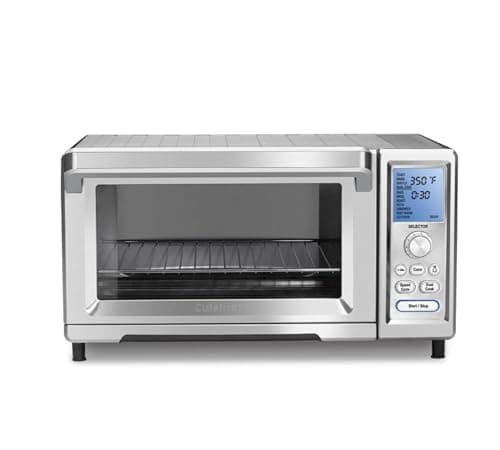
Cuisinart Chef's Convection Toaster Oven (TOB-260N1)
The only oven here whose manufacturer publishes both a wattage and an interior volume in cubic feet on the same page. 0.95 cubic feet at 1,800 W, with a stated list of what fits — a 13-inch pizza, a 9x13 pan, nine slices.
1,800 W
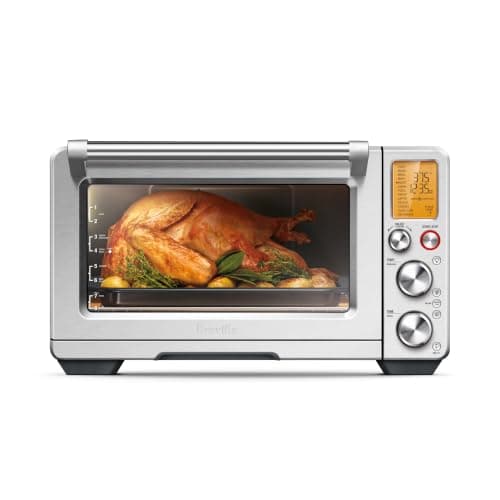
Breville Smart Oven Air Fryer Pro (BOV900BSS)
The most completely documented oven in the category, and the only one at any price whose manufacturer publishes a rated wattage, an interior volume and a full element layout in the same place. You pay roughly four times the category floor for that, and about a third of the premium is the documentation itself.
#ad · As an Amazon Associate we earn from qualifying purchases.
Questions
Frequently asked
How much do you reduce temperature for a convection oven?
Why does my convection oven burn everything?
Keep reading
Related
Receipts
Sources
- Cuisinart — Chef's Convection Toaster Oven TOB-260N1 product page
- Breville — the Smart Oven Air Fryer Pro (BOV900) instruction book [PDF]
We have not cooked in these ovens and we do not pretend to have. Specifications come from the manufacturer's own published documents; electricity rates come from the US Energy Information Administration; prices come from the live Amazon API. Where a figure is not published, the page says “not published” rather than guessing. Read the full method.