HUB 06 · Guides & Answers
How Hot Does a Toaster Oven Get?
The answer is 450°F for most of the market, 500°F at the very top, and — for about two-thirds of the ovens we cover — not published at all. Here is every temperature figure we have been able to read off a manufacturer document, in one table, with what each end of the band is actually good for.
We earn a commission if you buy through our links. It does not change the price you pay, and it does not decide our picks — the scoring rubric is published in full, including what disqualifies an oven. How this works.
The answer, first
A typical countertop oven publishes a maximum of 450°F. The highest published figure anywhere in our catalog is 500°F, from the Panasonic FlashXpress (published band 250–500°F) and the Nuwave Bravo XL Pro (50–500°F in 5°F steps). The lowest published floor is Nuwave's 50°F. And the figure most people need and nobody gives them: roughly two-thirds of the ovens we cover publish no temperature range at all — twenty-three of thirty-four.
Everything below is a number a manufacturer printed. We have not put a thermometer in any of these ovens; there is no test kitchen behind this site. What follows is what the makers will commit to in writing, which in this category turns out to be a much shorter list than you would expect.
Every published temperature band we hold
| Oven | Published range | Notes on the figure |
|---|---|---|
| Nuwave Bravo XL Pro | 50–500°F, in 5°F increments | Widest published band and the finest published step size in the catalog |
| Panasonic FlashXpress | 250–500°F | Joint-highest ceiling; also the highest published floor here |
| Breville BOV950 | 80–480°F | Second-highest ceiling, second-lowest floor |
| Breville BOV680 Compact | 120–445°F | Published for Bake & Roast specifically, in the instruction book |
| Breville BOV845 Smart Oven Pro | 120°F floor on Bake and Roast | Floor published, ceiling not |
| Our Place Wonder Oven Pro | 80–450°F | Joint-lowest floor among ovens publishing a full band |
| Instant Pot Omni Plus | 170–450°F | Published alongside a 19 QT / 18 L interior |
| Our Place Wonder Oven | 200–450°F | With a 60-minute timer ceiling, also published |
| Our Place Large Wonder Oven | 200–450°F | Same band as the standard model, 1,700 W instead of 1,400 |
| Hamilton Beach Sure-Crisp 31403 | 200–450°F | From brand-supplied listing data rather than the product page |
| Proctor Silex 31260 | 200–450°F or 150–450°F | The brand's own page contradicts itself: feature list vs detail block |
| The other twenty-three ovens we cover | Nothing published | Including every Ninja, both Cuisinarts and the Toshiba |
Two things stand out. The first is how tightly the market clusters: once you exclude the two 500°F outliers and Breville's 480, every single published ceiling in this catalog is 445 or 450°F. That is not a coincidence of engineering — it is a category convention, and it means the practical answer to “how hot does a toaster oven get” is 450°F unless you deliberately shop for an exception.
The second is that a brand contradicting itself is still ahead of twenty-three brands saying nothing. Proctor Silex publishes two different floors for the same oven on the same page, which is sloppy; it is also more information than every Ninja in our catalog provides.
Why the ceiling matters less than people think
Almost everything a countertop oven is used for happens between 325 and 425°F. The jobs where the top of the band genuinely decides the outcome are a short list:
- Thin-crust pizza, which wants more heat than 450°F can give it — our pizza ranking covers what the published ceilings mean for a crust.
- Broiling and finishing, where you want the top element flat out rather than a cavity temperature at all.
- Reflow soldering, which is the one use where the difference between 450°F and 500°F is a hard pass-or-fail against a published process figure — worked through in full here.
For bread, roasts, vegetables, casseroles and reheating, 450°F is more ceiling than the recipe asks for. If you are choosing an oven and the maximum temperature is the specification you are comparing, you are comparing the wrong one.
The floor is the harder number, and the better signal
Getting hot is easy: put enough watts through a resistance element and it will glow. Holding a low set point steadily is the harder engineering problem, because it requires the thermostat to cycle a large amount of power on and off around a small target without overshooting. That is why a published floor tells you more about an oven's control than a published ceiling does.
It is also the number that decides whether whole categories of cooking are available. A 200°F floor — which is what Our Place publishes for two of its three models and what Hamilton Beach and Proctor Silex publish — rules out proofing dough (roughly 75 to 100°F), dehydrating (typically 130 to 165°F) and any genuinely low slow cook. Those are not features those ovens are missing; they are temperatures their own specifications exclude.
The ovens that publish a low floor are, in order: Nuwave at 50°F, then Breville's BOV950 and the Our Place Wonder Oven Pro at 80°F, then two Brevilles at 120°F. That is five ovens out of thirty-four where a manufacturer will commit to a low number in writing. Which of them can actually dehydrate, and which can proof bread.
How hot does the outside get?
Hot enough that every manual we have read warns about it, and no manufacturer in this category publishes an exterior surface temperature. What they publish instead is instruction. BLACK+DECKER's manual states plainly: “This oven gets hot. When in use, always use oven mitts or pot holders when touching any outer or inner surface of the oven.”Our Place's manual requires at least an inch of clearance from the wall and any other object and warns against touching the appliance after operation. Nuwave's warns against covering or blocking the air vents at all.
So the honest answer to that question is a refusal: we cannot give you a number because nobody publishes one, and we are not going to put an infrared thermometer on an oven we do not own and present one unit's reading as a specification. What we can tell you is that the published clearance requirements vary by a factor of six across this catalog, which is the practical version of the same question — every published clearance figure is collected here, including the one brand that bans operating its oven under a wall cabinet outright.
Does the set point equal the actual temperature?
Not necessarily, and exactly one manufacturer in this catalog is willing to say so. From BLACK+DECKER's own use and care manual: “Temperatures in the oven will be lower than your set point. This is due to advanced heating elements used in this oven. Temperature dial settings have been calibrated to provide expected results for most recipes taking into account the advanced heating elements.”
Nobody else publishes a thermostat tolerance of any kind — not a plus-or-minus, not a calibration statement, nothing. So for every other oven in this category the relationship between the dial and the cavity is simply unknown, and the only way to find out is a five-dollar oven thermometer run at 350°F in an empty cavity. For bread and cakes that is not optional: why a cake punishes a thermostat more than a roast does.
A related effect worth knowing: the number on the dial describes the air, and in a small cavity the radiant heat coming directly off a nearby element is a large part of what the food feels. That is why the same 400°F behaves differently in a 7-quart box and a 30-quart one, and it is part of why a small dense oven reheats faster — the density arithmetic is here.
What to do with these numbers
Ignore the ceiling unless you have a reason not to. 450°F covers essentially all home cooking. Pay for 500°F only if you make thin-crust pizza, broil constantly, or are using the oven for something other than food.
Shop on the floor instead. A published low temperature is both a capability (proofing, dehydrating, holding) and a signal about the thermostat. Five ovens in our catalog publish one below 200°F. That is a short enough list to shop from directly.
Treat a missing range as the answer about the brand. Twenty-three of the ovens we cover publish no temperature figure at all, which means no verifiable capability claim at either end and nothing to hold the brand to. Documentation is one of the five metrics we score for exactly this reason, and the same pattern shows up in who publishes a wattage.
The hardware
The ovens this page is about
The ovens referred to above, with prices pulled live from Amazon and dated on every card. Full rankings live in the roundups linked from this page.
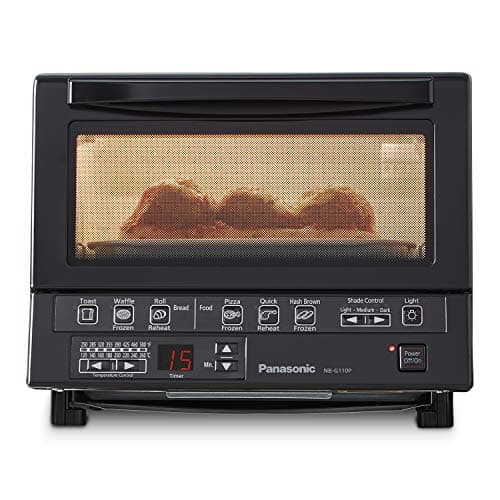
1,300 W
Panasonic FlashXpress Toaster Oven (NB-G110P)
The most completely documented oven on this entire site relative to its size: 1,300 W, 120 V, 60 Hz, 7.2 quarts, 250–500°F, exact millimeter dimensions and a stated weight. Panasonic publishes all of it, and almost nobody else does.
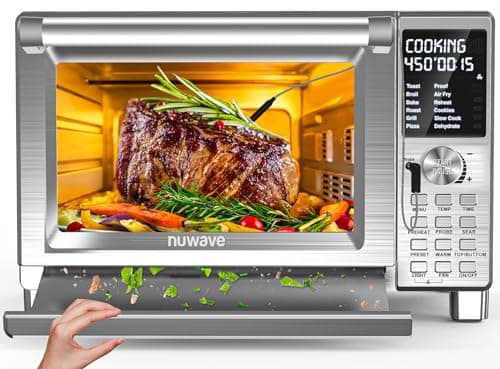
1,800 W
Nuwave Bravo XL Pro Air Fryer Toaster Oven (30 Qt, with probe)
A 30-quart, four-rack-level convection oven with an integrated temperature probe that stops the cook at a set internal temperature, and a maker that publishes its interior and exterior dimensions, weight, capacity, temperature range and warranty term — most of which the Ninja probe ovens do not. The 1,800-watt figure comes from a Nuwave support answer on its own product page rather than the manual's rating line, and we say so.
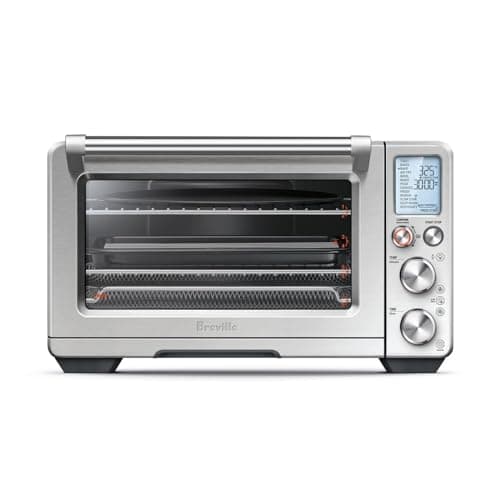
1,800 W
Breville Joule Oven Air Fryer Pro (BOV950BSS)
Mechanically the Smart Oven Air Fryer Pro with a radio in it. Every figure Breville publishes for the two — 1,800 watts, a cubic foot of interior, 21.4 x 17.3 x 12.7 inches, 38.89 pounds, 80 to 480°F, thirteen functions — is identical, and the premium buys the Joule app, Autopilot guided cooking and voice control. Nothing about the heat changes.
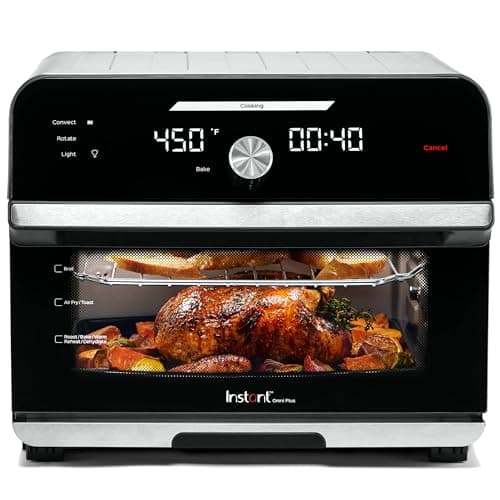
Wattage not published
Instant Pot Omni Plus 19QT/18L Toaster Oven Air Fryer, 10-in-1
One of the few ovens here that publishes its interior in liters, which makes it the easiest in the category to compare on paper. The rotisserie is a genuine mechanical addition rather than a relabeled fan setting.
#ad · As an Amazon Associate we earn from qualifying purchases.
Questions
Frequently asked
How hot does a toaster oven get?
What is the highest-temperature toaster oven?
How low can a toaster oven go?
Does a toaster oven reach the temperature on the dial?
How hot does the outside of a toaster oven get?
Is 450F hot enough for pizza?
Keep reading
Related
- Running cost by modelThe other figure this category half-publishes, with the arithmetic beside it.
- Best toaster ovens for reflow solderingWhere 450°F versus 500°F is a hard pass-or-fail against a published process figure.
- How much clearance does one need?What the makers publish about the outside of the box, since none publishes a temperature.
- Using a countertop oven as a dehydratorThe clearest case where the published FLOOR decides whether a job is possible.
- Best convection ovens for cakesWhere a thermostat that reads low stops being a footnote.
Receipts
Sources
- Nuwave — Bravo XL Pro Smart Oven & Air Fryer product page (specifications table: 50°F to 500°F in 5°F increments, inner and outer dimensions, capacity, warranty)
- Panasonic — FlashXpress Toaster Oven NB-G110P product page (power consumption, supply, capacity, 250–500°F range, dimensions)
- Breville — Joule Oven Air Fryer Pro (BOV950) product page (80–480°F range, 1 cubic ft interior, dimensions, weight, warranty)
- Breville — the Smart Oven Air Fryer Compact (BOV680) instruction book [PDF]: Rating Information 120 V ~ 60 Hz 1800 W, 120–445°F Bake & Roast band, 1–4 slice toast capacity
- Breville — Smart Oven Pro (BOV845) product page (1800 W, ten functions, published 120°F floor on Bake and Roast, no air-fry function)
- Our Place — Wonder Oven product page (200–450°F range, 13 qt / 12 L capacity, interior and exterior dimensions, steam infusion)
- Instant Brands — Instant Pot Omni Plus 18L Air Fryer Toaster Oven product page (19 QT / 18 L interior, 170–450°F range)
- Hamilton Beach — Sure-Crisp Air Fryer Toaster Oven, 4 Slice, model 31403 product page (1120 watts, dimensions, function list)
- Proctor Silex — 4 Slice Toaster Oven Broiler (31260G) product page (temperature range, timer, 3-year limited warranty)
- BLACK+DECKER — TO3250XSB / TO3260XSBD / TO3240XSBD use and care manual [PDF]: “During first few minutes of use you may notice smoke and a slight odor. This is normal and should cause no concern.”; “Temperatures in the oven will be lower than your set point.”; the 1½-inch top-element clearance rule; the timer rule; the short-power-supply-cord note
- Our Place — Wonder Oven user manual, model APL.WDO.ESN [PDF, retailer-hosted copy]: rating line 120V 60Hz 1400W, Before Your First Use steps 5–7 (1 inch clearance; trial run without food at 400°F for 10 minutes on Bake; “conduct the trial run in a well-ventilated area as a small amount of smoke and odor may be detected”), carbonised-residue warning, smoke-or-fire instruction
- Nuwave — Bravo XL Pro owner's manual, model 20813 [PDF]: Before First Use (remove glue and labels; “it is perfectly normal for your new unit to produce a heated plastic smell when used for the first time”), automatic shut-off odor note, white-smoke troubleshooting entry, probe target range
We have not cooked in these ovens and we do not pretend to have. Specifications come from the manufacturer's own published documents; electricity rates come from the US Energy Information Administration; prices come from the live Amazon API. Where a figure is not published, the page says “not published” rather than guessing. Read the full method.