Why a probe is worth caring about
Of everything a countertop oven can add, an integrated probe thermometer changes the most about what you can actually cook. Cooking to internal temperature rather than to a timer is the single biggest improvement available to a home cook: it is the difference between a roast that is reliably done and one you cut into and hope. A probe that plugs into the oven and stops it at a set temperature automates that, which a wall clock cannot. That is a real feature, and it is the reason these three ovens exist as a category worth ranking.
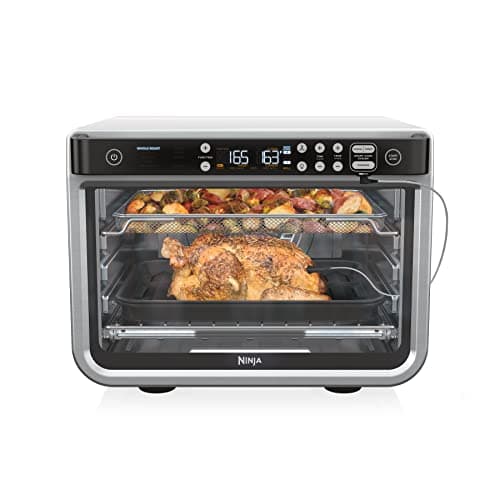
The Ninja DT251wins because the probe sits inside a genuinely good oven: the same two-level XL cavity as the DT201, so you get the sensor and the capacity in one box, with presets that are mapped to the probe rather than sitting alongside it. It costs well over twice a probe-less DT201 for that one sensor, which is the honest catch — a probe is worth a lot if you roast meat often and very little if you mostly cook vegetables and reheat.
Reading the order
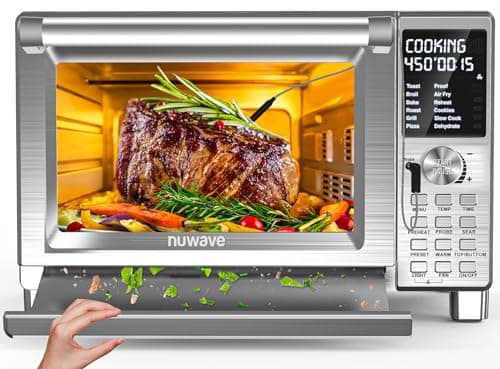
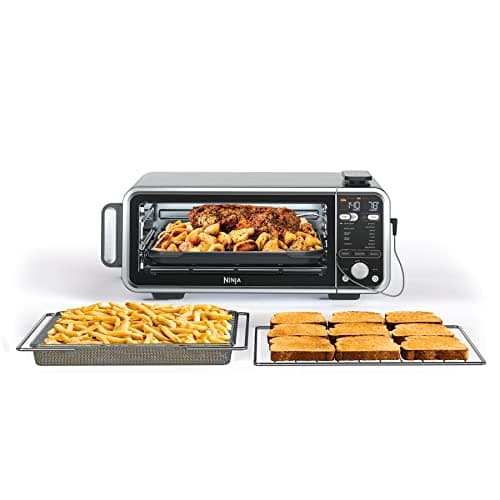
The Nuwave Bravo XL Prois second, and on our rubric it is the best-documented and the largest oven on this page: Nuwave publishes the outer and inner dimensions, the weight, a 30-quart capacity, a 50–500°F range and a one-year warranty, and its manual describes a probe that stops the oven at any target between 50 and 212°F. Four rack levels and a stated 13 x 9 pan fit, for about the DT251's price and well under the SP351's. The reason it sits second rather than first is the one figure this site cares most about: the 1,800-watt rating comes from a Nuwave support answer on the product page, not from the manual's rating line or the spec table, and we rank on what a maker commits to print. The Ninja SP351 is third and the most feature-dense small oven here: it combines the probe with the flip-away vertical storage of the SP line and a dedicated high-heat top element, which nothing else on this list does. You pay for all of it, and against ovens with far more interior room the price is hard to justify unless clearing the counter between meals matters to you.
The limit of a probe
A probe reads the food; it cannot fix the oven. If the thermostat runs hot or cycles coarsely, the probe will faithfully tell you the meat hit temperature in an oven that scorched the outside getting there — and none of these three publishes a temperature tolerance you can check. So the ranking rewards the oven, not the sensor: buy the DT251 for the cavity and the probe-mapped presets, the Nuwave for the most documented cavity at about the same price, and the SP351 for the storage. If you do not roast meat often, skip the probe entirely and buy a better-documented oven without one.
How we picked
Ovens we claim to have cooked in: 0
Everyone in this category tells you they roasted forty chickens. We have roasted none, and we say so. Here is what we do instead: read the manufacturer's manual and spec sheet, record the published wattage, interior volume, temperature range and warranty term, work out what the oven costs to run for an hour and for a year, show the arithmetic so you can redo it with your own electricity rate, and cite all of it. Where a brand publishes no wattage, we print no running cost rather than borrowing a number from a similar model. Prices come live from Amazon's API and disappear rather than go stale.
The scores above are judgments from that documented research — not test results. One of the five metrics is Documentation: whether the manufacturer will tell you what its oven draws at all. The full rubric, including what disqualifies an oven, is published in full.