HUB 06 · Guides & Answers
How Do Air Fryers Actually Work?
There is no frying and no oil. An air fryer is a small, fast convection oven, and understanding that one fact answers almost every other question people have about the category.
We earn a commission if you buy through our links. It does not change the price you pay, and it does not decide our picks — the scoring rubric is published in full, including what disqualifies an oven. How this works.
The mechanism, plainly
An air fryer has two working parts: a heating element and a fan. The element gets hot, the fan blows that hot air rapidly around a perforated basket or a rack, and the moving air cooks the food's surface fast enough to brown and crisp it before the inside overcooks. That is the entire machine. It does not fry, there is no oil bath, and the “fry” in the name is describing the result — crisp — not the method. Take the fan away and you have the appliance it grew out of: a toaster oven is the same elements, a thermostat and a timer.
Why moving air crisps
When hot air sits still against a wet surface, it forms a thin insulating layer — cooler and more humid than the air a few millimeters away — that slows both heat transfer and drying. A fan strips that layer off continuously and replaces it with fresh hot air. So the surface dries and browns faster, which is exactly the texture deep-frying produces by surrounding food in hot oil. Same crisp outcome, different mechanism, no oil.
This is also why the basket has holes and why a rack lets air under the food: the crisping depends on air reaching every surface. Lay food flat in a solid pan and the underside steams instead of crisping. It is the airflow, not the appliance, doing the work.
What follows from this one fact
Almost every other question in the category answers itself once you know an air fryer is a small convection oven:
- Why is it faster than my oven? Smaller cavity, less air to heat, and a fan that transfers heat quickly. Which also makes it cheaper to run.
- Can my convection oven do it? Yes — it is the same technology. Turn on convection and use a perforated tray.
- Is it healthier than frying? It uses far less oil for a similar crisp, because the crisping comes from hot air rather than an oil bath. The health question in full.
- Why do the presets barely differ? Because most of them are the same element and fan at different temperatures and times.
If you take one thing from this site, take this: you are choosing a small convection oven, and everything the marketing calls a feature is a variation on a fan and an element. That frame turns the whole category from a wall of jargon into a short list of things you can actually measure.
One piece of vocabulary worth settling while the mechanism is fresh, because it worries people unnecessarily: the element half of that pairing works by infrared radiation, which is non-ionizing and is simply radiant heat. Every oven ever built, including a wood fire, heats that way — and it is a completely different mechanism from a microwave, which is why only one of the two can brown anything.
The hardware
The ovens this page is about
The ovens referred to above, with prices pulled live from Amazon and dated on every card. Full rankings live in the roundups linked from this page.
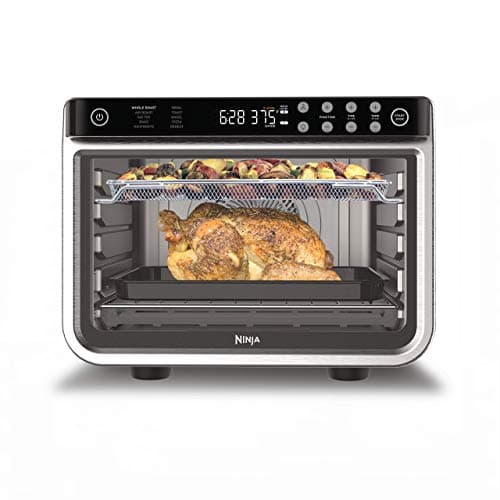
1,800 W
Ninja Foodi 10-in-1 XL Pro Air Fry Oven (DT201)
The value pick, and it is not close. Same 1,800 W as ovens costing more than twice as much, two full cooking levels, and a published capacity claim — two 12-inch pizzas — that is specific enough to be checkable rather than a vibe.
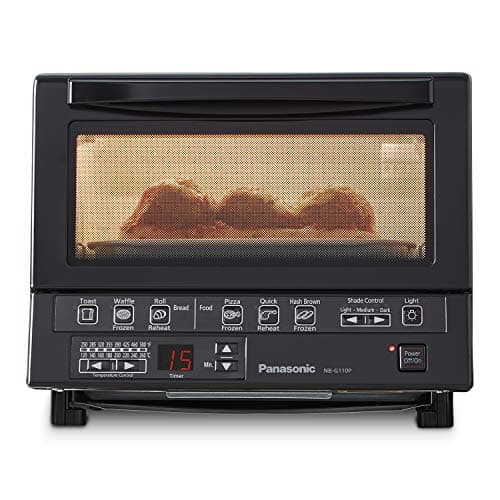
1,300 W
Panasonic FlashXpress Toaster Oven (NB-G110P)
The most completely documented oven on this entire site relative to its size: 1,300 W, 120 V, 60 Hz, 7.2 quarts, 250–500°F, exact millimeter dimensions and a stated weight. Panasonic publishes all of it, and almost nobody else does.
#ad · As an Amazon Associate we earn from qualifying purchases.
Questions
Frequently asked
Do air fryers actually fry food?
Do you need oil in an air fryer?
Keep reading
Related
Receipts
Sources
- SharkNinja — Ninja Foodi 10-in-1 XL Pro Air Fry Oven (DT201) product page
- Panasonic — FlashXpress Toaster Oven NB-G110P product page
We have not cooked in these ovens and we do not pretend to have. Specifications come from the manufacturer's own published documents; electricity rates come from the US Energy Information Administration; prices come from the live Amazon API. Where a figure is not published, the page says “not published” rather than guessing. Read the full method.