The short version
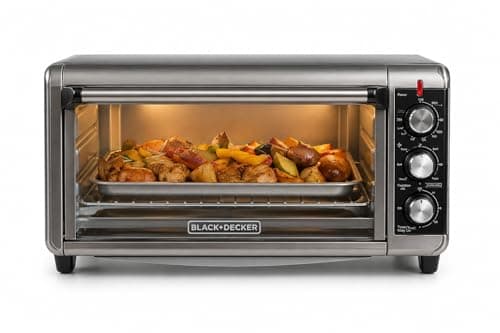
Buy the BLACK+DECKER TO3250XSB. It is the only oven in this catalog whose manufacturer publishes a broil procedurerather than the word “broil” on a control panel: set the temperature knob to BROIL, preheat for ten minutes, use the top rack position, keep the food more than 1½ inches below the top elements, and put the drip tray underneath. The manual also states the thing every other brand leaves you to guess — that during a broil the element “comes on and remains on during the entire broiling time” rather than cycling to hold a set point. For a function that works by sheer proximity to a glowing element, that single sentence is worth more than any feature list on this page.
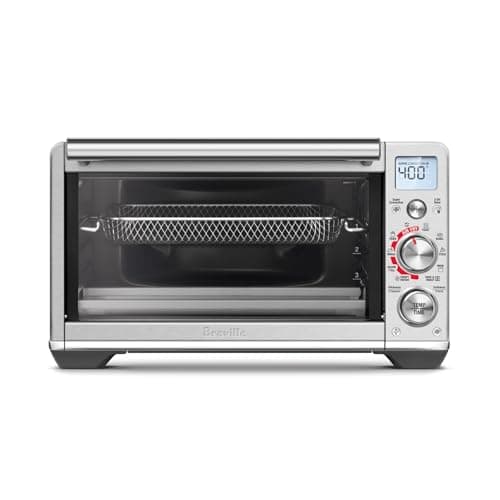
Choose the Breville Smart Oven Air Fryer Compact (BOV680) if you want control over how hard the broiler runs. Breville is the only brand here that publishes broil levels — BROIL LEVEL = HI or LO — and it is also the only one that publishes a broil time limit, stated in the instruction book as “TIME = Up to 20 minutes”. Two settings and a ceiling is a specification; “broil” among twelve presets is not.
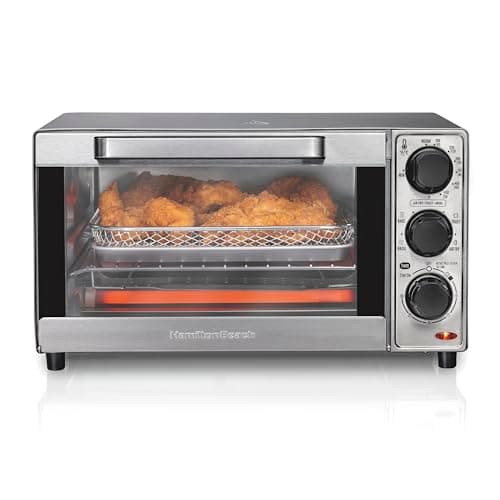
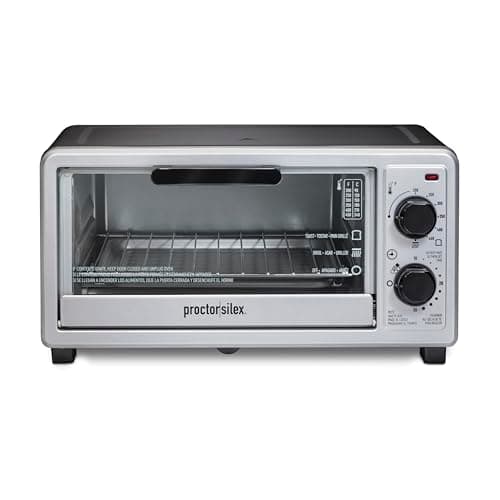
Spend the least and the Proctor Silex 31260 and Hamilton Beach Sure-Crisp 31403 both broil, both publish a thirty-minute timer with an automatic shut-off, and both cost a fraction of the top two. Neither publishes a broil temperature, a rack recommendation or an element behaviour.
We have broiled nothing in any of these. There is no test kitchen behind this site, and every figure below came off a manufacturer document we read this week.
Why broil is the least documented function in the category
Baking is a temperature job: you set 350°F, a thermostat cycles the elements, and the number on the dial is the claim. Broiling is not a temperature job at all. It is radiant heat at close range from the top element, and the three things that decide the result are how hot that element gets, how long it stays on, and how far the food sits beneath it.
Not one manufacturer in this catalog publishes a per-element wattage. Total rated power is the only proxy available and it is a poor one, because it is the sum of every element in the box — a 1,800-watt oven splitting power between four elements may put less into the top pair than a 1,500-watt oven with two. So the honest ranking is not a power ranking. It is a ranking of who tells you what the oven does.
Here is the whole published picture, which is thinner than the marketing suggests.
| Oven | Rated power | How broil is published | Published broil clearance | Published broil time limit |
|---|
| BLACK+DECKER TO3250XSB | 1500 W 120 V~ 60 Hz | A BROIL position on the temperature knob, with a written procedure: ten-minute preheat, top rack, element remains on throughout | Food or dish must not come within 1½ inches of the top heating elements | 60-minute Bake/Broil knob, or a Stay On position |
|---|
| Breville BOV680 Compact | 1800 W (manual) | A BROIL function with two levels, HI and LO | Not published | Up to 20 minutes, stated in the manual |
|---|
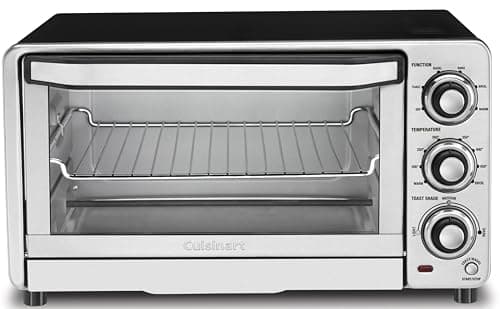
| Cuisinart Custom Classic TOB-40N | 1800 W | Published as a “toaster oven broiler” — broil is in the product type, not a preset | Not published | Not published |
|---|
| Hamilton Beach Sure-Crisp 31403 | 1120 watts | Broil listed among four functions; a broil rack is included | Not published | 30-minute timer with automatic shutoff, plus a stay-on setting |
|---|
| Proctor Silex 31260 | 1100 W | Published as a “4 Slice Toaster Oven Broiler”; the page states the oven rack is the one used for broiling | Not published | 30-minute timer with auto shutoff and a ready bell |
|---|
Two columns of that table are almost entirely empty, and they are the two columns that decide a broil. One oven fills both.
The naming trap: “broiler” in the product name means less than it sounds
Two of these ovens have broil in their published product type rather than in a feature list. Cuisinart publishes the Custom Classic as a toaster oven broiler, and Proctor Silex publishes the 31260 as a 4 Slice Toaster Oven Broiler. Both are dial-controlled ovens at the cheap end of the category, and that is not a coincidence: the phrase is a holdover from an era when a toaster oven did three things, and “broiler” was the third.
What neither brand publishes is a broil temperature. Cuisinart commits to 1,800 watts and to the product type; Proctor Silex commits to a three-year limited warranty — the longest published term anywhere on this site — and to a temperature range its own page states twice at two different floors, 200°F in one block and 150°F in another. We have quoted both rather than picking the flattering one. On a function that does not use the thermostat much, the floor matters less than it would elsewhere, but a page that disagrees with itself is still a page you should read twice.
The one figure that should change how you shop: 1½ inches
BLACK+DECKER's manual states that food or a baking dish must not come within 1½ inches of the top heating elements. That is the only published food-to-element clearance figure in this entire catalog, from any brand at any price, and it quietly answers a question that nothing else on the market will.
Work it through. If 1½ inches of air is the minimum and you are broiling a cut of chicken roughly 1½ inches thick on a rack and a drip tray that together stand about an inch off the shelf, you need something close to four inches of usable height between the top rack position and the element. That is a dimension almost nobody publishes: exactly three ovens in this catalog publish an interior height at all, which is the finding our cake ranking exists to state. On every other oven here, whether a thick cut can be broiled without touching the element is something you discover after paying.
The practical consequence is that a wide, shallow oven broils better than a tall one with the same badge, because the top rack sits closer to the element at a consistent distance across the shelf. The TO3250XSB is 22 inches wide and publishes a 13 by 9-inch pan fit with the handles included — the only pan-fit claim on this site that counts the handles, and the reason it also tops our pan-fit guide.
What broiling costs to run
Broiling is short and hot, so the running cost is small and the arithmetic is simple. At the EIA's published US average residential rate of 18.34¢ per kWh, 1,500 watts is 27.5 cents an hour, so a ten-minute broil after a ten-minute preheat is about nine cents. An 1,800-watt oven is 33.0 cents an hour, or about eleven cents for the same twenty minutes.
The number that matters more is the comparison against the appliance you already own. A full-size electric oven broils with the same physics and a far larger cavity to heat first — the full arithmetic for that comparison is here. For two pieces of fish, the countertop oven wins on both cost and time, and it wins by more on broil than on bake because there is no long preheat to amortise.
Three checks before you buy a broiler
Confirm the broil control is a position, not a preset. A knob with a BROIL detent puts the element under your control. A preset decides the level for you and, on most of this category, does not publish what it decided.
Look for a drip tray in the box, and a stated place to put it. BLACK+DECKER's manual tells you to place the bake pan under the slide rack during a broil. Fat dripping onto an exposed bottom element is the most common cause of smoke in this category, which is the subject of a whole page here.
Check whether the oven can run without a timer. On the TO3250XSB it cannot — the manual states you must set the timer or select Stay On for the oven to function, which makes the timer the shut-off. That is a safety property worth having under a broiler you are standing next to, and it is published far less often than you would expect.