Skip to content
CC

HUB 04 · Comparisons

Breville BOV900 vs BOV950 Joule Oven

Breville sells two Pro-size ovens side by side with the same published dimensions, the same six quartz elements and the same thirteen functions on the dial. One of them talks to your phone. That is very close to the whole difference, and the useful question is what the phone actually does.

By Stephen V.Updated How we rank
#ad

We earn a commission if you buy through our links. It does not change the price you pay, and it does not decide our picks — the scoring rubric is published in full, including what disqualifies an oven. How this works.

The short answer

Quick picks

#OvenBest forScorePrice
01
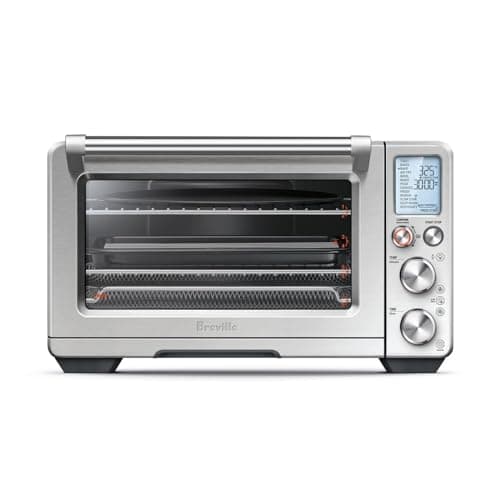
Breville Breville Smart Oven Air Fryer Pro (BOV900BSS)
Breville Smart Oven Air Fryer Pro (BOV900BSS)

The one to buy if you will keep it a decade

1,800 W
8.5
$399.95Amazon
02
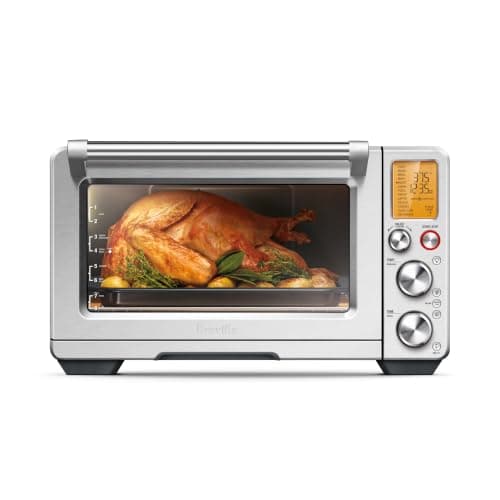
Breville Breville Joule Oven Air Fryer Pro (BOV950BSS)
Breville Joule Oven Air Fryer Pro (BOV950BSS)

The connected version of the best-documented oven here

1,800 W
8.3
$499.95Amazon

#ad · Prices pulled live from the Amazon Product API, last checked Sep 4, 2026. Where we have no verified live price we show none — we would rather leave a gap than print a number that has gone stale. The wattage column is what the manufacturer publishes; “not published” means exactly that, and we have not estimated one. Scores are ours, compiled from published specifications, and are not test results.

The short answer

Buy the BOV900 Smart Oven Air Fryer Pro unless you will genuinely cook from an app. On everything Breville publishes about the two ovens as ovens — the chassis, the element count, the rated power, the interior, the functions on the dial — they are the same machine, and the cheaper one is the same machine. Buy the BOV950 Joule Oven Air Fryer Pro if Autopilot and its three app-only heat modes describe how you want to cook, because those are real capabilities and the BOV900 does not have them at any setting.

That is a narrower difference than a step up a range usually buys, and it is unusually easy to check for yourself: Breville publishes both spec panels, and they read the same. What follows is what is identical, what is not, and where the line falls.

What is identical, and it is nearly everything

Both ovens measure 21.4 inches wide, 17.3 deep and 12.7 high — Breville states the same figure, to the tenth of an inch, on both product pages. Both are brushed stainless steel. Both run six independent quartz heating elementsunder Element IQ, which is Breville's name for steering power to individual elements rather than switching them in banks, and it is the actual mechanical substance behind the price of every oven in this family. Both carry a convection and a super convection setting on the panel.

Both are rated 1,800 watts. On the BOV950 that figure is the Rating Information line printed in Breville's own instruction book — 120 V ~ 60 Hz 1800 W — rather than listing copy, and the BOV900's figure comes from Breville's instruction book for that model rather than from a retailer. Both list thirteen cooking functions on the oven itself, and they are the same thirteen: toast, bagel, bake, roast, air fry, broil, pizza, cookies, proof, reheat, slow cook, keep warm and dehydrate.

Both ship with substantially the same box of hardware: a 13-inch pizza pan, two wire racks, a 9 × 13 broiling rack, a 9 × 13 enamel roasting pan and a mesh basket for air frying and dehydrating. If you were choosing between them on interior, on heat, on what fits, or on what the machine can be told to do from its own front panel, there is nothing here to choose. The BOV900 review is here and the BOV950 review is here, with the full published spec on each.

What the extra money buys

Connectivity, and — this is the part most write-ups miss — three cooking modes that come with it. The BOV950 is a Wi-Fi oven, paired to a phone or tablet through the Breville+ Cooking app(the app Breville formerly branded around Joule). The instruction book is clear that the oven works fully without any of it: “The oven can always be used via the control panel without Wi-Fi.” What the app adds is a recipe and cook-guide library that pushes time, temperature and mode straight to the oven, remote monitoring, firmware updates, voice control through Alexa or Google, and Autopilot.

Autopilot is the feature to weigh, because nothing else in our catalog does it. Breville describes it as an automated multi-event cook: the app drives the oven through a recipe on its own, moving between cooking modes and temperatures at each stage, so a dish that wants a long convection bake followed by four minutes of broil does not need you standing in front of it to make the switch. Recipes that use it are flagged with an airplane icon in the app.

The three modes that only exist in the app

This is the one genuine cooking difference between the two ovens, and it is easy to miss because it is not in the specification panel. Breville publishes the BOV950 as thirteen presets on the oven plus three app-exclusive modes, and names them: bottom bake, bottom broil and outer broil. Those are element behaviors, not recipes — a different distribution of heat across the same six quartz elements — and on this oven they are reachable only from a phone.

Whether that matters depends on what you cook. Bottom heat is the difference between a pizza base that sets and one that steams, and an outer broil is a gentler, wider grill than a full-power top broil. If you have ever wished an oven would put the heat somewhere else, that is what these are for. If you have not, they are three names on a screen. The gap between a convection setting and an air fry setting is smaller than a panel suggests, and the same caution applies here: a mode is a heat profile, not a new machine.

What we can say plainly is that they exist, that Breville publishes them, and that they are not on the BOV900 in any form. That is a fair thing to pay for. It is also a capability with a dependency — the app requires a phone or tablet and an account, and an oven bought for software is an oven whose headline feature lives on somebody else's release schedule. The panel keeps working either way.

Eight rack positions out of four grooves

Breville publishes a rack detail for the BOV950 it does not publish for the BOV900. The BOV950's two wire racks are reversible: each of the four grooves takes the rack facing up or down, which is how four slots become eight different rack heights. The instruction book goes further and says which pairs to use — positions 3 and 7, or 4 and 8, for two-tray cooking — and notes that rack placement only affects the result when the screen specifies a position.

The same book documents the magnetic auto-eject rack: with the wire rack in position 3 or 4, opening the door slides the rack halfway out on its own, with a warning to open the door slowly so it does not eject too quickly. Breville's BOV900 page lists two oven racks without stating a position count or an eject behavior, so this is a difference in what is published as much as a difference in hardware — and on a site that scores documentation, that distinction is the whole point. Our rubric is here.

The temperature band, function by function

Breville quotes the BOV950 as an 80–480°Foven, the widest published band of anything in our catalog. The instruction book shows what that headline is made of, and it is worth knowing before you buy on it: the band is the union of every function's range, not one continuous dial. From the book's own function table — bake and roast run 120–480°F, air fry, pizza and cookies run 300–480°F, reheat 160–480°F, keep warm 110–200°F, dehydrate 86–176°F, and proof runs 80–100°F, which is where the famous 80°F floor actually lives.

That is not a criticism — an 80°F proof setting is genuinely useful and most ovens in this category publish no low-temperature range at all — but “80 to 480” describes the oven's repertoire rather than the bake dial. If you are choosing between these two on the temperature line, note that Breville publishes no comparable per-function table on the BOV900 product page, so the honest statement is that we can show you the BOV950's numbers and cannot show you the BOV900's.

Running cost: the same, to the cent

Both ovens draw 1,800 watts, so both cost exactly the same per hour to run, and the cards above show the arithmetic with every step visible. Spending up to the BOV950 buys no efficiency whatsoever, and neither does spending up to the BOV900 from a $60 toaster oven — nearly every full-power countertop oven sold in the US lands on 1,800 watts, because 15 amps at 120 volts is 1,800 watts and that is where a standard kitchen circuit stops. Every published wattage we hold is tabulated here, with the sums beside it.

What a connected oven could plausibly save you is time rather than rate — a multi-stage cook that switches modes on schedule instead of when you remember is a shorter cook — but that is a claim about your attention, not about your electricity bill. Nobody should buy either of these expecting a lower bill.

The row we will not put in a table

Warranty. Breville does not print a term in the specification panel of either product page as we read them, and the terms it does publish live on its warranty and repairs pages rather than beside the specs. The BOV950 card above carries the two-year limited term Breville published for it; the BOV900 card carries no warranty spec at all, because we have no document for one. If the length of cover is going to decide this for you, read it on Breville's own page before you buy rather than taking a number off any review, including this one.

The decision rule

Buy the BOV950 if you will cook from the app — if Autopilot running a multi-stage recipe unattended, or bottom bake and outer broil, describe something you actually want. Buy the BOV900 if you will use the dial, because every published figure that describes the oven as an oven is the same number, and the cheaper one is the same oven. Running cost is identical — both are 1,800 watts, so this decision has no consequence for your bill.

One practical note that applies to both: at 17.3 inches deep before the clearance a drop-down door needs in front of it, this is the largest footprint we cover. Measure the four dimensions on this page before you order either one.

If neither is the answer

The Breville range has three rungs below this pair, and for most kitchens one of them is the better buy. The BOV860 Smart Oven Air Fryer is the same Element IQ oven two and a half inches narrower, which is the difference between fitting a standard counter and not; the BOV860-versus-BOV900 comparison settles that pair. The BOV845 Smart Oven Pro is the same family with the air fry function removed, which is the better buy if you bake more than you crisp. And the BOV680 compact takes the full 1,800 watts down to a 15.7-inch chassis.

All of them draw 1,800 watts, so none of them is cheaper to run than any other, and the entire Breville argument across the range is documentation and element control rather than room per dollar. The premium countertop band, ranked against everything else at the price, is here.
In detail

The picks, in full

01
Breville Breville Smart Oven Air Fryer Pro (BOV900BSS)

The one to buy if you will keep it a decade

Breville Smart Oven Air Fryer Pro (BOV900BSS)

Wattage published in the manualWidest footprint here
8.5/10

The most completely documented oven in the category, and the only one at any price whose manufacturer publishes a rated wattage, an interior volume and a full element layout in the same place. You pay roughly four times the category floor for that, and about a third of the premium is the documentation itself.

Power
9.5
Usable space
9.5
Footprint
6
Documentation
10
Value
7.5

What it gets right

  • Breville publishes the rated wattage, the interior volume, the exterior dimensions and the element count — almost nobody else in this category publishes all four
  • 1 cubic foot of interior is genuinely a small oven, not a large toaster: a 14-inch pizza or a 9x13 pan fits without diagonal gymnastics
  • Element IQ drives the six elements independently rather than switching them in banks, which is the actual mechanical difference behind the price

What it doesn't

  • 21.4 inches wide is wider than most upper-cabinet clearances allow you to slide it under
  • At the current price it costs more than several full-size wall ovens' worth of countertop convection you could assemble from cheaper parts
  • Thirteen functions is nine more than most households use; the presets are the same elements at different set points

What it costs to run

About 33.0¢ an hour at full draw, or $60.25 a year at 30 minutes a day, 365 days a year and 18.34¢ per kWh.

1,800 W ÷ 1000 × 182.5 h × 18.34¢ = $60.25

1800 W is the rating plate figure in Breville's own instruction book, not a marketing headline. This is an upper bound: the elements cycle off once the cavity is at temperature, and no manufacturer publishes a duty cycle, so we compute at full rated draw rather than invent a correction factor. The full method is published.

Skip this if…

your counter is under 24 inches deep with the backsplash, or you are buying an oven mainly to make toast and reheat pizza — nothing about this machine's price is recovered on those two jobs.

$399.95on Amazon

Price last checked Sep 4, 2026. Prices move constantly — Amazon's at checkout is the one that counts.

#ad · we may earn a commission from this link to Breville Smart Oven Air Fryer Pro (BOV900BSS)

02
Breville Breville Joule Oven Air Fryer Pro (BOV950BSS)

The connected version of the best-documented oven here

Breville Joule Oven Air Fryer Pro (BOV950BSS)

Wattage published in the manualSame published specs as the cheaper BOV900
8.3/10

Mechanically the Smart Oven Air Fryer Pro with a radio in it. Every figure Breville publishes for the two — 1,800 watts, a cubic foot of interior, 21.4 x 17.3 x 12.7 inches, 38.89 pounds, 80 to 480°F, thirteen functions — is identical, and the premium buys the Joule app, Autopilot guided cooking and voice control. Nothing about the heat changes.

Power
9.5
Usable space
9.5
Footprint
6
Documentation
10
Value
6.5

What it gets right

  • The most complete published spec sheet on this site: rated power, interior volume, exterior dimensions, weight, temperature range, capacity and warranty term all stated by Breville in one place, with the rating plate reproduced in the manual
  • 80°F is the lowest published temperature floor of any oven in our catalog that publishes a range at all, and 480°F the highest ceiling — holding a low set point is harder than getting hot
  • The Joule app adds guided step-by-step cooking, progress monitoring and Alexa or Google voice control, which is a genuine capability the rest of the category does not offer

What it doesn't

  • Every mechanical figure Breville publishes is identical to the cheaper BOV900 — same 1,800 W, same 21.4 x 17.3 x 12.7 inches, same cubic foot, same 38.89 lb, same 80–480°F, same thirteen functions
  • Tied with the BOV900 for the largest published footprint in our catalog: 21.4 inches wide and 17.3 deep before you add door clearance
  • The connected features need a phone or tablet — Breville's own note specifies Bluetooth 4.0 and iOS 13 or Android 8 and later — so an oven bought for the app stops being one if the app stops

What it costs to run

About 33.0¢ an hour at full draw, or $60.25 a year at 30 minutes a day, 365 days a year and 18.34¢ per kWh.

1,800 W ÷ 1000 × 182.5 h × 18.34¢ = $60.25

120 V ~ 60 Hz 1800 W is the Rating Information line printed in Breville's own BOV950 instruction book, not a marketing headline. This is an upper bound: the elements cycle off once the cavity is at temperature, and no manufacturer publishes a duty cycle, so we compute at full rated draw rather than invent a correction factor. The full method is published.

Skip this if…

you are not going to cook from your phone. Take the connectivity away and this is the BOV900 at a higher price: every wattage, dimension, capacity, weight and temperature figure Breville publishes for the two is the same number.

$499.95on Amazon

Price last checked Sep 4, 2026. Prices move constantly — Amazon's at checkout is the one that counts.

#ad · we may earn a commission from this link to Breville Joule Oven Air Fryer Pro (BOV950BSS)

How we picked

Ovens we claim to have cooked in: 0

Everyone in this category tells you they roasted forty chickens. We have roasted none, and we say so. Here is what we do instead: read the manufacturer's manual and spec sheet, record the published wattage, interior volume, temperature range and warranty term, work out what the oven costs to run for an hour and for a year, show the arithmetic so you can redo it with your own electricity rate, and cite all of it. Where a brand publishes no wattage, we print no running cost rather than borrowing a number from a similar model. Prices come live from Amazon's API and disappear rather than go stale.

The scores above are judgments from that documented research — not test results. One of the five metrics is Documentation: whether the manufacturer will tell you what its oven draws at all. The full rubric, including what disqualifies an oven, is published in full.

Questions

Frequently asked

What is the difference between the Breville BOV900 and the BOV950?
Connectivity, and the three cooking modes that come with it. Both ovens measure 21.4 × 17.3 × 12.7 inches, both run six independent quartz elements under Element IQ, both are rated 1,800 watts and both list the same thirteen functions on the dial. The BOV950 adds Wi-Fi and the Breville+ app, Autopilot multi-stage guided cooking, voice control, eight reversible rack positions, and three app-exclusive heat modes — bottom bake, bottom broil and outer broil. The full BOV950 review is here.
Is the Breville BOV950 worth the extra over the BOV900?
Only if you will cook from the app. Every figure Breville publishes about the two as ovens is the same figure, so the premium buys Autopilot, the connected recipe library, voice control and three heat modes that are reachable only from a phone. If those describe how you want to cook, it is a fair price for something nothing else in the category offers. If they do not, buy the BOV900 and keep the difference.
Can you use the Breville BOV950 without the app?
Yes. Breville's instruction book states that the oven can always be used via the control panel without Wi-Fi, and all thirteen of its on-oven functions run from the dial. What you lose without a phone is Autopilot, the connected recipes and cook guides, remote monitoring, voice control, and the three app-exclusive modes -- which is to say, everything you paid the premium for.
Do the BOV900 and BOV950 cost the same to run?
Yes, to the cent. Both are rated 1,800 watts, and running cost is decided by rated power and time, never by price or features. That is true of almost every full-power countertop oven in the US, because 15 amps at 120 volts is 1,800 watts. The published wattage of every oven we cover is tabulated here.
Is the Breville BOV950 bigger than the BOV900?
No. Breville publishes the same exterior dimensions for both — 21.4 inches wide, 17.3 deep and 12.7 high — and the cards above carry the same one cubic foot of interior for each. They are the largest published footprint in our catalog, tied, and 17.3 inches is before the clearance a drop-down door needs in front of it. The four measurements to take before ordering are here.
What are the three app-exclusive modes on the BOV950?
Bottom bake, bottom broil and outer broil, as Breville names them. They are heat distributions across the same six quartz elements rather than extra hardware, and on this oven they can only be selected from the Breville+ app -- the front panel carries the thirteen standard presets. The BOV900 does not offer them in any form.

Keep reading

Receipts

Sources

We have not cooked in these ovens and we do not pretend to have. Specifications come from the manufacturer's own published documents; electricity rates come from the US Energy Information Administration; prices come from the live Amazon API. Where a figure is not published, the page says “not published” rather than guessing. Read the full method.