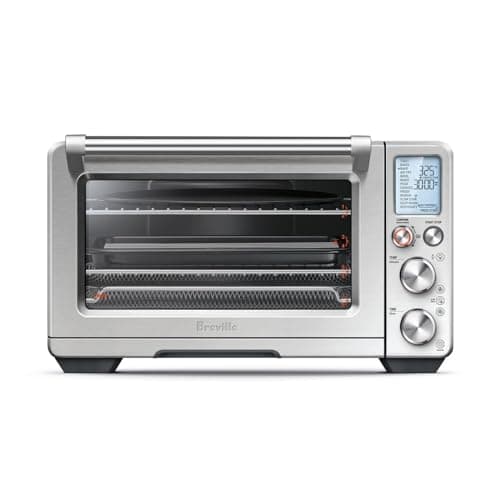
The short answer
Buy it if you will genuinely cook from the app. The Joule Oven Air Fryer Pro is the best-documented countertop oven we have written about — Breville publishes a rating-plate wattage, an interior volume, exterior dimensions, a weight, a temperature range, a capacity claim and a warranty term, which is a completeness almost nobody else in this category comes close to. It is also, by every one of those published numbers, the same machine as the cheaper Breville Smart Oven Air Fryer Pro sitting next to it on the shelf.
Do not buy it if the phone is incidental to how you cook. Strip the connectivity out and you have paid a premium for an oven whose published wattage, footprint, interior, weight, temperature band and function list are all identical to the BOV900. That is not a criticism of the oven. It is the buying decision.
The finding: two product pages, one spec sheet
This site has no test kitchen and says so on every page of the rubric. What we can do is read what a manufacturer is willing to put in writing, and then read it against what the same manufacturer writes about its other models. Doing that here produces the single most useful fact about this oven, and it is not on the box.
Breville's own product pages for the BOV950 and the BOV900 state the same figure in every field that describes the machine as a machine. Same rated power. Same exterior dimensions to the tenth of an inch. Same shipping weight to the hundredth of a pound. Same published interior. Same temperature band. Thirteen named functions on each, and the same thirteen names. The capacity claim is even word-for-word: nine slices of toast, a 13-inch pizza, a 9 × 13 baking pan, a 12-cup muffin tray, a 14-pound turkey.
The two sheets, side by side
| What Breville publishes | BOV950 Joule Oven Air Fryer Pro | BOV900 Smart Oven Air Fryer Pro |
|---|
| Rated power | 1800 W | 1800 W |
|---|
| Dimensions (W×D×H) | 21.4 × 17.3 × 12.7 in | 21.4 × 17.3 × 12.7 in |
|---|
| Weight | 38.89 lb | 38.89 lb |
|---|
| Interior | 1 cubic ft | 1 cubic ft |
|---|
| Temperature | 80–480°F | 80–480°F |
|---|
| Functions | 13, same names | 13, same names |
|---|
| Warranty | 2-year limited | 2-year product, 5-year glass |
|---|
| App / voice control | Joule Oven app, Autopilot, Alexa and Google Home | None published |
|---|
Every cell above is Breville's own published figure, taken from its US product page for each model; the BOV950's rated power was additionally read off the Rating Information line in its instruction book. The warranty row is the one line where the older model reads better on paper — the BOV900 page states a 5-year term for glass defects alongside the 2-year product warranty, and the BOV950 page states a 2-year limited warranty without that separate glass clause.
What the premium actually buys
Connectivity, and one specific thing built on top of it. The Joule Oven app pairs over Bluetooth and gives you guided step-by-step video recipes, remote progress monitoring, wireless firmware updates, and voice control through Alexa or Google Home. The feature Breville leads with is Autopilot: the app drives the oven through a multi-stage recipe on its own, changing function, time and temperature at each step, so a dish that wants twenty minutes of convection bake followed by four of broil does not need you standing there to make the switch.
That is a real capability and nothing else in our catalog has it. It is also a capability with a dependency, which Breville states plainly in its own note: the app requires a smartphone or tablet with Bluetooth 4.0, running iOS 13 or Android 8 (Oreo) or later. An oven bought primarily for the app is an oven whose headline feature lives on somebody else's release schedule. The panel on the front still works either way — this is a connected oven, not a phone-only one — but the reason to pay the difference is software, and software is the part of an appliance that ages fastest.
The other published difference is the racking. Breville lists two reversible wire racks giving eight rack positions, with a magnetic auto-eject that slides the rack forward when you open the door. In the box with it: a 13-inch non-stick pizza pan, a 9 × 13 broiling rack, a 9 × 13 enamel roasting pan and an air fry / dehydrate basket.
The 80°F floor is the number worth having
Every oven quotes a maximum. The more interesting figure is nearly always the minimum, because holding a low set point is harder than getting hot — the control has to cycle an 1,800-watt element gently enough to sit somewhere the element would blow straight past. Breville publishes this one at 80°F to 480°F, which is the lowest floor and the highest ceiling of any oven in our catalog that publishes a range at all.
Eighty degrees is low enough to proof dough properly rather than approximately, and there is a named Proof function on the dial to do it, plus Slow Cook, Keep Warm and Dehydrate at the same end of the scale. At the top, 480°F is enough for thin-crust pizza on the included 13-inch pan — a gap of thirty-five degrees over the compact BOV680's published 445°F that is real rather than a rounding error. Our pizza ranking is built on exactly that number.
Breville also publishes PID temperature control — a control loop that reduces overshoot rather than letting the cavity swing past the set point and settle back. That is the kind of claim we can repeat because Breville states it, and the kind we cannot verify because we have not put a probe in the box. Treat it as a design statement, not a measurement.
What a cubic foot actually holds
One cubic foot is a small oven rather than a large toaster, and Breville is specific about what that means: nine slices of toast, a 13-inch pizza, a 9 × 13 baking pan, a 12-cup muffin tray, or a 14-pound turkey. Those are the manufacturer's claims, and the useful ones are the pan sizes, because you can measure a 9 × 13 pan you already own against them.
The catch is the outside. At 21.4 inches wide and 17.3 inches deep, this is tied with the BOV900 for the largest published footprint in our catalog, and 17.3 inches is before you count the clearance a drop-down door needs in front of it. On a standard 24-inch counter with a backsplash that is most of the depth gone. The four measurements to take before anything arrives are here, and the pan-fit question is worked through separately if a specific tray is the constraint.
Thirty-nine pounds is worth registering too. This is not an appliance you lift into a cupboard between meals. If your counter has to be clear, the flip-away ovens we rank on footprint are a different answer to a different problem.
Element IQ, without the marketing
Element IQ is Breville's name for steering power to individual elements rather than switching them in banks — more heat at the top for a broil, more underneath for a pizza base, adjusted through a cook rather than fixed at the start. It is the actual mechanical difference behind Breville's pricing across the whole range and it is the one thing a cheaper oven cannot imitate at any setting. It is also identical here to the BOV900, because it is the same hardware.
The thirteen functions are Toast, Bagel, Bake, Air Fry, Broil, Roast, Pizza, Cookies, Proof, Reheat, Slow Cook, Keep Warm and Dehydrate. A function on a countertop oven is a heat profile at a set point — which elements come on, how hard, and how fast the fan runs — so a count is a convenience ranking rather than a capability one. The gap between the convection and air fry settings is smaller than the panel suggests, and the same is true of Bagel versus Toast. Thirteen is generous; it is not thirteen machines.
Running cost: exactly what the cheap ovens cost
The card above computes it from the published 1,800 watts with every step shown, and the answer is the reason this site exists: a $500 Breville costs the same per hour to run as a $60 toaster oven that also draws 1,800 watts. Nearly every full-power countertop oven sold in the US lands on that same figure, because 15 amps at 120 volts is 1,800 watts and that is where a standard kitchen circuit stops. Every published wattage we hold is tabulated here, with the arithmetic beside it.
What a better oven can save you is time, not rate. A cavity that reaches its set point sooner and holds it without overshooting finishes the same tray in fewer minutes, and minutes are what you are billed for. The full calculation, with every input shown, is here. Anyone buying at this price expecting a lower bill has misread the category.
Where it sits in the Breville line
Directly above the BOV900, at a higher price, with the same insides. Below both, the BOV860 Smart Oven Air Fryer is the same idea in a chassis two and a half inches narrower, and the BOV680 compact takes the full 1,800 watts down to a 15.7-inch footprint. The BOV845 Smart Oven Pro is the same family with the air fry function removed and a published 120°F floor, which is the better buy if you bake more than you crisp. All of them draw 1,800 watts, so none of them is cheaper to run than any other — the BOV860-versus-BOV900 comparison settles the pair below this one. The pair this page belongs to is settled in the BOV900-versus-BOV950 head-to-head, which reads the BOV950 instruction book rather than the product pages and finds the one cooking difference between them: three heat modes that exist only inside the app.
Against the rest of the category, the Breville argument has always been documentation and element control rather than room per dollar. Four of the six ovens in Ninja's line publish no wattage at all, and a Ninja gives you more interior for the money in every case. Breville versus Ninja, settled on that trade, is here, and the premium countertop band is ranked here.
Who should skip it
Anyone who is not going to open the app. That is the whole review in one line, and it is unusual for us to be able to write it so cleanly — normally a step up a range buys a mix of things and the reader has to weigh them. Here Breville has published two spec sheets that match in every mechanical field, so the premium resolves to exactly one question with a yes or no answer.
Also skip it if your counter is under 24 inches deep with the backsplash, because 17.3 inches plus door clearance will not sit comfortably; if you are buying a countertop oven mainly to toast and reheat, because a budget toaster oven does those two jobs at the same speed for a fraction of the money; and if you were hoping a better oven would cost less to run, because it draws the same 1,800 watts as everything else with a plug.
And a note on warranty, since it is the one row where the older model reads better: Breville publishes a 5-year term for glass defects alongside the 2-year product warranty on the BOV900 page, and a 2-year limited warranty on the BOV950 page with no separate glass clause. We have not seen a document explaining the difference, so we are not going to invent one — but if the two ovens are otherwise identical on paper, that is a line worth reading for yourself before you decide.