The short version
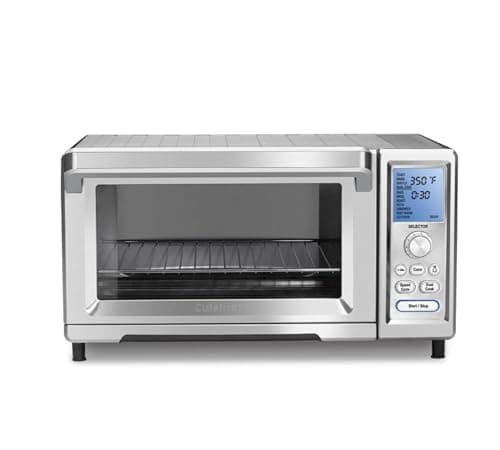
The pick is the Cuisinart Chef's Convection Toaster Oven (TOB-260N1), because it is the only oven in our catalog whose maker publishes a wattage and an interior volume in cubic feet in the same place — 1,800 watts and 0.95 cubic feet — along with a stated list of what fits: a 13-inch pizza, a 9 x 13 pan and nine slices of toast. Fifteen functions, convection, no air-fry mode, no basket. If you want the biggest honestly documented cavity without an air fryer bolted onto the marketing, it is this one, and it is the most expensive thing on the page by a distance.
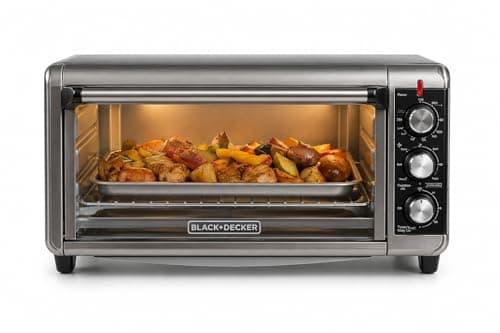
Spend less and the answer is the BLACK+DECKER 8-Slice Extra Wide (TO3250XSB), which is the value pick for a specific and checkable reason: BLACK+DECKER is the only maker in this catalog that publishes a pan-fit claim with the handles included — a 13 by 9 pan, a 12-inch pizza, eight slices — and prints the rating line in its own manual at 1500 W, 120 V, 60 Hz. It is a convection baker with dials and a two-year warranty, and it costs less than a third of the Cuisinart.
One thing we will not tell you anywhere on this page: how any of these ovens cooks. We have cooked in none of them. There is no test kitchen behind this site and the rubric says so in those words. What is checkable is what each manufacturer publishes, and that is the whole basis of the order below.
What “without an air fryer” has to mean to be a real criterion
It has to mean the manufacturer's own published function list does not contain air fry. Not that the name omits it, and not that the oven looks old. We checked each of the six against the maker's own page or manual, because the naming in this category is unreliable in both directions: the Oster French Dooris sold as a “Toaster Oven” and its function list includes air fry, so it is not on this page; the BLACK+DECKER TO3250XSB has a convection fan and a crisping-friendly cavity and no air-fry mode, so it is.
The practical distinction is narrower than the marketing suggests. An air-fry mode on a countertop oven is, in hardware terms, a fan speed plus a perforated tray. There is no separate heating technology in a $120 air fryer oven that a $120 convection oven lacks; the mechanism is set out in full here, and the difference between a convection setting and an air-fry setting comes down to how fast the fan runs and how much of the food's underside the tray leaves exposed. That is a real difference for frozen fries. It is not a difference in heat, in capacity, or in how well the oven is documented.
The five criteria, in the order they decide it
- Published function list omits air fry.Verified per model against the maker's own page or manual. This is a gate, not a score — fail it and the oven is not on the page.
- What moves the heat instead. Three answers appear here: a convection fan (Cuisinart TOB-260N1, BLACK+DECKER), infrared elements and no fan at all (Panasonic), or plain radiant elements (Cuisinart TOB-40N, Proctor Silex, Hamilton Beach). Each is a different buy and we say which you are getting.
- Is there a rated wattage, and where did it come from? A rating line in a manual outranks a figure in listing copy, and both outrank silence. Two of these six publish nothing we could find.
- Published fit. An interior volume, a pan claim, a pizza diameter or a slice count — any figure a buyer can check against their own cookware.
- Warranty term. Nobody publishes a duty cycle or an element life, so the warranty is the only number a maker puts its own money behind. It ranges from one to three years across this page, and it does not track price.
What the published figures actually say you give up
This is the finding, and it surprised us. Line the no-air-fry field up against the rest of the catalog on the things manufacturers publish, and the air fryers do not win:
| Published figure | Best on this page | Best anywhere in our catalog |
|---|
| Temperature ceiling | 500°F (Panasonic FlashXpress) | 500°F — the same oven |
|---|
| Rated power | 1,800 W (both Cuisinarts) | 1,800 W (Breville, Ninja and others) |
|---|
| Pan-fit claim including handles | 13 x 9 in (BLACK+DECKER TO3250XSB) | The same oven — nothing else publishes one |
|---|
| Interior volume published in cu ft | 0.95 cu ft (Cuisinart TOB-260N1) | 1 cu ft (Breville BOV900 / BOV950) |
|---|
| Warranty term | 3 years (Proctor Silex 31260) | 3 years — the same oven |
|---|
| Complete electrical specification | Panasonic: watts, volts, hertz | Panasonic — the most complete on the site |
|---|
Five of those six rows are either won outright by an oven on this page or tied with one. The single row the air fryers win is interior volume, and they win it by five hundredths of a cubic foot on a machine that costs three to four times the Cuisinart. On the published evidence, air fry is not a heat upgrade, a capacity upgrade or a documentation upgrade. It is a basket and a fan speed.
Where that leaves a buyer is simple enough: if you cook a lot of frozen food, the basket and the fast fan earn their keep, and the air fryer ovens we rank are here. If you bake, roast, broil and toast — which is what most countertop ovens actually do all week — you are paying for a mode you will use occasionally, and sometimes for a control panel that will fail before the elements do.
The one thing you do lose, stated plainly
Air-fry marketing comes bundled with two things that are genuinely useful and that mostly disappear from this page: a perforated basket, which exposes the underside of food to circulating air instead of sitting it on a solid sheet, and preset programs, which matter more than they should when nobody publishes times. Only two ovens here have a convection fan at all, and none ships a basket. If crisping frozen food is the main job, buy the thing built for it rather than the thing we ranked highest here — the basket-versus-oven trade-off is worked through here.
The second thing, and it is not a small one: four of these six are cheapovens, and two of them publish no wattage at all. That is a documentation failure, not a virtue, and it means no honest running-cost figure can be given for them. We do not borrow a sibling model's number and call it theirs.
Why the order is the order
1. Cuisinart Chef's Convection (TOB-260N1). Wins on criterion four by a wide margin: 0.95 cubic feet and 1,800 watts published in the same place, plus a stated fit list. Fifteen functions including a dual-cook mode that runs two temperatures in sequence. The honest objections are the price — it is several times the cheapest pick here — the depth (it is the deepest oven on this site, which is the dimension people forget to measure), and that Cuisinart lists the model as discontinued on its own site, so availability moves around. Full review here.
2. BLACK+DECKER 8-Slice Extra Wide (TO3250XSB).Second because it wins criterion three outright — the rating line is printed in BLACK+DECKER's own manual, not just in listing copy — and because of the handles-included pan claim nothing else in the catalog matches. Two-year warranty, dials rather than a capacitive panel. Against it: 22 inches wide is the widest oven in its price band, 1,500 W is the lowest of the three mid-size ovens here, and BLACK+DECKER's own copy states that its ovens read below the set point by design — which matters for bread. Full review here.
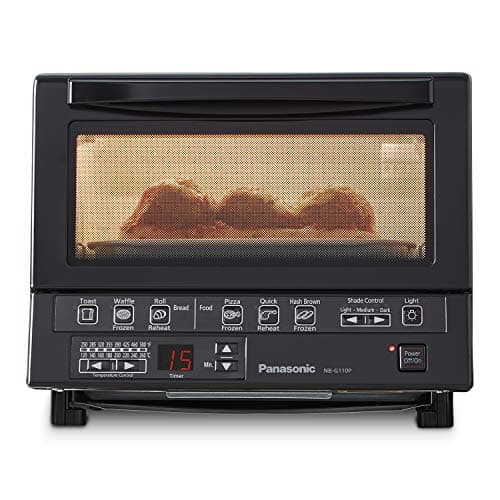
3. Panasonic FlashXpress (NB-G110P). The best-documented oven on this entire site: power consumption, supply voltage and frequency, capacity, temperature band and exact millimeter dimensions, all published by Panasonic. It also holds the highest temperature ceiling we have found anywhere in the catalog at 500°F, from twin infrared elements and no fan, which is why it also leads our polymer-clay ranking. Third rather than first for one reason: 7.2 quarts is small, four slices is the honest ceiling, and no amount of documentation adds capacity. It is also expensive for its size. Full review here.
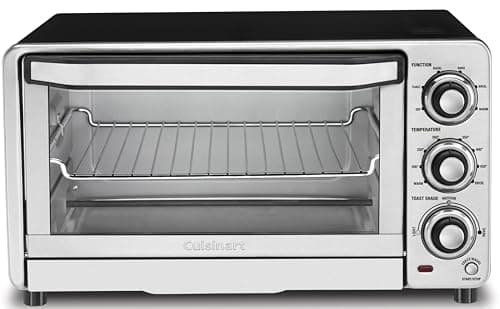
4. Cuisinart Custom Classic (TOB-40N). The full 1,800 watts behind three knobs, at well under half the price of an 1,800-watt Breville, and a design that has been sold essentially unchanged for over a decade — which in small appliances is the strongest reliability signal short of taking one apart. The costs are real: no convection fan at all, so everything this site says about moving air does not apply to it, and the only interior volume Cuisinart publishes for it (0.5 cubic feet) appears in its Amazon listing title rather than on a spec sheet — roughly half the cavity of the TOB-260N1 at the same wattage. Full review here.
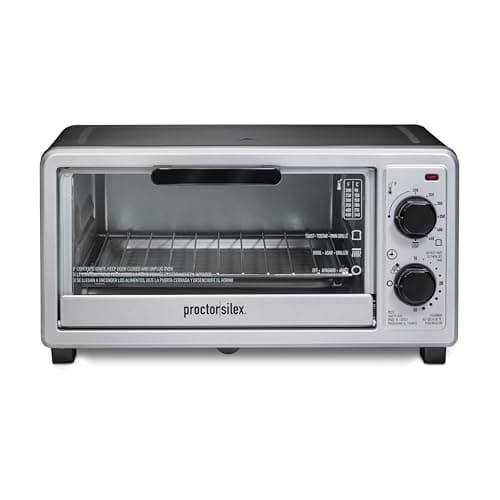
5. Proctor Silex 4 Slice (31260).The cheapest oven on the page and the holder of the longest warranty in our entire catalog — three years limited, which is longer than Breville gives. It publishes 1,100 watts and a 200–450°F band, so its running cost is checkable. Two honest cautions: the wattage comes from Amazon listing data rather than Proctor Silex's own page, and the brand contradicts itself on temperature — the feature list says 200–450°F where the detail block says 150–450°F. No fan, no published interior volume, four slices.
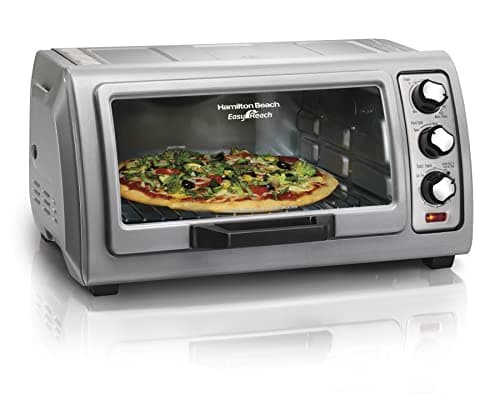
6. Hamilton Beach Easy Reach 6 Slice.Last, and on the page at all for one genuinely different idea: the door rolls up and out of the way instead of dropping down into your working space, so you can reach in without leaning over a hot panel. Six slices in the budget tier. It is last because it fails criterion three completely — we could find no published wattage for this SKU, and we are not willing to borrow the 4-slice model's figure and call it this one's — and because the roll-top is another moving part in a cheap appliance. Full review here. It is also the pick we rank first for a reader with limited reach or grip, where the door matters more than the spec sheet.
What it costs to run without the fan
Four of the six publish a wattage, and at the US average residential rate this site uses throughout, full rated draw works out at roughly 33.0 cents an hour for the two 1,800-watt Cuisinarts, 27.5 cents for the 1,500-watt BLACK+DECKER, 23.8 cents for the 1,300-watt Panasonic and 20.2 cents for the 1,100-watt Proctor Silex. Every one of those is a ceiling and we label it as such: an oven draws its rated wattage only while the elements are energized, and the thermostat cycles them off once the cavity is up to temperature. Nobody publishes duty cycles, so we compute at full draw rather than invent a correction factor.
A thing worth knowing if you are skipping the fan to save money: you probably will not. The fan motor in a countertop oven is a few tens of watts inside an 1,800-watt appliance, so it is not where the bill comes from — and a convection oven that finishes sooner can use less energy for the same dish than a radiant one that takes longer. There is no published figure to quantify that either way, so we are not going to pretend there is. The full arithmetic, with the usage assumption stated, and every published wattage we hold.
Who should buy an air fryer oven instead
Anyone whose weekly cooking is mostly frozen and mostly crisp. Anyone who wants presets because they do not want to think about a temperature. Anyone who needs more than about one cubic foot, because the biggest cavities in this category are all sold as air fryer ovens — the big-batch field is ranked here. And anyone replacing a full-size oven rather than supplementing one, for which the honest answer is set out here.
Everyone else is being sold a mode. If you bake, roast, broil and toast, buy on the cavity, the published wattage and the warranty, and treat air fry as a tiebreaker rather than a requirement. That is what this page ranks on, and it is why the oven at the top of it has no basket.