The short answer
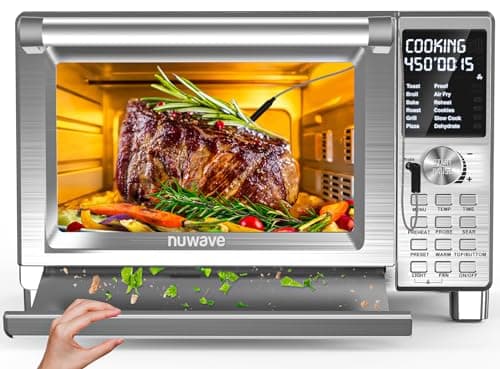
Buy it if you roast to an internal temperature and would rather the oven stopped itself than trusted a clock. The probe is the point of this machine: Nuwave's own manual states that it targets between 50 and 212°F and that the oven stops cookingwhen the target is reached, which is a mechanism rather than a readout. Everything else good about the oven — thirty quarts of claimed volume, four rack levels, a published 50–500°F band in 5°F steps — comes along at a price well under either Ninja that offers a probe. Skip it if you mostly air fry vegetables and reheat, because you are paying for the probe and the rack levels and nothing else here is best in class.
We have not cooked in this oven. There is no test kitchen behind this site and our rubric says so in those words. What follows is what Nuwave publishes, where each figure is published, the arithmetic those figures support, and the two places where Nuwave's own documents disagree with each other.
What Nuwave actually publishes, which is more than most
A real specification table, which in this category is not a given. Nuwave's own product page gives a 30 QT capacity, a 120 V supply, outer dimensions of 19.875 by 14.75 by 11.125 inches, inner dimensions of 14.50 by 13 by 7.625 inches, a weight of 25 pounds, a temperature range of 50 to 500°F in 5°F increments, and twelve menu functions. The model 20813 owner's manual adds the probe's target range and the warranty terms.
The interior figure is the one worth stopping on. Publishing an interior dimension puts Nuwave in a small minority here: Breville publishes an interior volume for the BOV900 and an interior dimension for none of its five models, Midea publishes an exterior and no interior at all, and the entire sub-fifty-dollar bandpublishes neither. Nuwave also publishes, in its own FAQ, that a standard 13 by 9 by 3 inch pan fits — so unlike almost every oven on this site, you can check a specific dish against this one before you spend anything. Our pan-fit guide covers who else does that, and it is a short list.
The 30 QT headline does not match Nuwave's own interior figures
This is the finding of the review, and it only exists because Nuwave published enough to be checked. Multiply the interior dimensions out: 14.50 by 13 by 7.625 inches is 1,437 cubic inches. A US quart is 57.75 cubic inches, so those figures describe a cavity of about 24.9 quarts— roughly 23.5 liters. The number on the box is 30 QT, which is about 17% more.
The honest caveats, because we are doing arithmetic on someone else's measurements and not measuring anything ourselves. Oven capacity has no industry definition: makers variously measure to the glass, to the cavity walls, with the racks removed, or to a nominal gross figure that includes space behind the fan housing. A rounded-up marketing quart is not uncommon and is not the same thing as a false specification. And a cavity that is square-cornered in its published dimensions is rarely square-cornered in reality.
What remains true regardless: the figure you should plan with is the interior dimension, not the quart count.7.625 inches of published interior height is the number that decides whether a tall dish, a stacked rack or a chicken fits, and it is also the number that explains the published 10 lb chicken claim being a reach. This is the third time this site has recorded a maker's headline capacity disagreeing with its own published interior — the Our Place Large Wonder Oven does it too, as does the Midea Flexify on its two weights — and in all three cases the contradiction is only visible on the ovens whose makers publish the most.
The probe, and what the published range means
A probe on a countertop oven can mean two very different things: a thermometer that shows you a number, or a control input that ends the cook. Nuwave's manual puts this one in the second category — it targets 50 to 212°F and the oven stops cooking when the target is reached. That is the difference between a feature and a mechanism, and it is why this oven ranks where it does on our probe-oven ranking.
The 212°F ceiling is a genuine limit and a sensible one: 212°F is boiling point, and every finished internal temperature anybody cooks to sits well below it — poultry at 165°F, a medium-rare roast at 130°F, bread at around 200°F. So the published range covers the whole useful span and stops exactly where usefulness stops. It also means the probe is not a cavity thermometer: you cannot use it to find out what the oven is actually doing at 400°F, which is the thing you would most like to know.
The practical value is specific. A probe that stops the oven converts roasting from a timing problem into a temperature problem, which is the right way round — a 4 lb chicken and a 6 lb chicken are done at the same internal temperature and at very different times. Against the two probe-equipped Ninjas in our catalog, both of which cost more, Nuwave is the only one of the three whose own manual states the target range and the stop behavior rather than leaving both to the listing copy.
The 50°F floor is a control range, not a capability
Nuwave publishes 50 to 500°F, in 5°F increments. The 5°F step is real and valuable: it is the finest published temperature increment of any oven on this site, matched only by Midea, and it is what makes the oven usable for the low, narrow-window jobs where a knob marked every 50 degrees is a guess — annealing a 3D print, holding a proof, running a dehydrate.
The 50°F end of that band deserves a plain sentence rather than a bullet point, though: 50°F is below room temperature in most kitchens. An oven heats; it does not refrigerate. So the bottom of a published range like this one describes the span the control will accept, not a cavity temperature the appliance can produce. In practice the lowest setting that means anything is somewhere above ambient, and no manufacturer in this category publishes a thermostat tolerance, so there is no document that tells you where. We are reporting the published figure and what it can and cannot be; we are not going to characterize its accuracy, because nobody has published anything to characterize it with.
Read alongside the rest of the catalog, the comparison is still flattering: the Breville BOV950 publishes an 80°F floor, the Our Place Wonder Oven Pro80°F, Midea 100°F, the BOV680 120°F in its manual, and a long list of cheaper ovens stop at 200°F. Whatever the 50 means, this oven is at the bottom end of a field where a low published floor is rare.
The wattage is a Q&A answer, not a rating plate
The one real documentation failure here, and it is the figure every running-cost page on this site depends on. Nuwave's specification table gives the supply as 120 V and prints no wattage. The model 20813 owner's manual gives the same 120 V and no wattage either. The 1,800-watt figure this site publishes for the oven comes from Nuwave's own answer, dated 30 June 2026, to a customer question on the product page — brand-supplied, in Nuwave's own words, and consistent with the 15 amps it quotes in the same answer, but not a reproduction of a rating line.
That distinction is not pedantry on a 1,800-watt appliance. Fifteen amps is the entire capacity of a 15-amp branch circuit, and the figure that tells you so is sitting in a Q&A reply rather than in the specification table where a buyer checking their kitchen wiring would look. Our dedicated-circuit guide works through why that matters, and Breville — which does print a rating line — recommends a dedicated circuit in its own instruction book.
With the figure we do have: at the US average residential rate of 18.34¢ per kWh, 1,800 watts costs 33.0¢ an hour of oven-on time. At half an hour a day every day that is about $60 a year, and the sum is written out in full on our air-fryer-oven electricity page. It is the same hourly cost as a Breville BOV900, a BOV860 or a BOV680, because all four draw the same rated power — spending more in this category does not buy efficiency, it buys documentation and control. Watts by model lists the whole field.
Size, footprint and the four rack levels
19.875 inches wide, 14.75 deep, 11.125 high and 25 pounds, all published. That is a large appliance but not an extreme one: it is narrower than the Breville BOV900's 21.4 inches, which is the width that defeats most upper-cabinet clearances, and at 14.75 inches deep it will sit on a standard counter without overhanging the front edge. Under a wall cabinet is a different question — 11.125 inches plus the clearance the manual asks for is most of the gap — and our clearance guide covers what the manuals require.
The four rack levels inside are the second real argument for the oven, after the probe. Nuwave's own figures for what the cavity takes are a 10 lb chicken or two 13-inch pizzas, and the published 13 by 9 by 3 inch pan fit is the one most people will actually use. Four levels in 7.625 inches of published height means the usable gap per level is small, so treat the count as flexibility about where one tray sits rather than as permission to fill all four.
The warranty, read properly
One year limited, and the manual's restrictions are the part worth reading: it covers the original purchaser only, and the continental US only. Both of those are meaningful. Original-purchaser-only voids the cover on a gift receipt resale and on anything bought second-hand; continental-US-only excludes Alaska, Hawaii and the territories.
In context, one year is below the middle of this category rather than at the bottom. BLACK+DECKER publishes two years on ovens costing a third as much, Proctor Silex publishes three on a fifty-dollar oven, and our brand-by-brand warranty audit found that eleven of thirty-five ovens publish a term at all and that the price order and the warranty order are close to unrelated. For a 25-pound appliance with a fan motor, a probe socket and a control board in it, a one-year term on a two-hundred-dollar purchase is the weakest thing on this page after the missing rating plate.
Who should buy it, and who should not
Buy itif you roast meat to temperature, if you want a low published floor and a 5°F step for proofing or dehydrating, or if you want an oven whose published interior dimensions let you check your own dishes before buying. At about two hundred and twenty dollars it undercuts every other probe oven in our catalog and it publishes more than most ovens at twice the money.
Skip it if you do not cook to an internal temperature. Everything this oven does better than a cheaper 30-quart box is the probe and the rack levels; without those, a smaller oven with a rating-plate wattage is the better-documented buy and the Breville comparison goes the other way. We ran that head-to-head separately, and the short version is that Breville publishes a rating line and a decade of production history while Nuwave publishes an interior you can measure.
Also skip it if the thirty quarts is why you are looking. On Nuwave's own interior figures this is a 25-quart oven with a 30-quart label, which is still a large countertop oven and is not the oven that will take a turkey — that page is about ovens with more published height.
How to check a capacity claim with a calculator
This oven is a good teaching case because it is one of the few that makes the check possible. Multiply the published interior dimensions in inches, then divide by 57.75 for US quarts or by 61.02 for liters. If the result is within a few percent of the headline figure, the headline is a measurement. If it is 15 or 20 percent under, the headline is a marketing number — and you now know which figure to plan your cookware against.
The asymmetry worth noticing: you can only run this check on makers who publish an interior dimension, which is a small minority of this category. An oven that publishes only “30 QT” is not more honest than one whose two figures disagree; it is simply unfalsifiable. That is the entire reason our Documentation score exists and why it weighs publishing a figure above the figure being flattering.
What a probe is worth, and what it is not
A probe that stops the oven is worth most on large, expensive, variable-mass proteins — a roast, a whole chicken, a pork shoulder — where the difference between done and overdone is twenty minutes and the right endpoint is a temperature rather than a time. It is worth nothing on anything you cook by time and appearance, which is most of what a countertop oven does: toast, reheating, trays of vegetables, frozen food. If your honest answer is “I roast something like that three times a year”, a $15 instant-read thermometer does the same job on any oven and costs a fourteenth of the premium.
What a probe does not do is tell you whether the oven's own thermostat is honest. The probe reads the food. The cavity temperature is still whatever the thermostat delivers, with a tolerance nobody in this category publishes — the one brand that has written anything down about it states that its ovens run below their set point by design. A probe is a better endpoint, not a better oven.
Reading a specification table against a Q&A answer
The hierarchy this site applies, in order: a rating plate reproduced in the manual, then a specification table on the manufacturer's own page, then the manufacturer's own listing copy, then a manufacturer's answer to a customer question. All four are brand-supplied; they are not equally durable. A rating plate is a regulatory artefact. A Q&A answer is one employee's reply on a date, and it can be deleted without a changelog.
For the Bravo XL Pro that hierarchy puts the capacity, the dimensions, the range and the increments on firm ground, the probe range and the warranty on the firmest ground available here (the manual), and the 1,800 watts on the softest. We publish the watt figure because Nuwave stated it and the 15 amps it quotes alongside is arithmetically consistent with it, and we label where it came from every time it renders. If the number matters to your decision, the rating plate on the back of the oven settles it in ten seconds on the day it arrives, inside the return window.