HUB 06 · Guides & Answers
True Convection vs Fan Convection
Five names describe three actual machines, and one of them has no fan at all. Here is what each term means, how to tell which one is sitting on your counter, and why the distinction that matters in a full-size range mostly collapses at countertop scale.
We earn a commission if you buy through our links. It does not change the price you pay, and it does not decide our picks — the scoring rubric is published in full, including what disqualifies an oven. How this works.
The answer, first
Fan convectioncirculates air that the oven's existing bake and broil elements heated. True convection — also sold as third-element convection or European convection — adds a separate heating element wrapped around the fan, so the air is heated as it is moved rather than merely stirred. Natural convection is not a third kind of fan; it means there is no fan, and the phrase describes hot air rising, which is true of every oven ever built. On a full-size range the true-convection distinction is real. On a countertop oven it is mostly absent from the specification sheets entirely, and what separates good from bad is a different number.
The five names, sorted
| Term | Is there a fan? | What it actually describes |
|---|---|---|
| Convection | Yes | The generic US term. A fan moves air heated by the bake and broil elements. |
| Fan / fan-forced / fan-assisted | Yes | The same machine, named the UK and Australian way. A “fan oven” is a convection oven. |
| True / third-element / European convection | Yes, plus its own element | A dedicated heating element ringed around the fan, so air arrives at temperature rather than borrowing heat from elements that are cycling on and off. |
| Natural convection | No | Hot air rising. A physics term used as a feature name on ovens that have no fan at all. |
| Air fry | Yes | A convection fan run fast, usually with a perforated basket. The mechanism is identical. |
What the third element actually buys
Evenness across more than one rack, and a shorter recovery after you open the door. In a fan-only oven the air the fan pushes is only as hot as whatever the bake element last put into it, and that element cycles: on to reach the set point, off while the thermostat waits. During the off phase the fan is circulating air that is cooling. With a dedicated element around the fan, air is being heated at the moment it is being moved, so the temperature the food sees fluctuates less. In a tall range with three racks of cookies, that difference is visible on the top tray.
On a countertop it is a much smaller effect, for a boring reason: the cavity is small. A countertop oven holds roughly one cubic foot of air rather than five, so it recovers temperature quickly whatever heats it, and almost none of them have more than two usable rack positions to be uneven across. That is why you will search a countertop oven's specification sheet for “true convection” and generally not find it — not because the manufacturers are hiding it, but because at this scale it is not the axis they compete on.
What replaces it at countertop scale
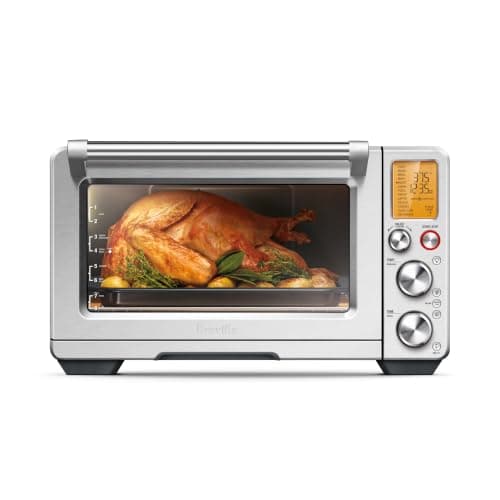
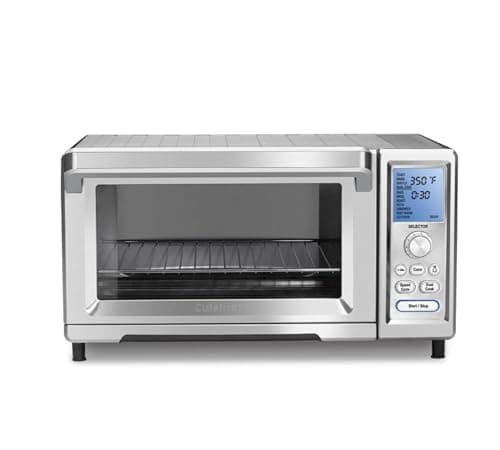
Element count and element control. The Breville Smart Oven Air Fryer Pro drives six elements independently rather than switching them in banks — that is the actual mechanical difference behind its price, and it addresses the same problem a third element does from a different direction: put heat where the food needs it, rather than heating the whole cavity and hoping the fan sorts it out. Our review covers what that costs. The Cuisinart TOB-260N1 takes the other approach that works here — a dual-cook mode that runs two temperatures in sequence — and it is the only oven on this site whose maker publishes both a wattage and an interior volume on the same page.
Neither is “true convection” in the range-marketing sense. Both solve the problem true convection was invented to solve. If a countertop listing does claim true convection, ask it the same question we ask everything else: where is that published? A claim that appears only in a bullet point and never in a specification table is a claim you cannot check.
How to tell which one you have
Look at the back wall of the cavity. A fan oven has a circular grille or a visible fan blade centered on the rear panel. No grille, no fan — whatever the box said. This is the only test that cannot be marketed around.
Then look at the control. If there is a setting labeled Convection, Fan, Air Fry, Convection Bake or Convection Roast, there is a fan and you can switch it. If the only settings are Bake, Broil and Toast, there is not. Convection bake and air fry are usually the same fan at different speeds, which is why an oven can offer both without adding hardware.
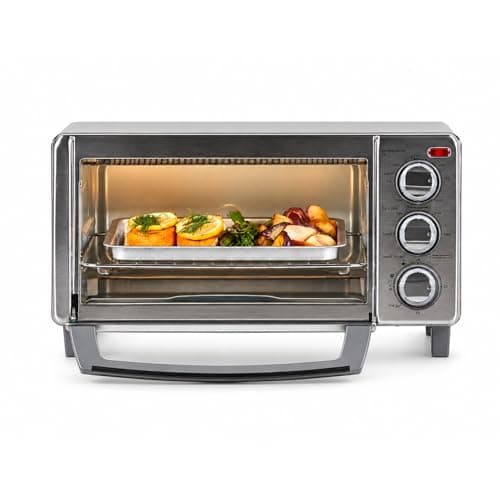
Be suspicious of “natural convection.” The BLACK+DECKER TO1785SG is honest about this in a way the category often is not: it says natural convection and it means no fan, and BLACK+DECKER still publishes 1,150 watts, 120 volts, the capacity, the dimensions and a two-year warranty for it — better documentation than several ovens here costing five times as much. Its review explains what you give up. The phrase is not a lie. It is just a description of physics wearing a feature's clothes.
Does the naming change how you cook?
Only in one direction, and the adjustment is the same for every fan oven regardless of which name it wears. Moving air transfers heat to food faster than still air, so a recipe written for a conventional oven runs hot in a fan oven: drop the temperature by about 25°F, or cut the time by roughly a fifth, and check early the first time. Our conversion chart does the arithmetic for every common temperature. A true-convection oven does not need a different conversion than a fan-convection one — the adjustment is for the fan, and both have one.
The part worth remembering
If you are shopping for a countertop oven, the true-versus-fan question is not the one to optimize. Almost nothing in this category publishes an answer to it, and the difference it describes shrinks with the cavity. The numbers that do change your outcome are published, and are on every page of this site: rated wattage, interior volume, and temperature range. Two of those decide how fast and how evenly the oven cooks; the third decides what fits. Our convection oven ranking sorts on exactly those.
The hardware
The ovens this page is about
The ovens referred to above, with prices pulled live from Amazon and dated on every card. Full rankings live in the roundups linked from this page.
1,800 W
Breville Smart Oven Air Fryer Pro (BOV900BSS)
The most completely documented oven in the category, and the only one at any price whose manufacturer publishes a rated wattage, an interior volume and a full element layout in the same place. You pay roughly four times the category floor for that, and about a third of the premium is the documentation itself.
1,800 W
Cuisinart Chef's Convection Toaster Oven (TOB-260N1)
The only oven here whose manufacturer publishes both a wattage and an interior volume in cubic feet on the same page. 0.95 cubic feet at 1,800 W, with a stated list of what fits — a 13-inch pizza, a 9x13 pan, nine slices.
1,150 W
BLACK+DECKER 4-Slice Toaster Oven with Natural Convection (TO1785SG)
1,150 W, 120 V, four slices, a 9-inch pizza and a two-year warranty — all published by BLACK+DECKER on its own site. For sixty-five dollars that is a more complete specification than several ovens here costing three hundred.
#ad · As an Amazon Associate we earn from qualifying purchases.
Questions
Frequently asked
What is the difference between true convection and fan convection?
Is a fan oven the same as a convection oven?
What does natural convection mean on a toaster oven?
Do countertop ovens have true convection?
How do I tell if I have a convection or a conventional oven?
Keep reading
Related
- Convection vs conventional ovenThe buying decision the terminology sits underneath.
- Convection conversion chartThe 25°F adjustment, worked out for every common temperature.
- Convection bake vs air fry settingWhy one machine can honestly offer both.
- Best countertop convection ovensRanked on the numbers that are actually published.
Receipts
Sources
- Breville — the Smart Oven Air Fryer Pro (BOV900) instruction book [PDF]
- Cuisinart — Chef's Convection Toaster Oven TOB-260N1 product page
- BLACK+DECKER — Crisp 'N Bake Air Fry 4-Slice Toaster Oven (TO1785SG) product page
We have not cooked in these ovens and we do not pretend to have. Specifications come from the manufacturer's own published documents; electricity rates come from the US Energy Information Administration; prices come from the live Amazon API. Where a figure is not published, the page says “not published” rather than guessing. Read the full method.