The short answer
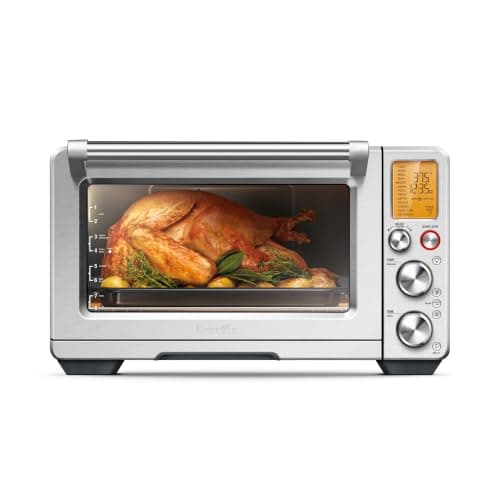
Buy the Breville Smart Oven Air Fryer Pro (BOV900) and keep the change. It is for the household making one purchase for the next decade: Breville publishes a 1,800-watt rating plate in the manual, a one-cubic-foot interior, the full exterior and thirteen functions, which is the most complete spec sheet in the category. The budget pick is the Nuwave Bravo XL Pro at roughly a third of this page's ceiling — it publishes both its inner and outer dimensions, a 50–500°F range and an integrated probe that stops the cook at a target temperature, which several ovens twice its price do not. The one oven here that genuinely costs near $500, the Breville Joule BOV950, publishes the same wattage, the same cubic foot, the same exterior, the same weight and the same temperature range as the cheaper BOV900.
Band check. As of November 13, 2026, 5 of the 5 picks here with a live Amazon price sat at or under $500 — Breville Smart Oven Air Fryer Pro (BOV900BSS) at $319.95; Ninja Double Oven with FlexDoor, 12-in-1 (DCT401) at $369.95; Our Place Wonder Oven Pro (8-in-1, 28 L) at $275.00; Nuwave Bravo XL Pro Air Fryer Toaster Oven (30 Qt, with probe) at $219.99; Breville Joule Oven Air Fryer Pro (BOV950BSS) at $499.95.
We have not cooked in any of these. Our rubric says so in those words. The comparison below is published specifications and arithmetic on them, not test results.
Why a $500 ceiling is not a constraint in this category
Every single countertop oven in this catalog of forty sells below $500, and the most expensive of them sits within a few dollars of the line. So “under $500” does not filter the field the way under $100 or under $200 genuinely do. What it does is put you in the position of being able to buy anything — and the honest finding, from the makers' own documents, is that the top of the market is not where the capability is:
- Spending more never buys a cheaper oven to run. Every Breville in this catalog, the Nuwave and the Cuisinarts are all rated 1,800 watts — 15.0 amps and 33.0¢ an hour at 18.34¢ per kWh. The Wonder Oven Pro is 1,700 W. Nothing above $200 is more efficient than anything else.
- The dearest oven here publishes nothing the cheaper one does not. The BOV950's premium over the BOV900 is the Joule app, Autopilot and voice control. Every mechanical figure Breville publishes for the two is identical.
- Two ovens below the middle of the band buy real mechanisms. A split door that makes two independently controlled ovens, and a published 80°F floor with a 24-hour timer. Neither is available at any price from the brands with the best spec sheets.
The five, on published figures
| Oven | Rated power | Published interior | Published range | Per hour | What the money buys |
|---|
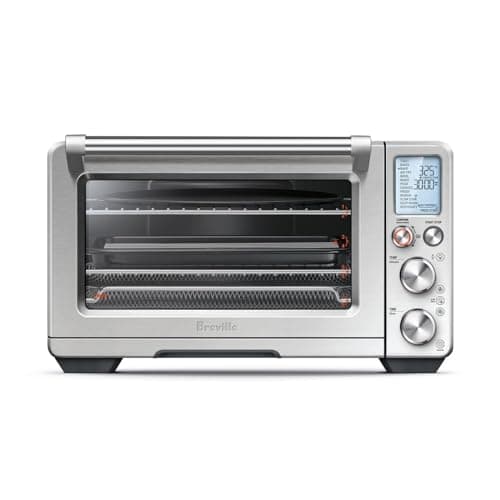
| Breville BOV900 | 1800 W (rating plate) | 1 cubic ft | Not published for this model | 33.0¢ | The most complete spec sheet here |
|---|
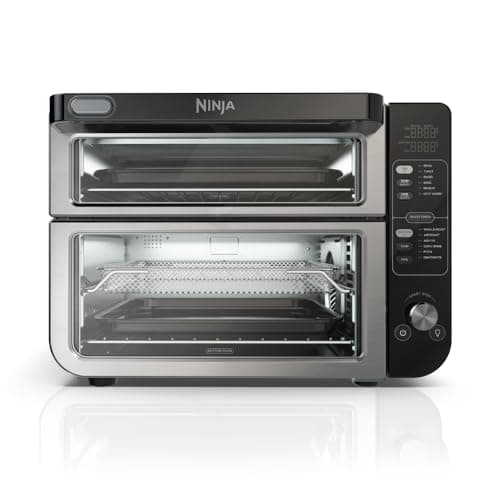
| Ninja DCT401 Double Oven | Not published | Not published | Not published | No figure — we publish none | Two independently controlled cavities |
|---|
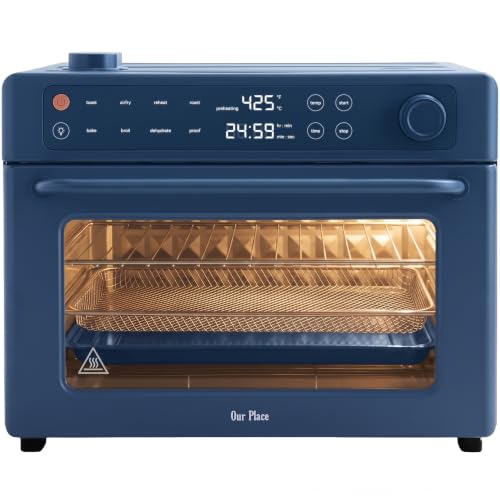
| Our Place Wonder Oven Pro | 1700W (product page) | W13.75" x D13" x H7.75" | 80–450°F | 31.2¢ | A published 80°F floor and a 24-hour timer |
|---|
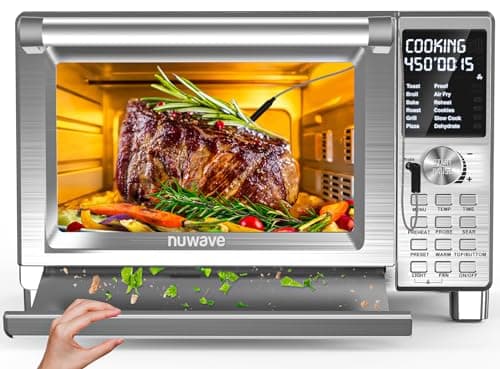
| Nuwave Bravo XL Pro | 1800 W (brand Q&A) | 14.50" x 13" x 7.625" (30 QT) | 50–500°F | 33.0¢ | A probe, four rack levels, both dimension sets |
|---|
| Breville BOV950 Joule | 1800 W (rating plate) | 1 cubic ft | 80–480°F | 33.0¢ | The BOV900 plus an app |
|---|
1. Breville BOV900 — for the ten-year purchase
Who it is for: the household that will buy once. Breville publishes the rated wattage, the one-cubic-foot interior, the exterior dimensions and the element count in one place, and almost nobody else in this category publishes all four. A 14-inch pizza or a 9x13 pan goes in without diagonal gymnastics, and Element iQ drives the six elements independently rather than switching them in banks.
The cons. 21.4 inches wide is wider than most upper-cabinet clearances allow and 17.3 deep is a lot of counter. Thirteen functions is nine more than most households use. And at 15.0amps it draws the whole of a 15-amp circuit — Breville recommends a dedicated one in its own instruction book. Our full review.
2. Ninja DCT401 Double Oven — for two dishes at two temperatures
Who it is for: anyone who regularly cooks two things that disagree about heat. The FlexDoor is real hardware rather than a preset: the box splits into two independently controlled ovens, and Ninja publishes the function split by cavity — six and six — plus a simultaneous fit of six pounds of wings and a 12-inch pizza.
The cons. Ninja publishes no wattage anywhere in its listing copy for this oven, so we show no running cost for it at all — on a page about what a premium buys, that is a real deduction. Neither cavity has a published interior volume, and splitting one box into two necessarily costs headroom in each; by how much, Ninja does not say. One-year warranty.
3. Our Place Wonder Oven Pro — for proofing, drying and a long cook
Who it is for: the baker or the batch cook. It is the only oven in this catalog whose own spec sheet permits proofing, dehydrating and an all-day cook: Our Place publishes an 80–450°F range and a timer that runs from 30 seconds to 24 hours, alongside interior and exterior dimensions, a weight, a rack count and the materials — more of the spec sheet than most brands print at any price.
The cons. Its stated 28 liters does not follow from the interior Our Place prints beside it: 13.75 x 13 x 7.75 inches is about 1,385 cubic inches, or roughly 22.7 liters. It draws 1,700 W, nearly the whole of a 15-amp circuit, for only marginally less than an 1,800-watt oven costs to run. And no rating-plate wattage is published — the figure is from the product page. Our full review.
4. Nuwave Bravo XL Pro — the budget pick
Who it is for: the cook who roasts to an internal temperature and does not want to spend the ceiling to do it. At roughly a third of this page's limit, Nuwave publishes both inner and outer dimensions, a 25 lb weight, a 50–500°F range in 5-degree increments, four rack levels and an integrated probe that stops the oven at a target between 50 and 212°F — per the manual, not a preset that merely displays a reading.
The cons. The 1,800-watt figure is a Nuwave support answer on its own product page rather than a rating line in the manual, and we say so wherever it renders. Twelve functions plus a hundred recipe presets is deep into marketing territory. One-year limited warranty, original purchaser only. Our full review.
5. Breville BOV950 Joule — the ceiling, and why it is last
Who it is for: precisely the person who will cook from a phone. It carries the most complete published spec sheet on this site — power, interior, exterior, weight, range, capacity and a two-year warranty — and an 80°F floor with a 480°F ceiling, the widest published band in our catalog.
The cons, and they are the whole point of this page. Every mechanical figure Breville publishes for it is identical to the cheaper BOV900: same 1,800 W, same 21.4 x 17.3 x 12.7 inches, same cubic foot, same 38.89 lb, same thirteen functions. The connected features need Bluetooth 4.0 and iOS 13 or Android 8 and later, so an oven bought for the app stops being one if the app stops. Our full review.
The honest summary of the band
If you have $500 to spend on a countertop oven, the published figures say spend less. The best-documented oven in the category costs well under the ceiling; the two most interesting mechanisms in the band — a split cavity and an 80°F floor — sit in the middle of it; and the single oven that actually reaches $500 is the mid-band flagship with a radio added. Spend the difference on pans that fit the cavity, or on nothing.
The three things a premium oven can genuinely buy
Documentation — a rating-plate wattage, an interior volume, a temperature range and a warranty term, which is what makes an oven comparable before you own it. A mechanism — a split cavity, a real probe, a published low temperature floor; these are hardware, not presets. And term — the warranty, because the control board usually fails before the elements. Function count is not on the list: thirteen functions is the same elements at different set points.
Check the circuit before the budget
Four of these five draw 1,700 to 1,800 watts, which is 14.2 to 15.0amps at 120 volts — effectively the entire rating of a standard 15-amp branch circuit before the kettle, the microwave or the fridge is counted. Breville recommends a dedicated circuit in its own instruction books. The amps arithmetic, worked through.
What “no published wattage” costs you at this price
Two ovens here publish no rating line, and one publishes none at all. At sixty dollars that is a footnote. At three to four hundred it is a brand declining to tell a paying customer what its appliance draws, which means no running cost, no amps figure and no way to plan a shared circuit. We publish no number rather than borrowing one from a similar model, and the gap is the finding. Where the published figures do exist, the arithmetic is here.