HUB 06 · Guides & Answers
Air Fryer Oven Disadvantages
Most lists of drawbacks in this category are opinions. These are six drawbacks you can check, because each one is a number a manufacturer published — or, in two cases, a number it conspicuously did not.
We earn a commission if you buy through our links. It does not change the price you pay, and it does not decide our picks — the scoring rubric is published in full, including what disqualifies an oven. How this works.
The short answer
The real disadvantages of an air fryer oven are not the ones usually listed. They are: it will not take a half-sheet pan, several models cannot reach the temperature a thin-crust pizza wants, the warranty terms are short and do not track price, a third of this catalog publishes no wattage at all, one maker bans operating its oven under a wall cabinet, and the function count is mostly labels. Every one of those is checkable before you buy, which is why they belong on a list and “the basket is annoying to clean” does not.
1. The pan ceiling, which nothing in this category exceeds
A half-sheet pan is 18 by 13 inches. Across every brand in this catalog, the largest pan any maker publishes a fit claim for is a 9 by 13 quarter-sheet. That is not a limitation of one model, it is the ceiling of the whole category as documented, and it is the drawback most likely to matter to somebody cooking for more than three. We worked that constraint through in full for batch baking.
2. Temperature ceilings, which vary more than the prices suggest
Published ceilings in this catalog run from 445°F to 500°F. The Instant Pot Omni Plus tops out at a published 450°F; the Breville BOV680 at 445°F; the Panasonic and the Nuwave both publish 500°F. Fifty degrees is a real gap for thin crust and for a hard finish on roast vegetables, and it does not correlate with price — one of the lowest published ceilings here belongs to one of the more expensive ovens.
3. Warranty terms, which are short and perverse
Nobody in this category publishes a duty cycle or an expected service life, so the warranty term is the only durability figure any maker commits to. The published terms in this catalog run from one year to three, and they run in the wrong direction: the longest term, three years limited, belongs to the Proctor Silex 31260, which is the cheapest oven on this site. Nuwave's manual limits its one-year term to the original purchaser and to the continental US. The lifespan guide tabulates every published term.
4. The missing wattages
Roughly a third of the ovens in this catalog publish no rated wattage anywhere in their maker's own materials. That has a direct consequence for a buyer: you cannot work out what the oven costs to run, you cannot check whether two of them will share a circuit, and you cannot compare it to anything on an energy basis. We print no running cost for those ovens rather than borrowing a number from a similar model. Every oven we can and cannot cost out is listed here.
The other half of this problem is evidence grade. Where a wattage does exist, it may come from a rating plate reproduced in an instruction book, from a spec table, or — in one case in this catalog — from a dated answer the brand gave to a customer question on its own product page. Same number, very different paperwork.
5. Placement, and the ban nobody mentions
These ovens need clearance, and the published figures differ by a factor of six: Breville asks 4 inches at the sides and 6 above, Nuwave 5 inches behind, beside and on top, Our Place 1 inch all round. More pointedly, Our Place's manual contains an outright prohibition most buyers never see: Do not operate your appliance in an appliance garage or under a wall cabinet.
If your plan for this oven is the gap under the upper cabinets — which is where most counters have room — that sentence is a disadvantage with your name on it. Every published clearance figure is tabulated here, and the ovens that actually fit under a cabinet are ranked here.
6. The function count is mostly labels
A thirteen-in-one oven does not do thirteen things. It has thirteen labelled combinations of element, fan speed and set point, and if a preset would be replaced by turning a dial to 400°F, it is a label rather than a feature. Two features in this category are genuinely hardware — a rotisserie spit and a temperature probe — and both are named in the specification rather than buried in the count.
The honest version of this drawback is about control panels rather than marketing: every preset is one more thing on a board, and the board is usually what retires an oven whose elements are fine.
The disadvantages people list that are not disadvantages
“It is not really air frying.” Correct and irrelevant. If the oven has a fan and a rack that lets air under the food, it does the thing the name describes. Where the basket genuinely wins.
“It is expensive to run.” The opposite, for single-tray cooking: heating one cubic foot of air beats heating five. The arithmetic is published here.
“They are unhealthy or toxic.” We have gone through the evidence rather than the headlines on both counts: are air fryers healthy, are air fryers toxic and do air fryers cause cancer. The short version is that the effects are real, modest, and apply to high-heat dry cooking generally rather than to air fryers specifically.
How to buy around the drawbacks
Buy the published pan, not the stated volume. It is the only capacity figure you can hold a tray against, and liters routinely include space no pan can occupy.
Check the ceiling if you make pizza. 450°F and 500°F are both published figures in this catalog, and the difference is visible in a crust.
Measure the cabinet gap before anything else. One maker bans the location outright and the published clearance requirements vary sixfold, so this decides the shortlist rather than refining it.
Prefer an oven with a published wattage. Not because the number is interesting, but because a brand that will tell you what its oven draws has told you something about itself. That is one of the five metrics we score.
Then pick from a ranking rather than a shelf. The best air fryer toaster ovens, the ones under $200 and the small-footprint ranking all sort the catalog on a different axis.
The hardware
The ovens this page is about
The ovens referred to above, with prices pulled live from Amazon and dated on every card. Full rankings live in the roundups linked from this page.
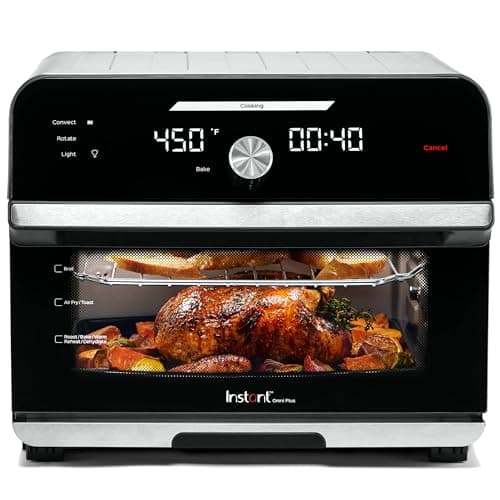
Wattage not published
Instant Pot Omni Plus 19QT/18L Toaster Oven Air Fryer, 10-in-1
One of the few ovens here that publishes its interior in liters, which makes it the easiest in the category to compare on paper. The rotisserie is a genuine mechanical addition rather than a relabeled fan setting.
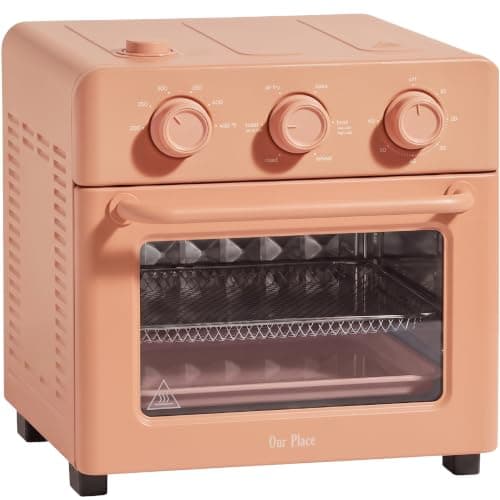
1,400 W
Our Place Wonder Oven (6-in-1, 13 Qt)
The most completely documented small oven we have covered, from a brand better known for pans. Our Place publishes the rating-plate wattage, the temperature range, the interior dimensions and the warranty term — all four things we score documentation on. At 1,400 W it costs less per hour than the 1,800 W field; at four slices and a 9-inch pizza it is genuinely small; and the limits are published too — a 200°F floor and a 60-minute timer.
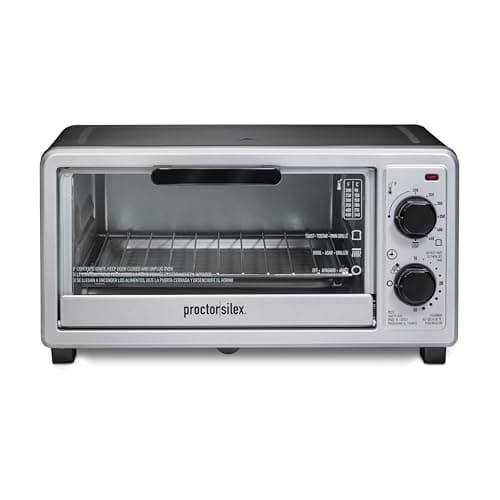
1,100 W
Proctor Silex 4 Slice Countertop Toaster Oven (31260)
Fifty dollars, four slices, three manual controls — and, unusually for the price, a published wattage and a three-year warranty. It does the same three things the ovens at four times the money do; what you give up is the fan, the evenness and the interior.
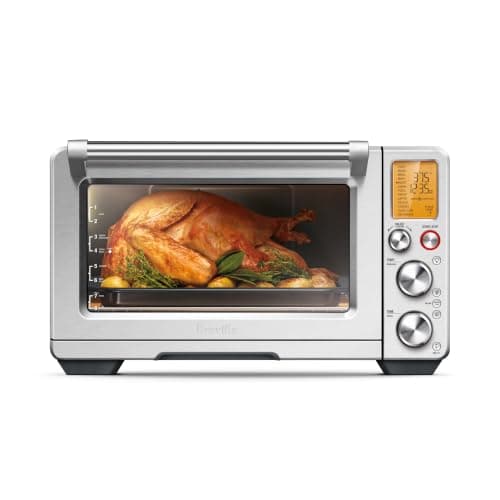
1,800 W
Breville Smart Oven Air Fryer Pro (BOV900BSS)
The most completely documented oven in the category, and the only one at any price whose manufacturer publishes a rated wattage, an interior volume and a full element layout in the same place. You pay roughly four times the category floor for that, and about a third of the premium is the documentation itself.
#ad · As an Amazon Associate we earn from qualifying purchases.
Questions
Frequently asked
What is the biggest disadvantage of an air fryer oven?
Do air fryer ovens use a lot of electricity?
Why is my air fryer oven warranty only one year?
Can I put an air fryer oven under a kitchen cabinet?
Are all those functions useful?
Keep reading
Related
- Can an air fryer replace your oven?The same drawbacks, framed as a decision.
- How much clearance does one need?Published figures that differ by a factor of six.
- How long do toaster ovens last?Every published warranty term, in one table.
- Countertop oven vs the oven in the wallThe arithmetic behind the category's main advantage.
- Basket vs ovenWhere a basket genuinely beats an oven.
Receipts
Sources
- Instant Brands — Instant Pot Omni Plus 18L Air Fryer Toaster Oven product page
- Our Place — Wonder Oven user manual, model APL.WDO.ESN [PDF, retailer-hosted copy]
- Our Place — Wonder Oven product page
- Nuwave — Bravo XL Pro owner's manual, model 20813 [PDF]
- Proctor Silex — 4 Slice Toaster Oven Broiler (31260G) product page
- Breville — Smart Oven Air Fryer Pro (BOV900) product page, capacity claim
- BLACK+DECKER — TO3250XSB / TO3260XSBD / TO3240XSBD use and care manual [PDF]
We have not cooked in these ovens and we do not pretend to have. Specifications come from the manufacturer's own published documents; electricity rates come from the US Energy Information Administration; prices come from the live Amazon API. Where a figure is not published, the page says “not published” rather than guessing. Read the full method.