The short version
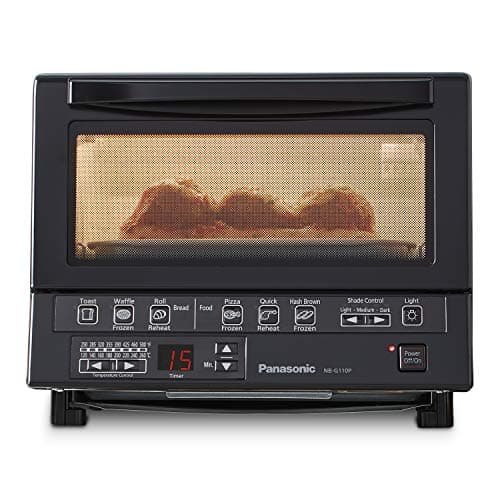
Buy the Panasonic FlashXpressif your cooking lives at the hot end — toast, reheating, a 9-inch pizza, anything you want browned fast. It publishes a 250 to 500°F range, and 500°F is the highest ceiling published by any oven on this site. It draws 1,300 watts against Breville's 1,800, which is about 28% less per hour, and it is the smallest completely specified box here at 330 by 304 by 260 millimetres — roughly 13 by 12 by 10 inches.
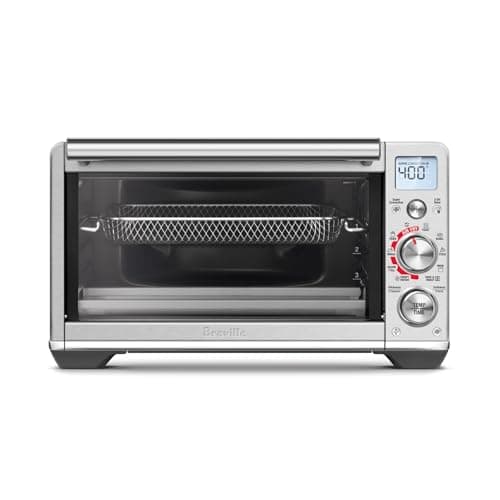
Buy the Breville Smart Oven Air Fryer Compact (BOV680) if you need the oven to go cold. Breville publishes a 120 to 445°F band on Bake and Roast, and everything that lives below 250°F — proofing dough, holding a plate warm, drying, slow roasting — is outside the FlashXpress's published range entirely. The BOV680 also adds an air-fry basket, a convection fan and ten functions, including a broil with two published levels.
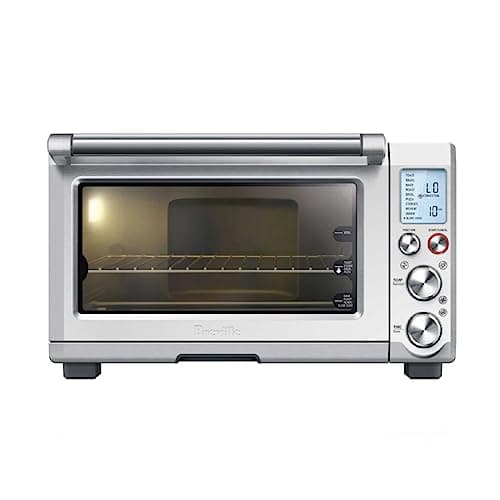
The Breville Smart Oven Pro (BOV845)is on this page because it is what most people actually mean by “the Breville Smart Oven”, and it is not really in this fight: 18.9 inches wide, 1,800 watts, a published 120°F floor, ten functions and no air fry at all. Against a FlashXpress it is a different class of appliance.
We have cooked in none of the three. There is no test kitchen behind this site and every figure below came off a manufacturer document.
The finding: the two bands do not contain each other
This is the reason the comparison is interesting rather than a price comparison with a predictable answer. Lay the two published ranges on one line:
- 120 to 250°F — Breville only.Proofing, holding, dehydrating, very slow roasting. Panasonic's published floor is 250°F, so these temperatures are not a feature the FlashXpress lacks; they are outside what Panasonic says the oven does.
- 250 to 445°F — both. Nearly all everyday baking and roasting. Here the two ovens are genuinely cross-shoppable and the decision is size, money and whether you want a fan.
- 445 to 500°F — Panasonic only.Pizza, fast browning, anything where surface heat is the whole point. Breville's published Bake and Roast ceiling is 445°F.
Neither oven is a superset of the other, which almost never happens in a category where spending more usually buys a wider band. If you can name the job, the published ranges name the oven.
Side by side, on published figures only
| Published figure | Panasonic FlashXpress NB-G110P | Breville BOV680 Compact | Breville BOV845 Smart Oven Pro |
|---|
| Rated power | 1300 W power consumption, 120 V 60 Hz | 120 V ~ 60 Hz 1800 W (manual) | 1800 W (product page) |
|---|
| Temperature range | 250–500°F | 120–445°F (Bake & Roast) | 120°F floor on Bake and Roast |
|---|
| Interior capacity | 7.2 quart | Not published | Not published |
|---|
| Interior dimensions | Not published | Not published | Not published |
|---|
| Exterior dimensions | 330 x 304 x 260 mm (about 13" x 12" x 10.2") | W15.7" x D16.9" x H10" | 18.9" x 15.9" x 10.9" |
|---|
| Toast capacity | Four slices | 1–4 slices (manual) | Not published as a figure |
|---|
| Functions | Six | Ten | Ten, no air fry |
|---|
| Air fry | No | Yes, with a basket | No |
|---|
| Heating described | Double infrared heater, front and back, published as giving instant heat that eliminates the need for preheating | Element and convection fan; broil published at HI and LO, capped at 20 minutes | Element and convection fan |
|---|
| Cost per hour at 18.34¢/kWh | 23.8¢ | 33.0¢ | 33.0¢ |
|---|
One row of that table is empty for all three ovens, and it is the row people most often need: neither maker publishes an interior dimension for any model here. Panasonic at least publishes a volume. Breville publishes no volume and no dimensions on either the BOV680 or the BOV845, which is the single consistent hole in an otherwise strong documentation record.
The preheat claim, reported rather than graded
Panasonic publishes something on its own product page that nobody else in this catalog does: the double infrared heater gives instant heat that eliminates the need for preheating, repeated in the marketing copy as no preheating required. The heaters sit at the front and back rather than above and below, and infrared heats the surface of the food directly rather than heating the air first.
We have not cooked in one, so we report the claim and its source rather than grading it — whether it holds for a cake as well as for toast is not something Panasonic breaks down. The preheat guide covers what every manual here does and does not promise. Set against it, Breville publishes a preheat step in the BOV680 book for most functions, with an alert when it finishes.
What 500 watts actually costs you
At the EIA's published US average of 18.34¢ per kWh, the FlashXpress is 23.8 cents an hour and either Breville is 33.0 cents — a difference of 9.2 cents per hour of cooking, or roughly $17 a year at half an hour a day. That is real but small, and it is not the reason to pick one.
The number that matters more is amperage. 1,300 watts is about 10.8 amps; 1,800 watts is about 15, which is a full household circuit on its own, and Breville recommends a dedicated circuit in its own instruction book. In a kitchen where the oven shares an outlet with a kettle or a microwave, that is the deciding figure rather than the cents — the full arithmetic is here.
Which Breville, if it is going to be a Breville
“Breville Smart Oven” covers four ovens in this catalog alone — the BOV680 Compact, the BOV845 Smart Oven Pro, the BOV860 Smart Oven Air Fryer and the BOV900 Smart Oven Air Fryer Pro — from 15.7 to 21.4 inches wide, all rated at 1,800 watts. Only the BOV680 is a sensible size opponent for a FlashXpress; the BOV845 is the name match and nearly twice the footprint.
If you were really weighing the FlashXpress against the big Breville air fryer, the relevant pages are the BOV900 review and the BOV845-versus-BOV900 head-to-head. If the FlashXpress's size is the appeal, the small-footprint ranking puts both against the rest of the field.
Two checks before either purchase
Write down the lowest temperature you will actually use. This is the only irreversible difference on the page. A small oven can be lived with and a slow oven can be waited on, but a published floor of 250°F cannot be worked around.
Measure depth, not width. The FlashXpress is about 12 inches deep; the BOV680 is 16.9 and its door drops down and out. Depth with the door open is what catches people out against a backsplash — the clearance guide covers what the manuals require.