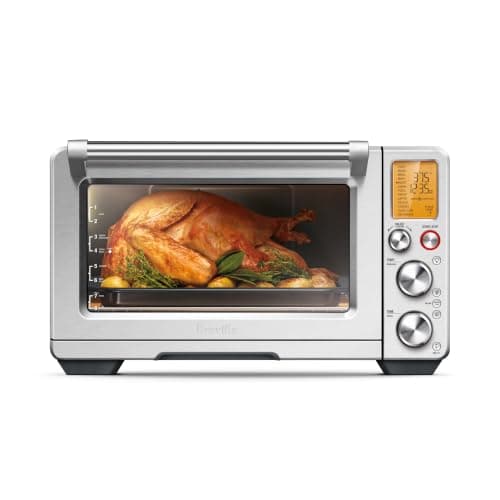
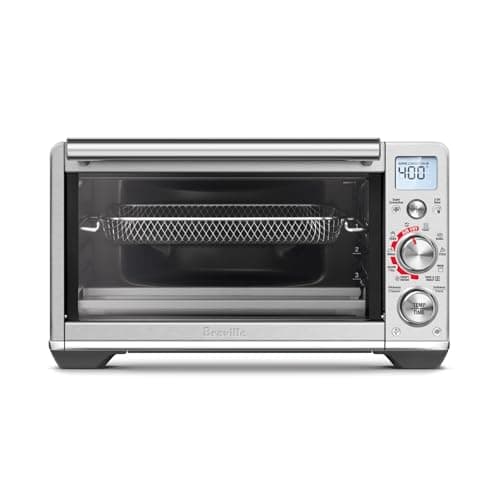
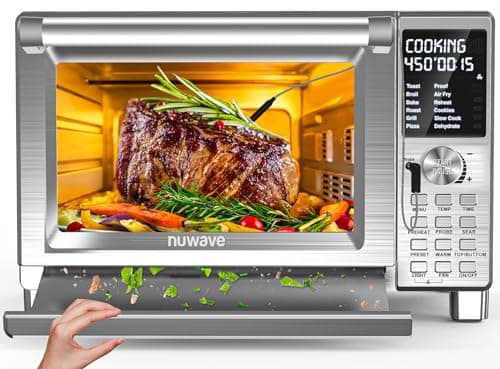
The short answer
Buy the Nuwave Bravo XL Proif you roast to an internal temperature. It has a probe that Nuwave's own manual says stops the cook at a target between 50°F and 212°F, it publishes both its outer and its inner dimensions, it publishes a 50–500°F band in 5°F increments, and it costs roughly half what the Breville does. Buy the Breville Smart Oven Air Fryer Pro (BOV900) if what you want is the best-documented oven in the category and six independently driven elements, and you are prepared to pay for engineering you can read about in an instruction book. For most kitchens the Nuwave is the better buy; for a kitchen that bakes, the Breville is the better oven.
Every published figure, side by side
| Published figure | Nuwave Bravo XL Pro | Breville BOV900 |
|---|
| Rated power | 1,800 W — a brand Q&A answer on the product page | 1,800 W — the rating line in the instruction book |
| Stated interior | 30 QT | 1 cubic ft (= 29.9 US qt) |
| Interior dimensions | 14.50 x 13 x 7.625 in | Not published |
| Exterior dimensions | 19.875 x 14.75 x 11.125 in | 21.4 x 17.3 x 12.7 in |
| Temperature band | 50–500°F, in 5°F increments | Not published for this model |
| Probe | Yes — target 50–212°F, oven stops at target | None |
| Weight | 25 lb | Not published for this model |
| Functions | 12 menu functions | 13 functions |
| Rack levels | 4 | Functions assigned across 8 rack positions in the book |
| Warranty | 1 year limited, original purchaser (manual) | Not in the specs we carry |
The finding: only one of these numbers can be checked
Both ovens claim about the same interior. Nuwave says 30 quarts. Breville says one cubic foot, which is 29.9 US quarts. On the headline, it is a tie.
Nuwave is the only one of the two that also prints the inside of the box: 14.50 x 13 x 7.625 inches. Multiply that out and you get 1,437 cubic inches, which is 0.83 cubic feet, 23.6 liters, or 24.9 US quarts. Against a stated 30 quarts, that is about five quarts short — roughly seventeen percent of the claim.
We are not calling that a false claim, because it probably is not one. Stated oven volume routinely includes space no pan can occupy, and an interior measurement may be taken between rack rails rather than wall to wall. Nuwave does not say which it did. We saw the same pattern on the Our Place Wonder Oven Pro, where a stated 28 liters computed to about 22.7 from the interior printed beside it — and where the same arithmetic on the standard Wonder Oven agreed. The useful conclusion is the same in both cases: buy on the inches, not on the quarts.
The awkward part for the expensive oven is that you cannot do this exercise to it at all. Breville publishes a cubic foot and no interior dimensions, so there is no arithmetic to run and no way to check. The cheaper oven is the only one of the two that is auditable, and being auditable costs it five quarts on paper. Which of those two situations you prefer is a real question, and we do not think the answer is obvious.
Where the money actually goes
Element control.This is the Breville's argument, and it is a good one. Element IQ drives six elements independently rather than switching them in banks, which is what lets the oven push heat at the top of a tray without cooking the base. Nuwave publishes a function list and no element architecture. If you bake, that difference is the premium and it is real. Why element behaviour decides bread.
The probe.This is the Nuwave's argument, and it is the more useful one for most households. A roast is done at an internal temperature, not at a time, and Nuwave's manual describes a probe that terminates the cook at a target you set. No Breville in this catalog has one at any price. Every probe-equipped oven here.
Counter.The Nuwave occupies 19.875 by 14.75 inches of worktop; the Breville 21.4 by 17.3. That is about 293 square inches against 370 — the Breville takes roughly a fifth more counter, and its 21.4-inch width is what makes it awkward to slide under a cabinet. Ovens ranked on under-cabinet clearance.
Running cost: identical. Both publish 1,800 W, so both cost the same per hour to run, and nothing about the price difference buys efficiency. The per-hour arithmetic is here with the rate exposed. What differs is the grade of evidencebehind the identical number: Breville reproduces its rating plate in the instruction book, while Nuwave's 1,800 W comes from a dated answer it gave to a customer question on its own product page, with the manual and the spec table both publishing 120 V and no wattage. Same figure, weaker paperwork.
Where the Breville is simply better documented
On two rows above, Breville publishes nothing: no temperature band and no weight for this model. That is worth saying out loud on a page that otherwise reads as an argument for the Breville's documentation, because the documentation is not uniform. Nuwave publishes a 50–500°F range in 5°F increments; the only Brevilles in this catalog with a published band are the compact BOV680 (120–445°F) and the BOV950 (80–480°F). On the BOV900 specifically, the set-point range is something you discover after delivery.
Where Breville is unambiguously ahead is the capacity claim. Its figure for this model is stated as objects — nine slices of toast, a 13-inch pizza, a 9 x 13 pan, a 12-cup muffin tray and a 14-pound turkey — and those are things you can hold up against your own kitchen. It is one of only two ovens here whose maker will print a bird weight.
The third oven on this page
If the Breville documentation is what you want and the footprint is what you cannot have, the Smart Oven Air Fryer Compact (BOV680)is the rung to look at: the same 1,800 W rating line printed in its own instruction book, a published 120–445°F Bake and Roast band, a stated one-to-four-slice toast capacity, and 15.7 inches of width instead of 21.4. The trade is honest and Breville states it — an 11-inch pizza pan, with a 12-inch pan going in only on the rack in the upward orientation.
How to decide between them
Do you roast meat to a temperature? If yes, take the Nuwave. The probe is the single biggest improvement available to a home cook in this category, and it is not available on the Breville at any price.
Do you bake things that brown unevenly? If yes, take the Breville. Independently driven elements are the mechanical difference behind the price, and they are the thing a function count cannot substitute for.
Is the counter the constraint?Measure before you decide. The Nuwave is about a fifth smaller in plan and nearly two inches shorter; the Breville is the widest oven in this catalog's premium band.
Is the specification the constraint? Then note which direction each gap runs. Nuwave publishes the interior, the exterior, the weight, the band and the probe behaviour, and fumbles the wattage evidence. Breville publishes the wattage off a rating plate and the element architecture, and publishes no interior dimensions, no band and no weight. Neither is complete. How we score documentation, and why it is one of the five metrics.
If neither is right, the alternatives are one click away. The overall convection ranking, the premium band, and the ovens that come in under two hundred dollars all sort the same catalog on different axes.