HUB 05 · Running Costs & Power
How Much Electricity Does a Convection Oven Use?
A few cents an hour, the same as any 1,800-watt oven -- and slightly less per dish than the same oven with the fan off, because convection finishes sooner. Here is the full arithmetic, with every input shown.
We earn a commission if you buy through our links. It does not change the price you pay, and it does not decide our picks — the scoring rubric is published in full, including what disqualifies an oven. How this works.
The answer, first
A full-size countertop convection oven at 1,800 watts costs about 33.0¢ an hour to run at full draw. A smaller, fully specified model at 1,300 watts costs about 23.8¢ an hour. Over a year, at 30 minutes a day, 365 days a year, that is roughly $60 and $44respectively. Turning the convection fan on does not raise that — it lowers the cost per dish, because the food finishes sooner.
The arithmetic
Identical to every other running-cost page on the site, because the sum does not change with the oven type. Power in watts, divided by 1,000, gives kilowatts. Times hours gives kilowatt-hours. Times your rate gives dollars.
Why the fan lowers cost rather than raising it
The fan in a convection oven draws a trivial amount of power on its own — a few watts, lost in the rounding against an 1,800-watt element. What it does is move heat onto the food faster, so the food reaches temperature and browns sooner, which means the oven is on for less time. Less time at the same draw is less energy. So a convection bake costs slightly less per dish than the same oven with the fan off, not more — the opposite of what most people assume. The standard adjustment is roughly 25°F lower or about a fifth less time; the conversion chart is here.
Where convection ovens are missing a number
Many of the largest convection ovens — the French-door 42- and 47-quart models — publish no wattage at all, so this page can only cost the ones whose makers state a figure, like the 1,800-watt Breville Smart Oven Pro and Cuisinart TOB-260N1, and the 1,300-watt Panasonic FlashXpress. Where a brand publishes no wattage, we print no running cost rather than borrow a similar model's number — the by-model table lists every oven we could cost.
Why this is an upper bound
Every figure here is computed at the full rated wattage, which makes it a ceiling, not a meter reading. A real oven does not draw its rating continuously: once the cavity is hot, the thermostat cycles the elements off and on to hold temperature, so a long bake spends a good fraction of its time drawing almost nothing — and a convection oven, finishing sooner, spends less time doing so. We compute at full draw because no manufacturer publishes a duty cycle, and an invented correction factor is exactly the kind of unsourceable number this site exists to avoid. Your rate matters more than the oven anyway: real US rates run from about half the 18.34¢ per kWh average to more than double, so take any per-hour figure here, divide by 18.34, and multiply by your own cents-per-kWh.
The hardware
The ovens this page is about
The ovens referred to above, with prices pulled live from Amazon and dated on every card. Full rankings live in the roundups linked from this page.
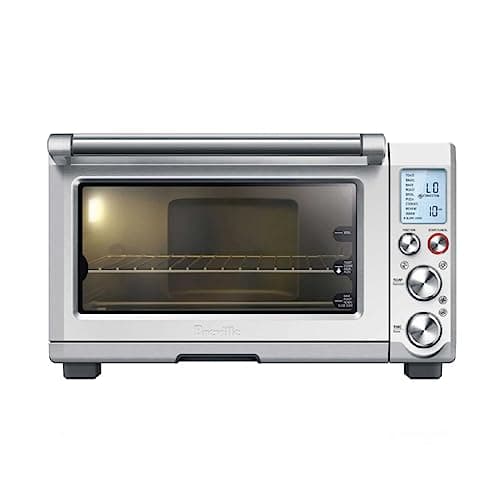
1,800 W
Breville Smart Oven Pro (BOV845BSS)
No air fry function, which is the point. This is the convection oven from the range with the marketing layer removed — ten functions, 1,800 W, and a published 120°F floor on Bake and Roast: no Proof preset, but a stated low end most ovens in the category never print.
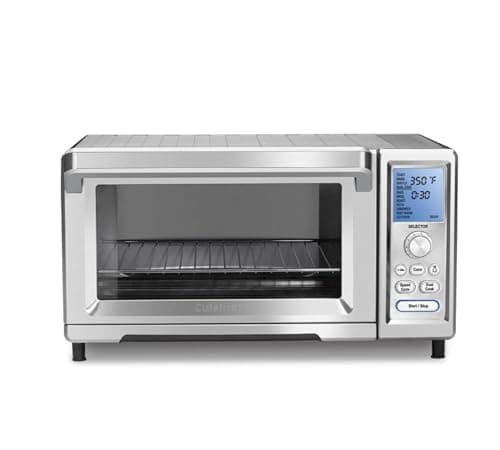
1,800 W
Cuisinart Chef's Convection Toaster Oven (TOB-260N1)
The only oven here whose manufacturer publishes both a wattage and an interior volume in cubic feet on the same page. 0.95 cubic feet at 1,800 W, with a stated list of what fits — a 13-inch pizza, a 9x13 pan, nine slices.
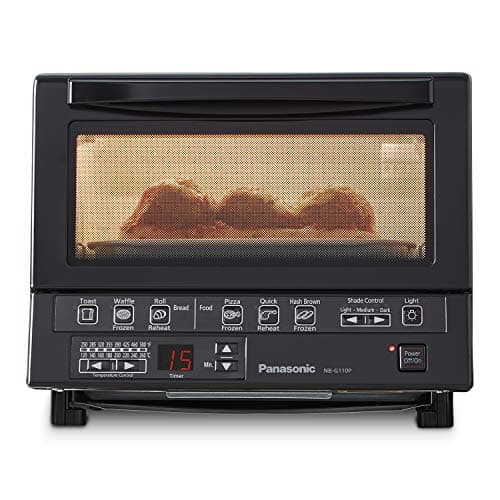
1,300 W
Panasonic FlashXpress Toaster Oven (NB-G110P)
The most completely documented oven on this entire site relative to its size: 1,300 W, 120 V, 60 Hz, 7.2 quarts, 250–500°F, exact millimeter dimensions and a stated weight. Panasonic publishes all of it, and almost nobody else does.
#ad · As an Amazon Associate we earn from qualifying purchases.
Questions
Frequently asked
How much does a convection oven cost to run per hour?
Does convection use more electricity than a regular oven setting?
Is a countertop convection oven cheaper to run than a full-size oven?
Keep reading
Related
Receipts
Sources
- US Energy Information Administration — Electric Power Monthly, Table 5.3 (average residential price)
- NFPA 70 (National Electrical Code) — branch-circuit and continuous-load basics
- Breville — Smart Oven Pro product page
We have not cooked in these ovens and we do not pretend to have. Specifications come from the manufacturer's own published documents; electricity rates come from the US Energy Information Administration; prices come from the live Amazon API. Where a figure is not published, the page says “not published” rather than guessing. Read the full method.