HUB 06 · Guides & Answers
Toaster Oven Recalls and Safety
Recalls happen, and checking for them takes two minutes on one government site. But the everyday safety of a countertop oven is decided less by recalls than by where you put it and how you use it. Here is how to check both — cited to the CPSC, without the scare tactics the query usually attracts.
We earn a commission if you buy through our links. It does not change the price you pay, and it does not decide our picks — the scoring rubric is published in full, including what disqualifies an oven. How this works.
The answer, first
To check whether a specific oven has been recalled, search the manufacturer and model on the US Consumer Product Safety Commission's recall database and register your product with the brand so you are notified if one is issued. Recalls in this category do occur — usually for a shock, fire or burn hazard — but they are uncommon, and most countertop-oven injuries come from placement and use rather than a defect. Both are worth two minutes of your attention; neither is a reason to fear the appliance.
How to check for a recall
Go to the CPSC recall database and search the brand and model number, which is printed on the rating plate on the underside or back of the oven. The CPSC is the US government body that publishes appliance recalls, and its database is the authoritative, free place to check — not a retailer's reviews or a forum thread. If you own the oven, register it with the manufacturer (most include a card or an online form) so a future recall reaches you directly. If you are buying used, checking the model against the database before you pay is the whole of the due diligence required.
If your oven develops a fault that seems dangerous — a cord that gets hot, a door glass that cracks, sparking — you can also report it through the CPSC's SaferProducts.gov, which is how patterns that lead to recalls get noticed in the first place. Reporting a genuine hazard helps the next buyer as much as checking protects you.
The safety that matters more than recalls
Where you put the oven, and what you do around it. A countertop oven vents real heat from the top and gets hot on the outside, so the everyday risks are heat and fire, not a hidden defect. The habits that prevent almost all of them are dull and effective:
Leave clearance above and behind the oven — several inches of air, never flush against a cabinet or wall, because the top vents heat. Keep the cord clear of the hot body and never run it under a rug or across a sink. Do not line the interior or the crumb tray with foil unless the manual explicitly allows it, since foil against an element is a common fire cause. Empty the crumb tray regularly — accumulated crumbs and grease are what actually catch fire. And never leave a running oven unattended for a long bake or a dehydrate cycle in an empty house.
None of this is exotic; it is the same fire sense a full-size oven asks for, applied to a box on the counter. The under-cabinet clearance question is the one people most often get wrong, and it is worth reading before you decide where the oven lives.
What a brand's track record tells you
A long, unchanged production run and a real service network are quiet safety signals. An oven that has been sold in essentially the same form for a decade — like the Cuisinart Custom Classic — has had its failure modes found and, where needed, fixed, and a brand with published documentation and a warranty stands behind it. That is not a guarantee against a recall, but it is a better bet than an anonymous SKU with no paper trail. Brands that publish a full specification, like BLACK+DECKER on the TO1785SG, also make it easier to confirm you are running the oven within its rated limits.
A limit worth stating plainly
We are not a safety-testing lab and do not issue safety verdicts on individual ovens — we point you to the CPSC, which does. Where we say a habit reduces risk, it is standard manufacturer and fire-safety guidance, not our own finding. If you smell burning insulation, see sparking, or a cord runs hot, stop using the oven and contact the manufacturer; those are signs to act on, not to diagnose from a web page.
The related question people ask at the same moment is when a working oven should simply be retired. No manufacturer publishes a service life, so we collected the only durability figure any of them commits to — the warranty term — along with the stop-using-it-immediately conditions the manuals list.
The hardware
The ovens this page is about
The ovens referred to above, with prices pulled live from Amazon and dated on every card. Full rankings live in the roundups linked from this page.
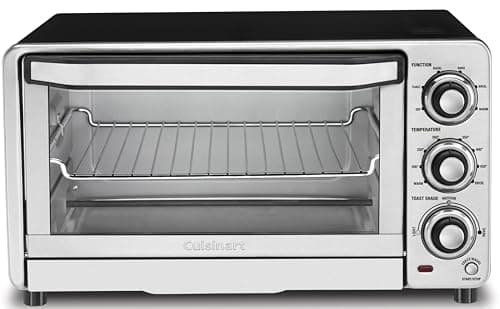
1,800 W
Cuisinart Custom Classic Toaster Oven Broiler (TOB-40N)
1,800 W behind three knobs. It has been sold essentially unchanged for over a decade, which in small appliances is the strongest reliability signal available short of taking one apart.
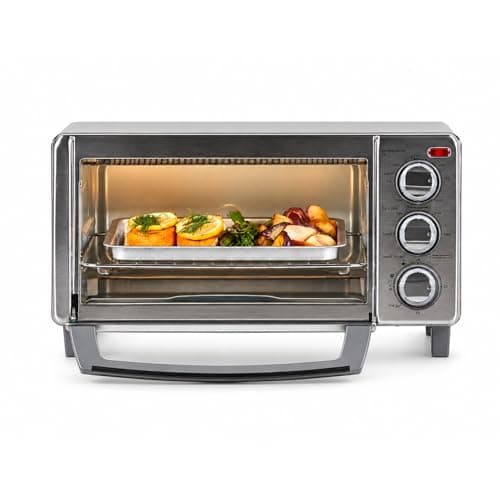
1,150 W
BLACK+DECKER 4-Slice Toaster Oven with Natural Convection (TO1785SG)
1,150 W, 120 V, four slices, a 9-inch pizza and a two-year warranty — all published by BLACK+DECKER on its own site. For sixty-five dollars that is a more complete specification than several ovens here costing three hundred.
#ad · As an Amazon Associate we earn from qualifying purchases.
Questions
Frequently asked
How do I check if my toaster oven has been recalled?
What is the most common toaster oven safety risk?
Are toaster ovens and air fryer ovens safe?
Keep reading
Related
Receipts
Sources
- US Consumer Product Safety Commission — Recalls database
- US CPSC — SaferProducts.gov (report an unsafe product / search incident reports)
We have not cooked in these ovens and we do not pretend to have. Specifications come from the manufacturer's own published documents; electricity rates come from the US Energy Information Administration; prices come from the live Amazon API. Where a figure is not published, the page says “not published” rather than guessing. Read the full method.