Skip to content
CC

HUB 04 · Comparisons

Ninja vs Cuisinart Countertop Ovens

The two brands people cross-shop after Breville, and the answer is a rule, not a winner. Cuisinart publishes the numbers and controls the heat precisely; Ninja gives you the most usable interior per dollar. What separates them is documentation against raw room.

By Stephen V.Updated How we rank
#ad

We earn a commission if you buy through our links. It does not change the price you pay, and it does not decide our picks — the scoring rubric is published in full, including what disqualifies an oven. How this works.

The short answer

Quick picks

#OvenBest forScorePrice
01
Cuisinart Cuisinart Chef's Convection Toaster Oven (TOB-260N1)
Cuisinart Chef's Convection Toaster Oven (TOB-260N1)

The best-documented interior in the category

1,800 W
8.6
$299.95Amazon
021,800 W
8.1
Check priceAmazon

#ad · Prices pulled live from the Amazon Product API, last checked Aug 8, 2026. Where we have no verified live price we show none — we would rather leave a gap than print a number that has gone stale. The wattage column is what the manufacturer publishes; “not published” means exactly that, and we have not estimated one. Scores are ours, compiled from published specifications, and are not test results.

The short answer

Buy the Cuisinart if you want published, checkable specifications and precise control; buy the Ninja if you want the most usable interior and two cooking levels for the money. Both are 1,800-watt-class ovens, so neither is cheaper to run than the other. What separates them is what Cuisinart tells you and Ninja does not — and what Ninja gives you in room that Cuisinart charges more for.

What Cuisinart buys

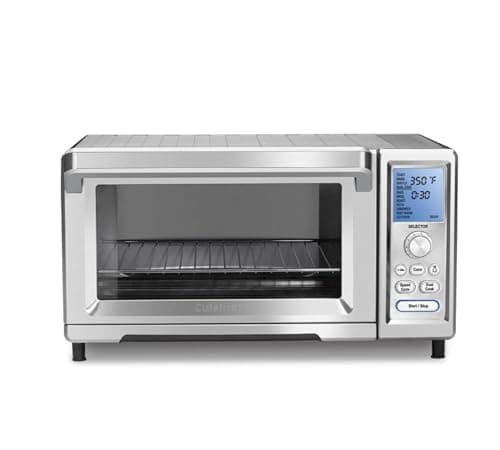
Documentation and control. The Cuisinart Chef's Convection Toaster Oven (TOB-260N1) is the only oven on the site whose maker publishes both a wattage (1,800 W) and an interior volume (0.95 cubic feet) on the same page, with a stated list of what fits, and it adds a dual-cook mode that runs two temperatures in sequence. Its full review is here. That checkability is the whole Cuisinart argument: you can confirm the pizza fits and the oven draws what it claims before you buy, which on a site that scores documentation is worth real money.

What Ninja buys

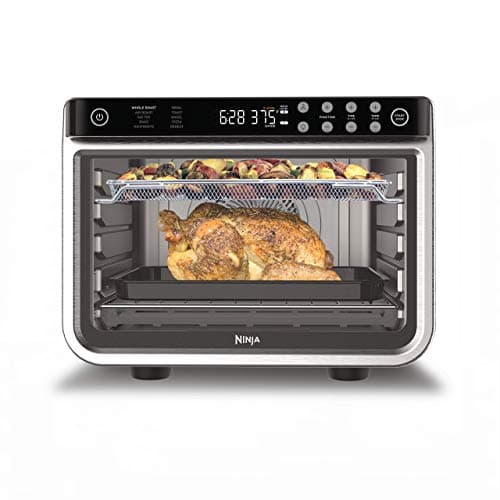
Interior per dollar, and it is not close. The Ninja DT201matches the 1,800-watt draw and adds two genuine cooking levels — a whole meal in one pass — with a capacity claim (two 12-inch pizzas) specific enough to measure, for a fraction of the Cuisinart's price. Its review is here. What it gives up is documentation: SharkNinja publishes the wattage and the capacity-as-objects but no interior volume, so a paper comparison of its space is guesswork. And it is a big box — furniture-sized where the Cuisinart is merely deep.

The footprint both of them ask for

Neither is small. The Cuisinart is 530 mm deep — the deepest oven on the site — and the Ninja is large in every dimension, so both demand you measure the counter, especially depth, before buying. Depth is the number people forget until the door will not clear the backsplash. If a tight counter is your real constraint, note that the flip-away Ninja SP line keeps the power and reclaims the space, which neither of these does.

The decision rule

Buy the Cuisinart if you want published wattage and interior volume, precise dual-temperature control, and the ability to check the specification before you buy. Buy the Ninja if you want two cooking levels and the most interior per dollar, and have the counter space for a large box. Running cost is a wash — both are 1,800 watts, so neither is cheaper to operate.

If you are also weighing Breville, the two brand comparisons complete the triangle: Breville vs Ninja and Cuisinart vs Breville.

In detail

The picks, in full

01
Cuisinart Cuisinart Chef's Convection Toaster Oven (TOB-260N1)

The best-documented interior in the category

Cuisinart Chef's Convection Toaster Oven (TOB-260N1)

Wattage and volume both publishedDeep cabinet footprint
8.6/10

The only oven here whose manufacturer publishes both a wattage and an interior volume in cubic feet on the same page. 0.95 cubic feet at 1,800 W, with a stated list of what fits — a 13-inch pizza, a 9x13 pan, nine slices.

Power
9.5
Usable space
9.5
Footprint
5.5
Documentation
10
Value
8.5

What it gets right

  • 0.95 cubic feet published in the same place as the 1,800 W rating, which makes it the easiest oven here to compare on paper
  • Within 5% of the Breville Pro's interior for a good deal less money
  • Fifteen functions including a genuine dual-cook mode that runs two temperatures in sequence

What it doesn't

  • 530 mm deep is a lot of counter — deeper than the Breville Pro
  • Fifteen functions on a backlit panel is a lot of interface between you and heat
  • Cuisinart lists this model as discontinued on its own site, so availability moves around

What it costs to run

About 33.9¢ an hour at full draw, or $61.86 a year at 30 minutes a day, 365 days a year and 18.83¢ per kWh.

1,800 W ÷ 1000 × 182.5 h × 18.83¢ = $61.86

1800 watts as published by Cuisinart on the TOB-260N1 product page, alongside the 0.95 cubic foot interior figure. This is an upper bound: the elements cycle off once the cavity is at temperature, and no manufacturer publishes a duty cycle, so we compute at full rated draw rather than invent a correction factor. The full method is published.

Skip this if…

your counter is shallow. At 530 mm deep this is the deepest oven on the list, and depth is the dimension people forget to measure until the door will not clear the backsplash.

$299.95on Amazon

Price last checked Aug 8, 2026. Prices move constantly — Amazon's at checkout is the one that counts.

#ad · we may earn a commission from this link to Cuisinart Chef's Convection Toaster Oven (TOB-260N1)

02
Ninja Ninja Foodi 10-in-1 XL Pro Air Fry Oven (DT201)

Most usable interior per dollar

Ninja Foodi 10-in-1 XL Pro Air Fry Oven (DT201)

Two cooking levelsLarge external footprint
8.1/10

The value pick, and it is not close. Same 1,800 W as ovens costing two and a half times more, two full cooking levels, and a published capacity claim — two 12-inch pizzas — that is specific enough to be checkable rather than a vibe.

Power
9.5
Usable space
9
Footprint
5.5
Documentation
7
Value
9.5

What it gets right

  • Identical 1,800 W draw to the Breville Pro at a fraction of the price — on running cost alone they are the same oven
  • Two genuine cooking levels rather than one shelf and an optimistic second slot
  • The capacity claim is stated as objects that fit, which you can measure against your own baking sheet

What it doesn't

  • SharkNinja publishes no interior volume in cubic feet or liters, so cross-brand space comparison is guesswork
  • The external footprint is large enough that it stops being a countertop appliance and starts being furniture
  • Ten functions on a dial that mostly changes fan speed and set point

What it costs to run

About 33.9¢ an hour at full draw, or $61.86 a year at 30 minutes a day, 365 days a year and 18.83¢ per kWh.

1,800 W ÷ 1000 × 182.5 h × 18.83¢ = $61.86

1800 W as published by SharkNinja on the DT201 product page and repeated in the brand's own retail listings. This is an upper bound: the elements cycle off once the cavity is at temperature, and no manufacturer publishes a duty cycle, so we compute at full rated draw rather than invent a correction factor. The full method is published.

Skip this if…

counter space is the binding constraint rather than money — this is one of the biggest boxes in the category, and a smaller oven that costs more may still be the right buy.

Check price on Amazon →

No buyable offer at the last price check (Aug 8, 2026). We show nothing rather than a stale number.

#ad · we may earn a commission from this link to Ninja Foodi 10-in-1 XL Pro Air Fry Oven (DT201)

How we picked

Ovens we claim to have cooked in: 0

Everyone in this category tells you they roasted forty chickens. We have roasted none, and we say so. Here is what we do instead: read the manufacturer's manual and spec sheet, record the published wattage, interior volume, temperature range and warranty term, work out what the oven costs to run for an hour and for a year, show the arithmetic so you can redo it with your own electricity rate, and cite all of it. Where a brand publishes no wattage, we print no running cost rather than borrowing a number from a similar model. Prices come live from Amazon's API and disappear rather than go stale.

The scores above are judgments from that documented research — not test results. One of the five metrics is Documentation: whether the manufacturer will tell you what its oven draws at all. The full rubric, including what disqualifies an oven, is published in full.

Questions

Frequently asked

Is Ninja or Cuisinart better for a countertop oven?
Neither universally -- both are 1,800-watt-class ovens that cost the same to run. Cuisinart publishes both wattage and interior volume and controls the heat precisely with a dual-cook mode, which suits buyers who want checkable specs. Ninja gives two cooking levels and more interior per dollar, which suits batch cooks with counter space.
Does the Cuisinart or the Ninja cost more to run?
Neither -- both draw 1,800 watts, so their running cost is identical, a few cents an hour. Spending more on either buys control or interior, never a lower electricity bill. See both in the by-model table.
Which has more interior room, Ninja or Cuisinart?
The Ninja DT201 gives two cooking levels and claims two 12-inch pizzas, which is more usable room than the Cuisinart's single-level 0.95 cubic feet -- but Ninja publishes no volume figure, so the comparison is by stated capacity rather than a checkable number.

Keep reading

Receipts

Sources

We have not cooked in these ovens and we do not pretend to have. Specifications come from the manufacturer's own published documents; electricity rates come from the US Energy Information Administration; prices come from the live Amazon API. Where a figure is not published, the page says “not published” rather than guessing. Read the full method.