HUB 06 · Guides & Answers
Is a Toaster Oven a Convection Oven?
Some toaster ovens are convection ovens and some are not, and the word printed on the box is not how you tell. One model we cover is sold as a toaster oven “with Natural Convection” and contains no fan whatsoever; another is sold as a plain “Toaster Oven” and air fries. The function list is the only thing that settles it.
We earn a commission if you buy through our links. It does not change the price you pay, and it does not decide our picks — the scoring rubric is published in full, including what disqualifies an oven. How this works.
The answer, first
Some toaster ovens are convection ovens; most sold today are, in the sense that they have a fan. But the word on the box does not tell you, and the clearest proof of that is in our own catalog: BLACK+DECKER sells a model named the 4-Slice Toaster Oven with Natural Convection, and natural convection means there is no fan — the air moves because it is hot, not because anything pushes it. The only reliable test is the manufacturer's own published function list, and the quickest tell in it is whether air fry appears, because a fan is how air fry works.
Three kinds of air movement, which the labels blur
Every oven moves heat three ways — radiation off the elements, air carrying it, and the pan touching the food. What “convection” refers to is only the middle one, and in appliance marketing it covers two quite different things plus one absence.
| What it is | Is there a fan? | How it is usually labelled | What it means for cooking |
|---|---|---|---|
| Radiant only | No | “Toaster oven”, “toaster oven broiler” | Fast on surfaces, uneven on big items; great for toast and melting |
| Natural convection | No | “Natural convection”, sometimes just “convection” | Hot air rises on its own — a real effect, and a small one |
| Forced convection | Yes | “Convection”, “convection bake”, “air fry”, “turbo” | Faster and more even; the setting recipes need 25°F taken off for |
Rows two and three are both legitimately called convection, and they are not close to equivalent. Natural convection is physics that happens in any hot box; forced convection is a motor and a blade. One costs nothing to claim and the other costs a few dollars of parts, which is exactly why the labelling gets loose.
The naming trap, in both directions
Our own catalog contains the trap running each way, which is the most useful thing on this page.
Says convection, has no fan.The BLACK+DECKER TO1785SG is published by BLACK+DECKER as a 4-slice toaster oven with natural convection, at 1,150 W, 120 V, four slices, a 9-inch pizza and a two-year warranty — a well-documented budget oven by the standards of this category, and a fanless one. “Natural convection” is doing more work in the marketing than it does in the oven, and we say so on its own page. The full review.
Says toaster oven, has a fan and air fries.The Oster Extra Large 42 L French Door is sold as a “Countertop Toaster Oven” and its published function list is 6-in-1 with air fry — which necessarily means a fan, since the air-fry setting is a fan speed and a perforated tray. It is a convection oven that the name does not describe. The full review.
A third pattern worth knowing: a brand may publish the fan in the function list without putting it in the name at all. BLACK+DECKER's TO3250XSB is named simply as an 8-slice extra-wide toaster oven, and its published function list is bake, broil, toast and keep warm with a convection fan. It has the fan and no air-fry mode — which is why it leads a different ranking of ours entirely. The ovens with no air-fry mode, ranked.
How to tell, in four checks
- Read the function list on the manufacturer's own site, not the retailer's. Retailers add “convection” and “air fryer” to titles for search traffic, and the two lists disagree surprisingly often.
- Look for air fry. If air fry is in the published function list, there is a fan — that setting is a fan speed plus a perforated basket, and the difference between the two settings is smaller than the labels suggest.
- Treat “natural” as a negation.“Natural convection” means no fan. So, usually, does silence about a fan on a cheap oven whose function list is bake, broil and toast.
- Look for a convection switch or a separate convection mode. A fan that can be selected is a fan that exists. The reverse does not hold, though — and this is worth knowing — because not one function list in this catalog states whether the fan can be switched OFF independently of the cooking mode. We are not going to infer it for you.
If you already own the oven there is a simpler test than any of this: run it empty at a moderate temperature and listen. A forced-convection oven makes a continuous airflow noise distinct from the tick of a thermostat. We are describing a physical fact about fans rather than a result we measured in any particular oven.
Does it matter whether yours has a fan?
For three things, yes, and the rest is preference.
Recipe temperatures. Written for still air. A forced-convection oven cooks faster and dries the surface sooner, so the standard adjustment is to drop the set point about 25°F and check early — our conversion chart sets out the arithmetic. Applying that correction to a fanless oven will simply undercook your dinner, which is the practical cost of not knowing which kind you own.
Evenness on anything large. This is what the fan buys and the reason it is usually worth having. On a slice of toast it is irrelevant; on a tray of vegetables or a whole chicken it is the difference between one roasted side and two.
Jobs where you want the fan off. Delicate baking — cakes and meringues, where moving air domes and crusts the surface — and curing polymer clay, where the published instruction from the material manufacturer is to turn convection off for liquid clay. For those, a fanless oven is not a compromise but the specification, and three ovens in our catalog have no fan at all: the Panasonic FlashXpress, the Cuisinart Custom Classic and the Proctor Silex 31260. Where that becomes the top of a ranking and where it matters for a cake.
What it does not change meaningfully is your bill. A fan motor draws a few tens of watts inside an appliance rated at 1,100 to 1,800, so it is not where the electricity goes — and an oven that finishes sooner can use less energy for the same dish than a radiant one that takes longer. No manufacturer publishes a figure that would let anyone prove that either way, so we are not going to pretend there is one. What a toaster oven actually costs to run.
Convection, true convection, and air fry
Three more words that get used as though they were a ladder, and are not quite. Plain convection is a fan. True convection— sometimes “European convection” — normally means a third heating element around the fan rather than just a fan in front of the existing ones; whether a given countertop oven has one is almost never published, and we go through what can and cannot be verified. Air fry is a faster fan speed plus a perforated basket, which is a real difference for frozen food and not a difference in heat, capacity or documentation.
The short version of the whole hierarchy: it is a fan moving hot air, and the differences between the names are speed, tray geometry and what the marketing department called it. The mechanism in full, and the comparison everybody searches for.
What to buy, once you know which you want
If you want the fan, the published-figures pick in our catalog is the Cuisinart Chef's Convection (TOB-260N1) — the only oven we cover whose maker publishes a wattage and an interior volume in cubic feet in the same place, at 1,800 W and 0.95 cu ft with a stated 13-inch pizza, 9 x 13 pan and nine-slice fit. For a fraction of that, the BLACK+DECKER TO3250XSB has a published convection fan in its function list, the rating line printed in its own manual and a two-year warranty. The convection field ranked.
If you want no fan, buy that deliberately rather than by accident. The Panasonic FlashXpress is the best-documented oven on this site and uses twin infrared elements with no fan; the Cuisinart Custom Classic is 1,800 radiant watts behind three knobs. Both are genuine specifications rather than old designs that missed out. The field with no air-fry mode at all.
If you are buying at the bottom of the market, assume no fan unless the function list says otherwise, and do not pay a premium for the word. “Natural convection” on a $65 oven is describing physics, not hardware. The budget field ranked.
The habit that prevents all of this
Check the manufacturer's published function list before you believe a product name, in either direction. It takes a minute, it is free, and in this category it is the single highest-yield check a buyer can do — the same habit that catches a wattage that only exists in listing copy and a pan-fit claim that quietly excludes the handles. The pan-fit version of the same problem.
The hardware
The ovens this page is about
The ovens referred to above, with prices pulled live from Amazon and dated on every card. Full rankings live in the roundups linked from this page.
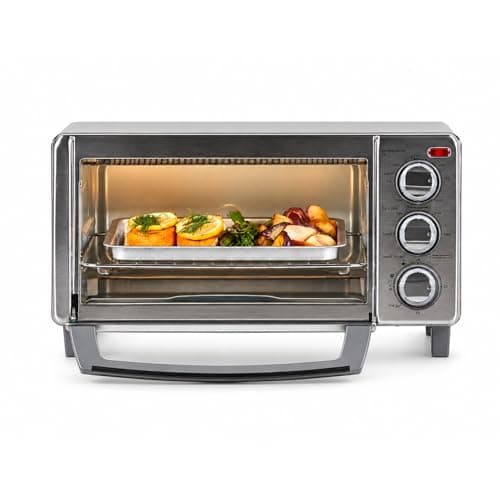
1,150 W
BLACK+DECKER 4-Slice Toaster Oven with Natural Convection (TO1785SG)
1,150 W, 120 V, four slices, a 9-inch pizza and a two-year warranty — all published by BLACK+DECKER on its own site. For sixty-five dollars that is a more complete specification than several ovens here costing three hundred.
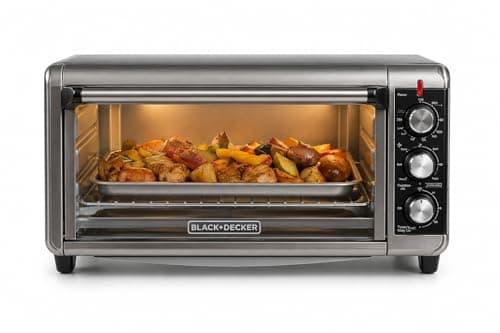
1,500 W
BLACK+DECKER 8-Slice Extra Wide Convection Toaster Oven (TO3250XSB)
A dial-controlled convection toaster oven whose maker publishes the wattage, the dimensions, the weight and a two-year warranty on its own page, and prints the rating line in the manual — 1500 W, 120 V, 60 Hz. Eight slices, a 12-inch pizza and a 9 x 13 pan with handles, for under a hundred dollars. It is a convection baker, not an air fryer: there is no basket and no air-fry setting.
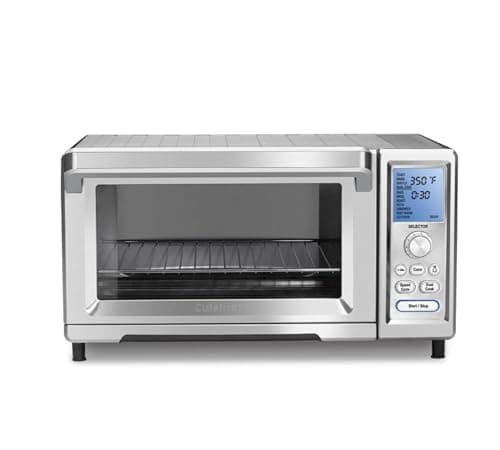
1,800 W
Cuisinart Chef's Convection Toaster Oven (TOB-260N1)
The only oven here whose manufacturer publishes both a wattage and an interior volume in cubic feet on the same page. 0.95 cubic feet at 1,800 W, with a stated list of what fits — a 13-inch pizza, a 9x13 pan, nine slices.
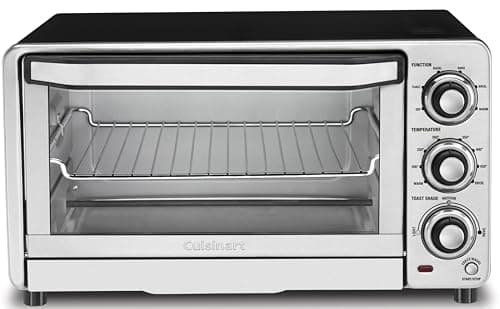
1,800 W
Cuisinart Custom Classic Toaster Oven Broiler (TOB-40N)
1,800 W behind three knobs. It has been sold essentially unchanged for over a decade, which in small appliances is the strongest reliability signal available short of taking one apart.
#ad · As an Amazon Associate we earn from qualifying purchases.
Questions
Frequently asked
Is a toaster oven a convection oven?
What does “natural convection” mean on a toaster oven?
How can I tell if my toaster oven has convection?
Is convection better in a toaster oven?
Is a toaster oven convection or conventional?
Does a convection toaster oven use more electricity?
Keep reading
Related
- Convection toaster oven vs plain toaster ovenWhether the fan is worth paying for, once you know which one you are looking at.
- True convection vs fan convectionThe next word up the ladder, and what can actually be verified about it.
- Convection vs air fry settingWhy air fry in a function list is a reliable tell that there is a fan.
- Best toaster ovens with convectionThe fan models ranked, once you have decided you want one.
- Best toaster ovens without an air fryerIncluding the fanless ones, where buying radiant heat is the point.
Receipts
Sources
- BLACK+DECKER — Crisp 'N Bake Air Fry 4-Slice Toaster Oven (TO1785SG) product page: 1150 W, 120 V, 4 slices / 9-inch pizza, dimensions, 2-year limited warranty, and the “natural convection” designation
- BLACK+DECKER — Extra-Wide 8-Slice Toaster Oven (TO3250XSB) product page: specifications block, published function list (bake, broil, toast, keep warm; convection fan) and stated pan fit
- Cuisinart — Chef's Convection Toaster Oven TOB-260N1 product page (1800 watts, 0.95 cubic feet, stated fit list, fifteen functions)
- Cuisinart — toaster ovens product line
- Panasonic — FlashXpress Toaster Oven NB-G110P product page (power consumption, supply, capacity, 250–500°F range, dimensions)
- Proctor Silex — 4 Slice Toaster Oven Broiler (31260G) product page (temperature range, timer, 3-year limited warranty)
- Amazon listing (manufacturer-supplied copy) — Oster Extra Large 42 L French Door Countertop Toaster Oven, published 6-in-1 function list including air fry
We have not cooked in these ovens and we do not pretend to have. Specifications come from the manufacturer's own published documents; electricity rates come from the US Energy Information Administration; prices come from the live Amazon API. Where a figure is not published, the page says “not published” rather than guessing. Read the full method.