HUB 06 · Guides & Answers
Baking Sourdough in a Countertop Oven
It can be done, and it is not the same bake. Sourdough wants fierce initial heat, trapped steam and room to spring — three things a countertop cavity gives you grudgingly. Here is what works, what to change, and where the honest answer is that it will not.
We earn a commission if you buy through our links. It does not change the price you pay, and it does not decide our picks — the scoring rubric is published in full, including what disqualifies an oven. How this works.
The answer, first
A countertop convection oven bakes a very good pan loaf and a decent small boule. It will struggle with a large round loaf baked the classic way, for three specific reasons: most cap out at 450°F where the classic bake wants 475–500°F, none of them trap steam the way a lidded Dutch oven does, and the headroom above the stone or tin is measured in inches, which is roughly what oven spring wants for itself. Work with those limits and the bread is good. Ignore them and you get a pale, tight loaf and blame the starter.
The three things sourdough asks for
Heat, early and hard. The first ten minutes decide the loaf. High initial heat drives oven spring — the last burst of expansion before the crust sets — and sets the color of the crust. This is the requirement countertop ovens most often fail, because their published ceilings sit at 450°F. The Panasonic FlashXpress is the one on this site that publishes 500°F, and it is a 7.2-quart cavity, so it has the temperature and not the room — which is the trade in miniature.
Steam, for the first phase.Steam keeps the crust soft while the loaf is still expanding; without it the crust sets early and the spring stops. A Dutch oven works by trapping the loaf's own moisture under a lid. A countertop convection oven does the opposite of that by design — the fan is a moisture-removal machine, which is exactly why it crisps so well and exactly why it fights you here.
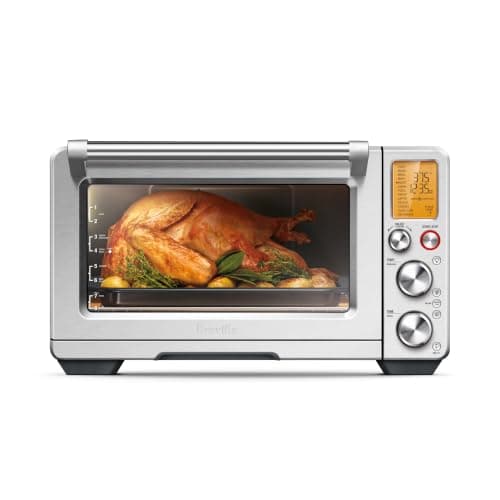
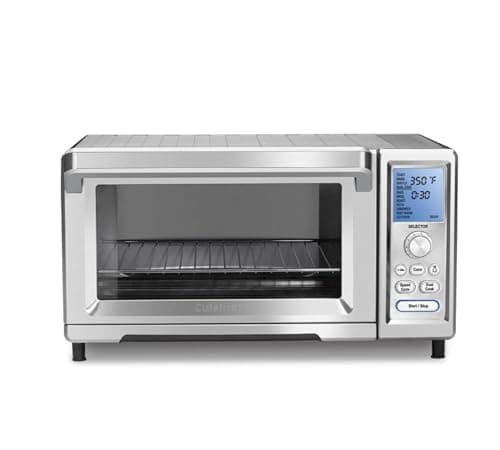
Room to rise. A boule can gain a third of its height in the oven. In a one-cubic-foot cavity with a rack in the middle, that is a real constraint rather than a theoretical one. The Breville Smart Oven Air Fryer Pro publishes one cubic foot and the Cuisinart TOB-260N1 publishes 0.95 — the two largest published interiors on this site, and the two worth planning around if bread is why you are buying.
What to change
Turn the fan off for the first phase if the oven lets you. This is the single biggest improvement available. Bake conventional for the first ten to twelve minutes so the crust stays pliable, then switch convection on to finish and color. An oven that can only run with the fan is at a real disadvantage here, which is why our bread ranking weighs control over raw power.
Get a lid on it. A small cast-iron combo cooker or a lidded ceramic baker reproduces the Dutch-oven effect at a scale that fits — if the height allows, which is the thing to measure before you buy either. Preheat it with the oven from cold; a countertop cavity heats a heavy vessel far more aggressively than a big oven does, and thermal shock is a genuine risk. Our pan-fit guide covers the clearance arithmetic.
Preheat longer than you think. Countertop ovens reach their set air temperature quickly and their surfaces slowly. If you are baking on a stone or in cast iron, the three-minute preheat that suits a tray of vegetables is not enough — give the mass fifteen or twenty minutes at temperature before the dough goes near it.
Bake smaller, and change the shape. A 500g batard or a pan loaf fits and rises within the headroom you have. A 1kg boule usually does not. This is not a compromise on quality — a pan loaf baked properly beats a boule baked in a cavity too short for it, every time.
Which of our ovens is actually suited
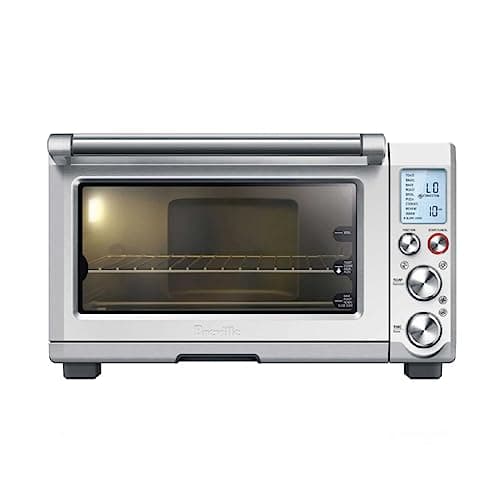
The ones that publish enough to plan around and let you control the fan. The Breville Smart Oven Prois the deliberate pick here: no air fry function at all, ten functions with a published 120°F floor on Bake and Roast (no Proof preset — Breville's book lists ten functions and Proof is not one of them), 1,800 watts published, and Element IQ driving its elements independently rather than in banks. Its review is here. The Cuisinart TOB-260N1 is the documentation pick — the only oven on this site whose maker publishes both a wattage and an interior volume on one page, at 1,800 watts and 0.95 cubic feet — and its dual-cook mode runs two temperatures in sequence, which is precisely the hot-start-then-lower-finish shape a loaf wants. Its review is here.
Note what is not on that list: the small ovens, however well specified, and the ones that publish no temperature range. A proof setting whose floor temperature is unpublished is a label rather than a specification, and for bread the floor matters as much as the ceiling.
When the honest answer is the big oven
If you bake 1kg boules in a Dutch oven at 500°F and you are happy with them, a countertop oven is a downgrade and we are not going to pretend otherwise. The ceiling is lower, the steam is harder, the headroom is tighter. Where a countertop oven genuinely wins is the everyday case: one pan loaf, twice a week, without heating five cubic feet of range for forty-five minutes — which is a real saving we have put numbers on. Buy it for that and it is an excellent bread oven. Buy it expecting a bakery deck and it will disappoint you at 450°F.
The hardware
The ovens this page is about
The ovens referred to above, with prices pulled live from Amazon and dated on every card. Full rankings live in the roundups linked from this page.
1,800 W
Breville Smart Oven Air Fryer Pro (BOV900BSS)
The most completely documented oven in the category, and the only one at any price whose manufacturer publishes a rated wattage, an interior volume and a full element layout in the same place. You pay roughly four times the category floor for that, and about a third of the premium is the documentation itself.
1,800 W
Cuisinart Chef's Convection Toaster Oven (TOB-260N1)
The only oven here whose manufacturer publishes both a wattage and an interior volume in cubic feet on the same page. 0.95 cubic feet at 1,800 W, with a stated list of what fits — a 13-inch pizza, a 9x13 pan, nine slices.
1,800 W
Breville Smart Oven Pro (BOV845BSS)
No air fry function, which is the point. This is the convection oven from the range with the marketing layer removed — ten functions, 1,800 W, and a published 120°F floor on Bake and Roast: no Proof preset, but a stated low end most ovens in the category never print.
#ad · As an Amazon Associate we earn from qualifying purchases.
Questions
Frequently asked
Can you bake sourdough in a countertop convection oven?
What temperature should I bake sourdough at in a countertop oven?
Should the convection fan be on or off for bread?
Do you need a Dutch oven to bake sourdough in a countertop oven?
What size loaf fits in a countertop oven?
Keep reading
Related
- Best countertop ovens for baking breadThe ranking these picks are drawn from.
- What pans fit in a countertop ovenThe clearance arithmetic before you buy a baker.
- True convection vs fan convectionWhat the fan is doing, and why bread minds.
- Best countertop convection ovensThe overall ranking, with published interiors.
Receipts
Sources
- Breville — Smart Oven Air Fryer Pro product page
- Cuisinart — Chef's Convection Toaster Oven TOB-260N1 product page
- Breville — Smart Oven Pro product page
We have not cooked in these ovens and we do not pretend to have. Specifications come from the manufacturer's own published documents; electricity rates come from the US Energy Information Administration; prices come from the live Amazon API. Where a figure is not published, the page says “not published” rather than guessing. Read the full method.