The trap, before the picks
A large share of budget toaster ovens advertise natural convection. There is no fan in those ovens. Natural convection is the physics term for hot air rising, which is true of every oven ever built, and using it as a feature name is describing the absence of the feature. If you want crisping and even browning, that listing is not the one — and the test that cannot be marketed around is to look for a circular fan grille on the back wall of the cavity. We untangle all five convection terms here.
What a real fan buys is worth being specific about, because it is the only capability in this category that is genuinely binary. Moving hot air strips moisture off the surface of food faster than still air, so the surface dries and browns — that is crisping, and that is air frying, and a radiant oven cannot do it at any temperature or for any length of time. The mechanism takes one paragraph.
Reading the order
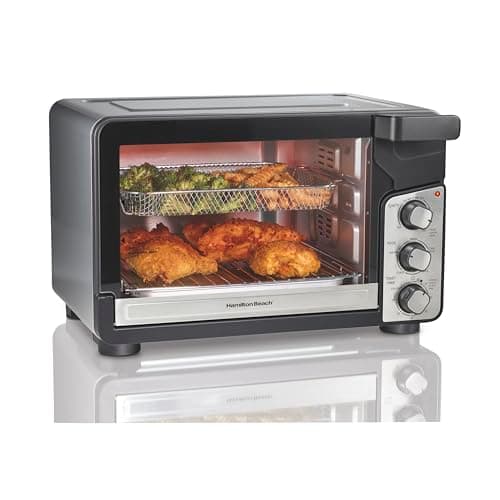
The Hamilton Beach Easy View XL with Sure-Crisp leads because it is the cheapest fan on this site that is not a gimmick, in a six-slice cavity where four is the norm at the price. The glass door is the underrated part: being able to watch something crisp without opening the door and dumping the heat is worth more day to day than three extra presets. The honest limitation is documentation — Hamilton Beach publishes no wattage for this SKU in any document we could find, so we give it no running-cost figure.
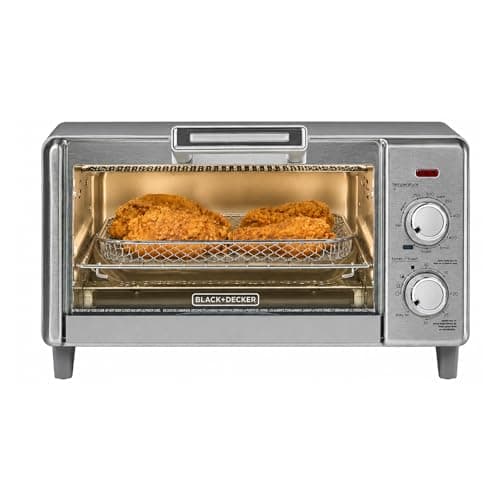
The BLACK+DECKER Crisp 'N Bakeis second and is the floor of the category: around sixty dollars for a genuine convection oven with air fry. It sits in a line whose sibling model, the TO1785SG, publishes 1,150 watts and a two-year warranty on BLACK+DECKER's own site — which makes the line easier to reason about than most things costing twice as much. We have not found a separate published figure for this exact SKU, and we have not assumed the two are identical. Its review is here.
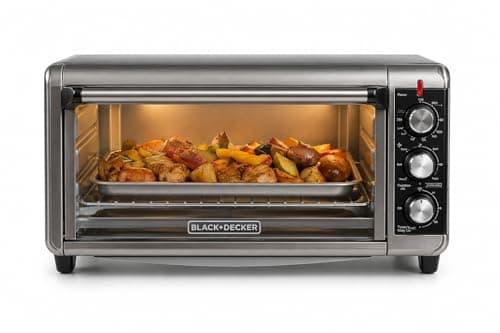
The BLACK+DECKER 8-Slice Extra Wide Convection Toaster Oven (TO3250XSB)is third and is the best-documented oven in the band: 1,500 watts printed in the manual's rating line and on BLACK+DECKER's own product page, alongside the dimensions, the weight and a two-year warranty. It is also the biggest — eight slices, a 12-inch pizza, a 13 x 9 pan with handles — behind dials rather than a panel. It sits third rather than first for a reason this page has to be honest about: the two ovens above it have an air-fry setting and a basket, and this one has neither. Its fan is for convection baking. If crisping is the point, that matters; if a wide, checkable convection baker is the point, it is the pick. Our review is here.
What this band cannot tell you
Its wattage, mostly. Two of the three picks here publish no power figure, which means we cannot compute what they cost to run and will not estimate it. That is not an oversight on our part; it is a finding about the band, and it is the reason our wattage table is shorter than the number of ovens on this site. Budget convection ovens typically run well under 1,800 watts — which means longer cooking times for the same result — but without a published number we cannot tell you by how much, and a plausible guess is indistinguishable from a fabricated one.
If a published wattage matters to you more than a basket does, the TO3250XSB above is the answer inside this page. If it matters more than a fan does at all, the honest recommendation points out of it: the BLACK+DECKER TO1785SG publishes 1,150 watts, 120 volts, its capacity, its dimensions and a two-year warranty — and has no fan. That is the trade, stated as plainly as we can put it.
Where the money stops mattering
Around the point where you leave this band. Above roughly $150 you are into air fryer toaster ovens proper and countertop convection ovens, where the ovens are 1,800 watts, publish more, and compete on interior and element control. Below it, you are buying a fan and a thermostat, and the differences between one and the next are smaller than the listings suggest. The single upgrade that changes your cooking is the fan itself, and this page exists because it arrives cheaper than most people assume.
The one job where the fan buys you almost nothing is the one on the front of the box. Toasting is radiant work, so a convection oven and a plain one brown bread by the same mechanism — which is why the toast ranking reorders this band entirely, around published slice counts, darkness steps and the rack position the manual names.
Two of the three ovens on this page have a convection fan and no air-fry mode, which is a combination worth shopping on purpose rather than settling for. The ovens whose own function lists omit air fry are ranked separately, including the fanless ones, and the published figures say that omission costs a buyer close to nothing.
How we picked
Ovens we claim to have cooked in: 0
Everyone in this category tells you they roasted forty chickens. We have roasted none, and we say so. Here is what we do instead: read the manufacturer's manual and spec sheet, record the published wattage, interior volume, temperature range and warranty term, work out what the oven costs to run for an hour and for a year, show the arithmetic so you can redo it with your own electricity rate, and cite all of it. Where a brand publishes no wattage, we print no running cost rather than borrowing a number from a similar model. Prices come live from Amazon's API and disappear rather than go stale.
The scores above are judgments from that documented research — not test results. One of the five metrics is Documentation: whether the manufacturer will tell you what its oven draws at all. The full rubric, including what disqualifies an oven, is published in full.