Skip to content
CC

HUB 04 · Comparisons

Air Fryer vs Convection Oven

The highest-volume question in the category, with the cleanest answer: they are the same technology at different scales. If you own a convection oven with a rack, you own an air fryer.

By Stephen V.Updated How we rank
#ad

We earn a commission if you buy through our links. It does not change the price you pay, and it does not decide our picks — the scoring rubric is published in full, including what disqualifies an oven. How this works.

The short answer

Quick picks

#OvenBest forScorePrice
011,800 W
8.1
$159.95Amazon
02
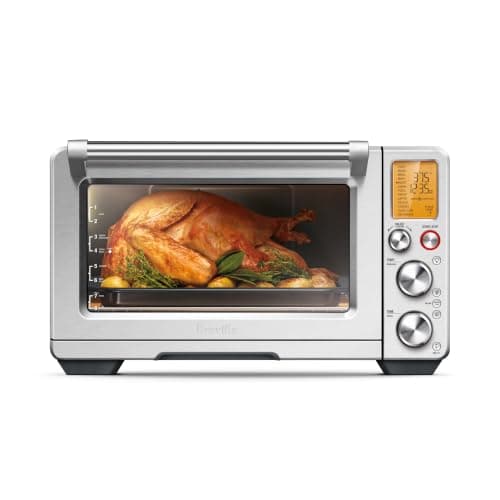
Breville Breville Smart Oven Air Fryer Pro (BOV900BSS)
Breville Smart Oven Air Fryer Pro (BOV900BSS)

The one to buy if you will keep it a decade

1,800 W
8.5
$399.95Amazon

#ad · Prices pulled live from the Amazon Product API, last checked Jul 20, 2026. Where we have no verified live price we show none — we would rather leave a gap than print a number that has gone stale. The wattage column is what the manufacturer publishes; “not published” means exactly that, and we have not estimated one. Scores are ours, compiled from published specifications, and are not test results.

The mechanism is identical

An air fryer is a convection oven. Both use a heating element and a fan that circulates hot air around the food, which strips away the insulating boundary layer of cooler, humid air against the surface and lets it dry and brown faster. There is no oil, there is no frying, and there is no mechanism in an air fryer that a convection oven has lacked since the 1960s. The full explanation of how it works is here.

The differences are all geometry. An air fryer is a small cavity with a fast fan and a perforated basket that lets air reach the underside of the food. A convection oven is a larger cavity with a slower fan and a solid rack. The small cavity heats faster and concentrates the airflow, which is why a basket air fryer crisps a small batch so well; the large cavity holds a tray and also toasts and bakes, which the basket cannot.

When you already own one

If your range or wall oven has a convection setting and you own a perforated tray or an air-fry basket insert — about fifteen dollars — you can air fry in it today. The result on a full tray will be close to what a dedicated oven-style air fryer produces, because they are doing the identical thing. Where the dedicated appliance wins is speed on a small batch (less air to heat) and not having to preheat the big oven.

The decision rule

Buy a countertop air fryer / convection oven if you want one appliance that air fries, toasts and bakes a tray, or you want to stop heating the full-size oven for small jobs. Skip it and use the oven you own if your range already has a convection setting and you mostly cook full trays — a $15 basket insert gets you there. Buy a small basket air fryer instead if you cook for one or two, want it fast, and do not need to toast or bake.

On cost, there is nothing to choose: both a countertop convection oven and your wall oven's convection setting run their elements at whatever wattage they draw, and the countertop model — heating one cubic foot instead of five — is the cheaper of the two for a single tray. We costed that out.

In detail

The picks, in full

01
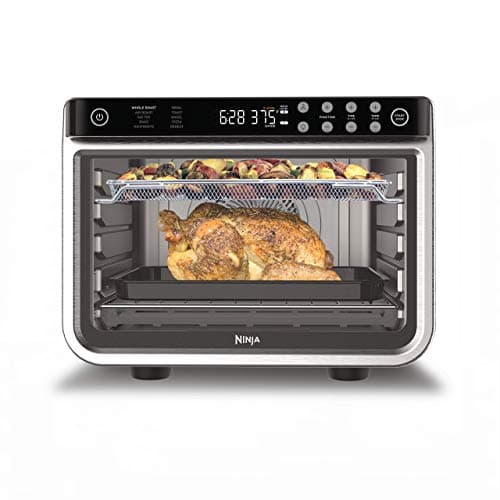
Ninja Ninja Foodi 10-in-1 XL Pro Air Fry Oven (DT201)

Most usable interior per dollar

Ninja Foodi 10-in-1 XL Pro Air Fry Oven (DT201)

Two cooking levelsLarge external footprint
8.1/10

The value pick, and it is not close. Same 1,800 W as ovens costing two and a half times more, two full cooking levels, and a published capacity claim — two 12-inch pizzas — that is specific enough to be checkable rather than a vibe.

Power
9.5
Usable space
9
Footprint
5.5
Documentation
7
Value
9.5

What it gets right

  • Identical 1,800 W draw to the Breville Pro at a fraction of the price — on running cost alone they are the same oven
  • Two genuine cooking levels rather than one shelf and an optimistic second slot
  • The capacity claim is stated as objects that fit, which you can measure against your own baking sheet

What it doesn't

  • SharkNinja publishes no interior volume in cubic feet or liters, so cross-brand space comparison is guesswork
  • The external footprint is large enough that it stops being a countertop appliance and starts being furniture
  • Ten functions on a dial that mostly changes fan speed and set point

What it costs to run

About 33.9¢ an hour at full draw, or $61.86 a year at 30 minutes a day, 365 days a year and 18.83¢ per kWh.

1,800 W ÷ 1000 × 182.5 h × 18.83¢ = $61.86

1800 W as published by SharkNinja on the DT201 product page and repeated in the brand's own retail listings. This is an upper bound: the elements cycle off once the cavity is at temperature, and no manufacturer publishes a duty cycle, so we compute at full rated draw rather than invent a correction factor. The full method is published.

Skip this if…

counter space is the binding constraint rather than money — this is one of the biggest boxes in the category, and a smaller oven that costs more may still be the right buy.

$159.95on Amazon

$379.9958% off

Price last checked Jul 20, 2026. Prices move constantly — Amazon's at checkout is the one that counts.

#ad · we may earn a commission from this link to Ninja Foodi 10-in-1 XL Pro Air Fry Oven (DT201)

02
Breville Breville Smart Oven Air Fryer Pro (BOV900BSS)

The one to buy if you will keep it a decade

Breville Smart Oven Air Fryer Pro (BOV900BSS)

Wattage published in the manualWidest footprint here
8.5/10

The most completely documented oven in the category, and the only one at any price whose manufacturer publishes a rated wattage, an interior volume and a full element layout in the same place. You pay roughly four times the category floor for that, and about a third of the premium is the documentation itself.

Power
9.5
Usable space
9.5
Footprint
6
Documentation
10
Value
7.5

What it gets right

  • Breville publishes the rated wattage, the interior volume, the exterior dimensions and the element count — almost nobody else in this category publishes all four
  • 1 cubic foot of interior is genuinely a small oven, not a large toaster: a 14-inch pizza or a 9x13 pan fits without diagonal gymnastics
  • Element IQ drives the six elements independently rather than switching them in banks, which is the actual mechanical difference behind the price

What it doesn't

  • 21.4 inches wide is wider than most upper-cabinet clearances allow you to slide it under
  • At the current price it costs more than several full-size wall ovens' worth of countertop convection you could assemble from cheaper parts
  • Thirteen functions is nine more than most households use; the presets are the same elements at different set points

What it costs to run

About 33.9¢ an hour at full draw, or $61.86 a year at 30 minutes a day, 365 days a year and 18.83¢ per kWh.

1,800 W ÷ 1000 × 182.5 h × 18.83¢ = $61.86

1800 W is the rating plate figure in Breville's own instruction book, not a marketing headline. This is an upper bound: the elements cycle off once the cavity is at temperature, and no manufacturer publishes a duty cycle, so we compute at full rated draw rather than invent a correction factor. The full method is published.

Skip this if…

your counter is under 24 inches deep with the backsplash, or you are buying an oven mainly to make toast and reheat pizza — nothing about this machine's price is recovered on those two jobs.

$399.95on Amazon

Price last checked Jul 20, 2026. Prices move constantly — Amazon's at checkout is the one that counts.

#ad · we may earn a commission from this link to Breville Smart Oven Air Fryer Pro (BOV900BSS)

How we picked

Ovens we claim to have cooked in: 0

Everyone in this category tells you they roasted forty chickens. We have roasted none, and we say so. Here is what we do instead: read the manufacturer's manual and spec sheet, record the published wattage, interior volume, temperature range and warranty term, work out what the oven costs to run for an hour and for a year, show the arithmetic so you can redo it with your own electricity rate, and cite all of it. Where a brand publishes no wattage, we print no running cost rather than borrowing a number from a similar model. Prices come live from Amazon's API and disappear rather than go stale.

The scores above are judgments from that documented research — not test results. One of the five metrics is Documentation: whether the manufacturer will tell you what its oven draws at all. The full rubric, including what disqualifies an oven, is published in full.

Questions

Frequently asked

Is an air fryer just a small convection oven?
Yes, essentially. Both circulate hot air with a fan around the food. An air fryer is a smaller cavity with a faster fan and a perforated basket; a convection oven is larger with a slower fan. The cooking mechanism is the same.
Can I air fry in my regular convection oven?
Yes. Turn on the convection setting, use a perforated tray or air-fry basket so air reaches the underside of the food, and you will get results close to a dedicated air fryer. The dedicated appliance is mainly faster on small batches because there is less air to heat.
Which costs more to run, an air fryer or a convection oven?
For the same food, the smaller cavity wins — a countertop air fryer heats about one cubic foot against roughly five in a wall oven, so it reaches temperature faster and uses less energy for a single tray. The arithmetic is here.

Keep reading

Receipts

Sources

We have not cooked in these ovens and we do not pretend to have. Specifications come from the manufacturer's own published documents; electricity rates come from the US Energy Information Administration; prices come from the live Amazon API. Where a figure is not published, the page says “not published” rather than guessing. Read the full method.