The short answer
Buy it if you want a French-door oven and you want to know what it actually does. The Midea Flexify is the cheapest of the four French-door ovens we cover and simultaneously the one with the most published about it — it is the only one whose maker states a temperature range at all, and 100 to 450°F in five-degree increments is a genuinely useful band rather than a marketing figure. Do not buy it if you need to work out what it costs to run, because Midea publishes no rated wattage for it and neither will we.
We have not cooked in this oven. There is no test kitchen behind this site and our rubric says so in those words. Everything below is what Midea publishes, what Amazon's own item data says, and the arithmetic you can do on those figures.
What Midea actually publishes
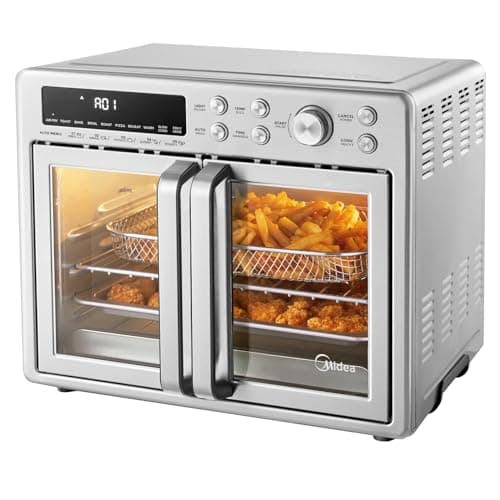
More than anyone else in this category, which is the first thing worth saying. Midea's US product page carries an actual specification block: a capacity of 26.4 quarts, an exterior of 16.92 inches wide by 15.93 deep by 13.74 high, an itemized accessory list — one baking tray, two baking racks, an air fry basket, one crumb tray — and a published fit stated in objects rather than adjectives: one 12-inch pizza, up to six slices of toast, or fourteen chicken wings.
Its own listing copy adds two figures the product page omits and that no other French-door maker publishes anywhere: a temperature range of 100–450°F, and the control granularity — temperature adjustable in five-degree Fahrenheit steps, timer in one-minute steps. Then the ten presets, named individually instead of summed into a marketing total: Air Fry, Roast, Bake, Broil, Toast, Pizza, Reheat, Slow Cook, Dehydrate and Warm.
For context on how unusual that is: of the four French-door ovens in our catalog, the other three publish no temperature figure of any kind. Oster publishes a 42-liter interior and a function count. Elite Gourmet publishes a capacity and “four manual control knobs”. Emeril publishes twenty-four function names and essentially nothing measurable. Our full French-door ranking explains why that matters.
The 100°F floor is the most useful number on the page
A published low temperature is the specification that decides whether an oven can do the slow, cool jobs its mode list advertises, and it is the one brands skip most often. Midea names a Dehydrate preset and a Slow Cook preset, and then publishes a 100°F floor that makes both credible: dehydrating generally runs between roughly 100 and 160°F depending on the food, so an oven that genuinely holds 100°F can do it.
Compare that with the rest of this catalog. The standard Our Place Wonder Oven and the Our Place Large both stop at a 200°F floor, which rules out dehydrating outright whatever the dial says. Only Breville's BOV900 and BOV950 and the Our Place Wonder Oven Propublish a floor below Midea's, at 80°F. So on published figures the Flexify — a hundred-and-fifty-dollar oven — has a lower stated floor than every oven on this site except three, two of which cost three to four times as much.
The honest limit of that claim: proofing dough wants roughly 80–100°F, which sits right at or below Midea's floor, and Midea does not name a Proof mode. So dehydrating yes, on the published numbers; proofing is marginal and unclaimed. And no manufacturer in this category publishes a thermostat tolerance, so “100°F” means the number the control shows, not a guaranteed cavity temperature.
The spec block contradicts itself on weight
This is the finding of the page, and it is the reason Documentation scores 7.0 here rather than higher. Midea's own specification block gives this oven a product weight of 25.57 lb and a shipping weight of 20.94 lb. Those cannot both be right: a boxed appliance weighs the appliance plus the box plus the accessories plus the foam, so the shipping weight is always the larger of the two. One of the two figures is wrong, and Midea does not say which.
Amazon's own item data for the same model gives 20.9 lb, which matches Midea's smaller figure almost exactly — so the balance of evidence is that around 21 lb is the oven and the 25.57 lb entry is the error. We are not going to print that as a fact, because two of the three sources available are the manufacturer disagreeing with itself. Both figures appear in the specifications above, and a buyer who needs to know whether a shelf will hold it should plan for the larger.
The same regional instability shows in the capacity. This oven is sold in the US as 26.4 quarts; Midea's Canadian listing for the same model family is sold as 25 quarts. That is a four-percent difference in the headline number on the box, for what is presented as the same product.
The missing wattage, and what it costs you
Midea publishes no rated power for this oven anywhere we could read — not in the specification block, not in the listing copy, and not in a manual, because Midea links no manual PDF for it and the third-party manual hosts that claim to carry one refuse automated requests. The only figure in circulation is 1,750 W from a third-party review, and a third-party review is not a manufacturer source, so it does not appear as a specification on this site.
The practical consequence is specific rather than vague: every running-cost page on this site works from a published watt figure times hours times your electricity rate, and that arithmetic cannot be performed for this oven at all. It does not appear in our watts-by-model table, and it never will unless Midea publishes the number. For scale: an 1,800 W oven costs roughly a third of a dollar per hour at the US average residential rate, and a 1,400 W one roughly a quarter — so the unknown here is worth about eight cents an hour, or a few dollars a year for most people. It is a small amount of money and a large amount of missing documentation.
You can resolve it yourself in about ten seconds: the rating plate is on the back or underside of the oven and prints volts, hertz and watts. Read it the day it arrives, inside the return window.
Size, and where it sits
26.4 US quarts is about 25 liters, which puts the Flexify in the smaller of the two French-door size classes — effectively the same cavity as the Emeril Lagasse 26 QT, and a little over half the Oster's 42 liters or the Elite Gourmet's 47.5 quarts. Twenty-five liters is the mainstream countertop-oven size: it is roughly what the Our Place Large Wonder Oven and the Breville BOV900 hold, and the published fit — a 12-inch pizza, six slices, fourteen wings — is consistent with that class.
What is missing is any interior dimension. Midea publishes the outside of the box and not the inside of the cavity, so there is no way to check a specific pan, dish or tray against it before buying; the 12-inch-pizza claim is the only proxy. If a particular pan is the reason you are shopping, our pan-fit guide lists the ovens whose makers publish interior measurements, and this is not one of them.
At 15.93 inches deep it is deeper than a standard 12-inch upper cabinet, like every oven in its class, and at 13.74 inches tall it is the shortest of the four French-door ovens — worth knowing if your cabinets sit low.
Who should buy it
Someone who wants French doors, has about 25 liters of cooking to do, and would rather have a published temperature range than four more function names. At its price it is the cheapest French-door oven we cover, it publishes more than its competitors, and the 100°F floor is a real capability claim rather than a label. The ten presets include the two — Slow Cook, Dehydrate — that most ovens at this price advertise and cannot substantiate.
Skip it if the running cost is part of your decision, because the number required to compute it does not exist publicly. Skip it too if you need the big class: 25 liters will not take a rotisserie chicken and an 18-slice toast load, and the two large French-door ovens are here.
How to read a specification block that contradicts itself
Midea's block is a useful teaching case, because it is both unusually complete for this category and internally inconsistent. The rule we apply, and that we would suggest to any buyer: when a manufacturer publishes two figures for the same property, treat the one corroborated by an independent data source as the likelier, treat the other as live, and plan for the worse case where it matters physically. Here Amazon's item data corroborates 20.9 lb against Midea's own 20.94 lb shipping figure, so about 21 lb is probably the oven — but if you are mounting it on a shelf, size the shelf for 25.57.
The same logic applies to the US-versus-Canada capacity split. When one product is sold as 26.4 qt in one market and 25 qt in another, the honest reading is that the cavity is about 25 liters and the headline number is a rounding decision, not a measurement.
What five-degree increments actually buy
Midea publishes a five-degree Fahrenheit temperature step and a one-minute timer step, which is finer control than the knob-controlled ovens in this category offer and is worth a sentence because almost nobody publishes it. Five degrees is a meaningful resolution for baking, where a 25°F convection adjustment is the standard rule and a knob that only marks 50°F intervals makes that adjustment a guess.
It is not, however, an accuracy claim. Resolution is how finely you can ask; accuracy is how close the cavity gets. No manufacturer in this category publishes a thermostat tolerance — the only disclosure of that kind anywhere on this site is BLACK+DECKER stating in its own manual that its ovens run below the set point by design. Treat a five-degree step as a convenience, not as precision.
The ten presets, and what a preset commits a maker to
Very little, usually. A preset is a stored time-and-temperature pair plus a fan setting, and naming one “Dehydrate” does not oblige a manufacturer to publish the temperature it uses. That is exactly why the published 100–450°F band matters here: it is the thing that turns Midea's Dehydrate and Slow Cook labels from claims into checkable claims. On the three French-door ovens that publish no range, a Dehydrate preset is a word on a panel.