Why this ranking is different
Every other roundup on this site treats wattage as a speed and running-cost question. In an RV it is a hard ceiling. A 30-amp shore hookup delivers 120 volts at 30 amps — 3,600 watts for the whole coach, air conditioning and water heater included. A 50-amp service is a different animal entirely at 12,000 watts, and if you have one, the constraint below mostly evaporates.
volts × amps = watts available
30-amp hookup: 120 × 30 = 3,600 W total
An 1,800-watt oven takes half of it
A 1,100-watt oven takes under a third
On an inverter the ceiling is whatever the inverter is rated for continuously. An inverter below 1,800 W continuous cannot run an 1,800-watt oven at all, regardless of battery capacity.
That arithmetic is why we can rank this honestly and most publishers cannot: it needs a published wattage per model, and only a minority of this category publishes one. Every pick below either states its own figure or states plainly that it does not.
The order, and the fork in it
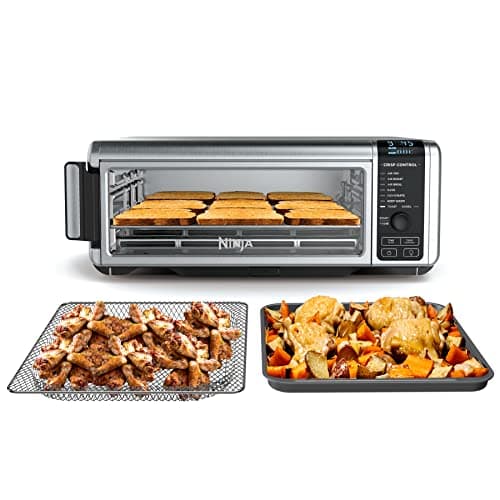
The Ninja SP101 leads if you have the supply for it. It is a full 1,800 watts — SharkNinja publishes the figure in its own quick start guide — and it flips vertically against the backsplash when you are done, which is the single most useful property an appliance can have in a space where the counter is also the prep area and the dish rack. It quotes a 13-inch pizza and nine slices of toast, both checkable against what you actually cook. Our review is here. The catch is the honest one: at 1,800 watts it is half a 30-amp hookup, so it is a shore-power oven, not a generator-and-inverter oven.
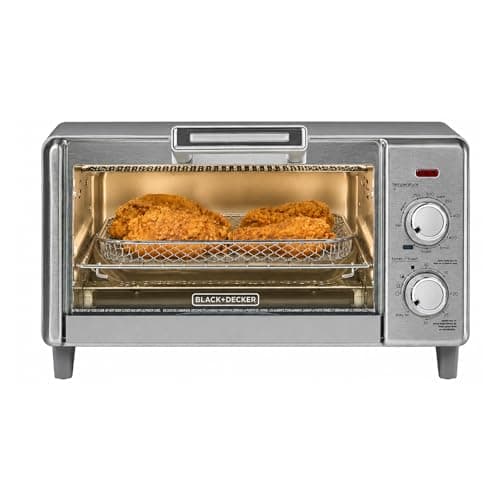
The BLACK+DECKER Crisp 'N Bake is second and is the compromise pick — a real convection fan at around sixty dollars, from a line whose sibling model publishes 1,150 watts and a two-year warranty. We have not found a separate published figure for this exact SKU and we have not assumed the two are identical, which is a limitation worth knowing before you plan a power budget around it.
Where the honest answer stops being an air fryer
If you are running on a generator, an inverter, or a 30-amp hookup that is already carrying an air conditioner, the ovens that fit your supply are the ones without a fan. That is an uncomfortable finding for a page with “air fryer” in the title, and it is the finding.
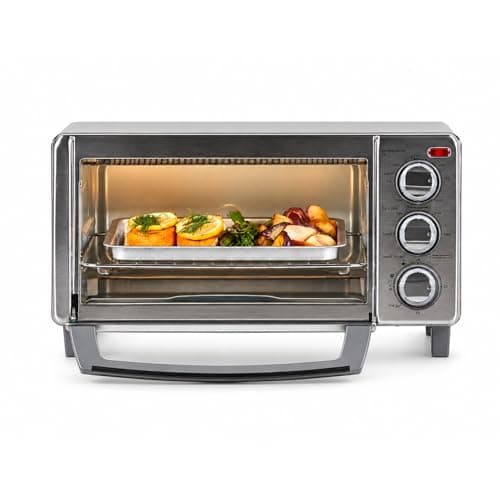
The BLACK+DECKER TO1785SG is third for exactly this reason. BLACK+DECKER publishes 1,150 watts at 120 volts on its own product page, along with the capacity, the dimensions and the warranty — better documentation than several ovens here costing five times as much. At about 9.6 amps it leaves genuine headroom on a shared circuit. It is a natural convection oven, which means no fan, which means it does not air fry. Its review says so plainly, and so does our guide to what that term actually means.
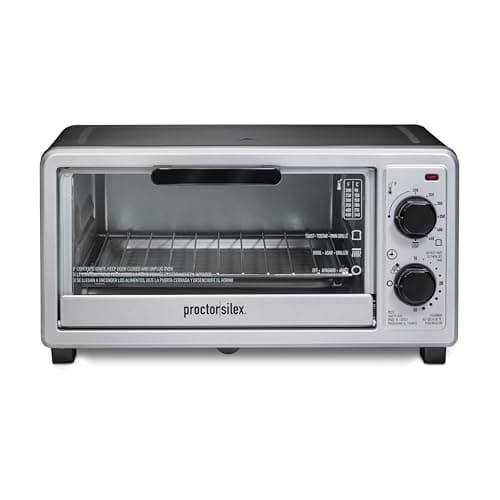
The Proctor Silex 31260 is fourth and is the floor: 1,100 watts published in its listing data — the lowest published draw of any oven on this site — a 200–450°F range, a three-year limited warranty, and an 8-inch depth. Three knobs, no fan, no pretense. If your supply is genuinely tight, this is the oven that will run when the others trip something.
The trade you are making
Lower wattage is cheaper per hour and slower per cook, and in an RV the second half of that sentence matters more than usual, because a slower cook means the load sits on your supply for longer. A 1,100-watt oven costs less per hour than an 1,800-watt one but may not cost less per meal. We put numbers on both sides of that trade. What lower wattage definitely buys is the ability to run the coffee maker at the same time, which on a 30-amp hookup is not a small thing.
What else to check before you buy
Depth and travel. Everything on a countertop becomes a projectile in motion. The flip-away geometry of the SP101 and the 8-inch depth of the Proctor Silex are both genuinely relevant here in a way they are not in a house. Our small-kitchen ranking covers footprint in more detail.
Clearance and venting.These ovens vent upward and get hot on the outside. In a cabinet-dense RV galley that matters more than it does under a domestic wall cabinet — check the manual's stated clearances rather than eyeballing them.
What is already on the circuit. The failure mode is never the oven alone; it is the oven plus the microwave, or the oven plus the air conditioner cycling on. The circuit arithmetic is the same one we run for domestic kitchens, with a much lower ceiling.