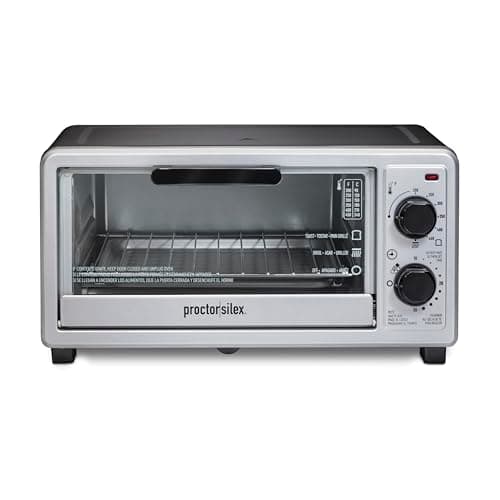
The short answer
Buy the Proctor Silex 31260. It publishes 1,100 watts — 9.2amps at 120 volts, the lowest draw of any oven here with a real bake temperature — a 30-minute timer that is also the auto shut-off, and a three-year limited warranty, which is the longest term published by anybody in this category. For about fifty dollars. If you want air fry at a draw a shared circuit can still absorb, the Hamilton Beach Sure-Crisp 31403 publishes 1,120 watts. If somebody else is paying, the Panasonic FlashXpress is the most completely specified small oven on this site.
What you should notbuy for an office is any of the ovens this site usually recommends. The Breville BOV900, the Ninja SP101, the Cuisinart TOA-70, the Nuwave Bravo XL Pro and both of 2026's new French-door ovens all draw 1,800 watts, which is 15 amps — the entire rating of a standard branch circuit. At home you solve that with an electrician. At work you cannot.
We have not cooked in any of these. Our rubric says that in those words— there is no test kitchen behind this site. What follows is what each manufacturer publishes, the arithmetic those figures support, and what nobody publishes at all.
Why an office is a different problem, and not a smaller one
We already rank the smallest toaster ovens on footprint and whether you can keep one in a dorm on published university housing policies. Neither of those is the question here, and the honest reason this is a separate page rather than a paragraph on one of them is that at an office you control none of the variables a home buyer controls.
Four of them, specifically. You cannot add a circuit, because the panel is not yours. You cannot find out what is already on the break-room circuit, because nothing is labeled and the microwave, the kettle, the coffee machine and the under-counter fridge were all installed by different people in different years. You cannot choose when someone else plugs something in. And you are not in the room — the entire premise of an office oven is that you put something in it and go back to your desk, which makes the shut-off behavior a safety specification rather than a convenience.
Both of the figures that answer those constraints are published, which is why this page can rank honestly on them instead of on adjectives. Everything else — the function count, the preset names, the interior finish — is downstream.
The criteria, in the order they decided the ranking
1. A published rated wattage, converted to amps. Amps are watts divided by volts, so an 1,800-watt oven at 120 V is 15 amps and a 1,100-watt oven is 9.2. The NEC treats a load running three hours or more as continuous and limits it to 80% of the breaker — 12 amps on a 15-amp circuit, which is 1,440watts — and that ceiling is where this ranking draws its line. Our dedicated-circuit guide works the arithmetic through in full. We are not electricians and this is general guidance drawn from published code basics, not an inspection of your building.
2. Published auto shut-off behavior. On a mechanical oven the timer is the shut-off: the dial winds down, a bell rings, the elements stop. There is no separate thermostat-independent safety sensor published for any oven on this site. We wrote the mechanism up separately, and the part that matters at work is the corollary: any setting that bypasses the timer bypasses the shut-off. Two of the five picks here publish such a setting, and both of them say so in their cons.
3. Published footprint. Break-room counters are shallow, usually interrupted by a sink and a microwave, and frequently under a cabinet. The figure that decides it is depth, then height plus clearance. The makers who publish a clearance requirement ask for two to four inches.
4. Shared air.An office has colleagues in it and no range hood. Smoke and smell are not performance faults, they are social ones, and the mechanisms behind both are published — fat reaching a hot element and the first-use cure-off of manufacturing residues. Both have the same answer: the oven with less exposed element and a real crumb tray causes fewer arguments.
5. A published warranty term, because nobody owns an office oven. This is the criterion that behaves differently at work than at home. A shared appliance is used by people who did not buy it, gets cleaned by nobody in particular, and has no one obvious to chase a claim. A published multi-year term is worth more here than it is in a kitchen, and a published warranty term is the exception in this catalog rather than the rule.
What gets disqualified, and on which number
The 1,800-watt class, which is most of what this site recommends everywhere else. Breville's BOV900, BOV860, BOV845 and BOV680 all publish 1,800 W as a rating-plate figure in their own instruction books. The Ninja SP101 publishes it in SharkNinja's own quick start guide. Cuisinart publishes it for the TOA-70. The Nuwave Bravo XL Pro states it in a brand Q&A answer. All of them are 15 amps, all of them sit at or above the entire rating of a 15-amp circuit before anything else is on it, and Breville recommends a dedicated circuit in its own instruction book.
That recommendation is the whole argument. At home it is an afternoon and an electrician. In a leased office it is a facilities request, a landlord and a conversation about the lease — so an oven whose own manufacturer asks for a dedicated circuit is not an office oven, however good it is. Both French-door ovens released this season fall the same way: the Ninja FO101 does not publish a wattage at all, which is worse than publishing a high one, and the Cuisinart TOA-FD70's 1,800 W comes from a retailer's table.
Going the other way, the 650-to-800-watt band is not here either, and the reason is the opposite one. Those ovens draw 5.4 to 6.7 amps, which is wonderful for a shared circuit, and they publish a 200°F floor, a 15-to-30-minute timer and, on the cheapest, two slices of capacity. We rank that whole band separately, and the honest summary is that below about a thousand watts you stop buying an oven and start buying a toaster. If your office needs are strictly toast and reheat, go read that page; it is the cheaper answer and it is a real one.
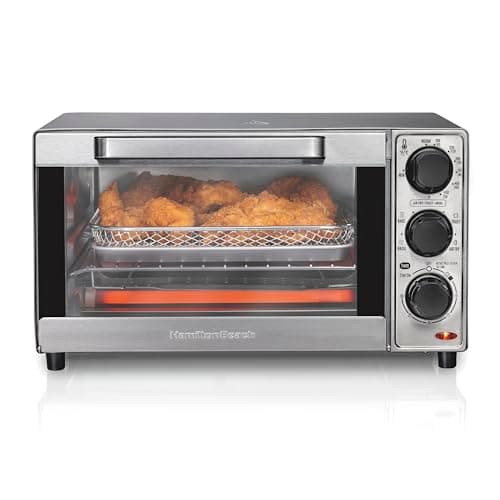
1. Proctor Silex 31260 — the only sensible default
1,100 published watts, which is 9.2 amps— comfortably inside the 12-amp continuous-load ceiling with nearly three amps of headroom for whatever else is on the counter. A 200–450°F range, four slices, three mechanical knobs, and a three-year limited warrantypublished on Proctor Silex's own page, which is the longest term anybody in this category publishes and comes on the cheapest oven here by a factor of three.
The shut-off story is published too, and it is the best and the worst thing about the oven. The 30-minute timer ends with a ready bell and shuts the elements off — which is exactly what you want from a machine you walked away from. Proctor Silex also publishes a Stay On option, and that is the one setting on this page that will leave an office oven energised indefinitely. It exists for a reason (a bake longer than half an hour) and in a shared kitchen it is the setting to agree never to use.
At 18.34¢ per kWh it costs 20.2¢ an hour of oven-on time, the cheapest figure on this page by a third against the 1,800-watt class's 33.0¢. The honest counterweight is on our electricity page: a lower-wattage oven is cheaper per hour and not necessarily cheaper per job, because it takes longer to get there.
The cons, plainly.No fan, so no convection and visibly uneven browning across four slices. A mechanical thermostat with no published tolerance. 1,100 watts preheats noticeably slower than everything above it. Four slices is the hard ceiling, which in an office means one person's lunch rather than two. And the wattage, unusually for this site's top pick, is published in Amazon's product-details table rather than by Proctor Silex — its own page publishes the range, the timer and the warranty and no watt figure.
2. Hamilton Beach Sure-Crisp 31403 — air fry that still shares a circuit
1,120 published watts, 9.3amps, and a fan. Hamilton Beach prints the wattage, the 200–450°F range, the four functions and the exact exterior on its own page for model 31403, and 31403 is the model number Amazon's listing data gives for this ASIN. That makes it the cheapest oven on this site with a fan and a maker-published wattage, and twenty watts more than the Proctor Silex buys the convection the Proctor Silex does not have.
For an office the fan earns its keep in a specific way: it is what makes reheating yesterday's food come out crisp instead of damp, which is most of what an office oven is for. Our reheating ranking is built on that distinction.
The cons.Hamilton Beach sells two variants under near-identical names at 1,120 and 1,500 watts — the J suffix is the 1,500 — so the rating plate on delivery is the only thing that tells you which one arrived, and a 1,500-watt unit is 12.5 amps and over the continuous-load line. One year of warranty. Four slices again. And no interior dimension published, so the 9-inch pizza claim is the only capacity figure you can check.
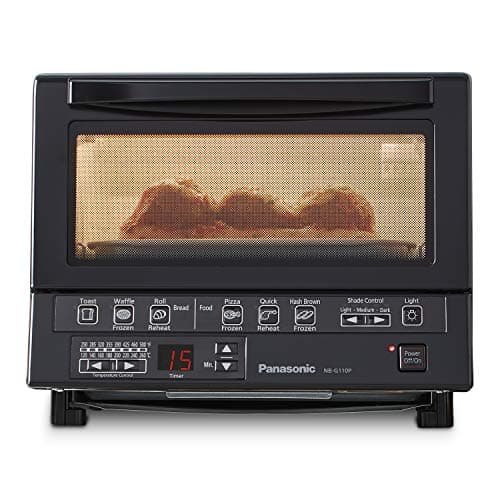
3. Panasonic FlashXpress — the one that publishes everything
1,300 W, 120 V, 60 Hz, 7.2 quarts, 250–500°F, exterior dimensions in millimeters and a stated weight. Panasonic publishes all of it, which makes this the most completely specified oven on this site relative to its sizeand the only pick here where every figure comes from the manufacturer rather than a retailer's table. 10.8 amps still sits inside the 12-amp ceiling.
The specification that matters for a desk lunch is the top of the range, not the bottom: 500°F is 50 degrees above both of this season's new French-door ovens, and Panasonic's infrared element pair is what the FlashXpress name is about — it is built to come up fast from cold, which is the behavior you want from an oven used in twelve-minute bursts.
The cons.It costs three times the Proctor Silex and buys no extra capacity — 7.2 quarts is small, and no amount of documentation adds volume. A 250°F floor is the highest minimum on this page, which rules out anything low and slow. Panasonic publishes no warranty term for it, which is the one gap in an otherwise exemplary spec sheet and matters more on a shared appliance than a private one. And the control is digital with preset buttons rather than knobs, which in a shared kitchen means more things for a colleague to set wrong.
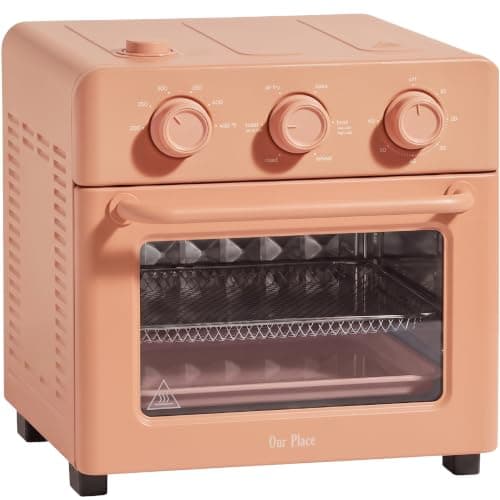
4. Our Place Wonder Oven — the nice-office pick
1,400 watts, and the figure is a rating line printed on the cover of Our Place's own user manual — the strongest sourcing of any wattage on this page. 11.7 amps, which is inside 12 with about a third of an amp of margin after the continuous-load allowance. Our Place also publishes the one thing almost nobody in this category does: interior dimensions, 10 by 10.3 by 7.6 inches, so you can check a specific dish against it before buying.
It is also the only pick here that publishes all four of the things our Documentation score covers— wattage, temperature range, interior dimensions and a warranty term — and it is the pick to argue for if the office oven is also a thing people will see. Six functions, a steam-infusion mode, 11.6 pounds, and a review of its own.
The cons. It costs about $185, which is a hard sell as a shared appliance nobody owns. 1,400 watts at 25.7¢ an hour is the second-highest running cost here. The dial starts at 200°F and the timer stops at 60 minutes, both published, so proofing and dehydrating are out. One year of warranty. And the steam function — the reason to want this oven at home — needs water added and the reservoir emptied, which is precisely the kind of maintenance that does not happen in a shared kitchen.
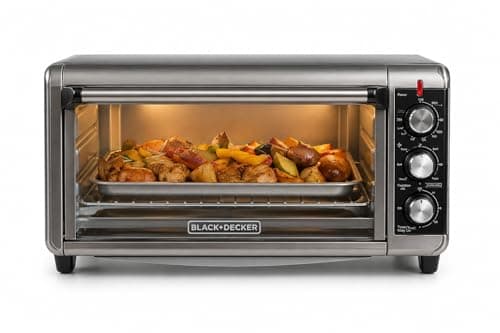
5. BLACK+DECKER TO3250XSB — the one just over the line, named as such
1,500 W, 120 V, 60 Hz, and the figure is the rating line printed in BLACK+DECKER's own use and care manual and repeated on its product page. That is 12.5 amps, which is over the 12-amp continuous-load ceiling, and it is on this page anyway because the honest answer for a lot of offices is a wider oven and a rule about not running it alongside the kettle.
What the extra 400 watts and the extra width buy is real: eight slices, a 12-inch pizza, and a 13-by-9 pan with handles— all three published by BLACK+DECKER — plus a convection fan and a two-year warranty, for under ninety dollars. It is the only pick here that can heat lunch for more than one person at a time, which in an office is often the actual requirement. Our full review covers the rest.
The cons, and the first one is the reason it is ranked fifth.12.5 amps exceeds the continuous-load guidance for a 15-amp circuit, so on a long bake it wants a line it is not sharing — exactly the thing an office cannot promise. 22 inches wide will not slide under most upper cabinets and will not fit beside a break-room sink. There is no air fry function and no basket, so “crisp” here means convection rather than air frying. And BLACK+DECKER publishes, in this manual, that temperatures in the oven will be lower than the set point by design — which is admirable disclosure and still means the dial is an approximation.
The honest summary of the whole page
Every oven here draws between 9.2and 12.5 amps and every one of those figures was published by somebody before we did the division. That span — 1,100 to 1,500 watts — is the whole range in which an office oven is a reasonable thing to own, and the ranking inside it is mostly about which compromise you would rather explain to a colleague: slow (Proctor Silex), small (Panasonic), expensive (Our Place), or wide enough to need its own outlet (BLACK+DECKER).
The thing that is not a compromise is the shut-off, and it is the one specification worth agreeing on as a group. Set the timer, never use the hold-on setting, and the oven is as safe unattended as the mechanism it publishes. Use the hold-on setting once and the published safety behavior is gone, on any oven on this page.
Doing the amps arithmetic for a circuit you cannot see
Watts divided by volts is amps, and US office outlets are 120 V. So 1,100 W is 9.2A, 1,500 W is 12.5 A, and 1,800 W is 15 A. A standard branch circuit is rated 15 or 20 amps, and the NEC treats anything drawing for three hours or more as a continuous load and limits it to 80% of the breaker — 12 A on a 15-amp circuit, 16 A on a 20-amp one. Heat is cumulative; it is sustained draw rather than the instantaneous number that overheats wiring.
Since you cannot read the panel, the useful version is a budget. Assume the worst case — a 15-amp circuit, so 12 amps of continuous headroom — and subtract what is already there. A microwave is typically the largest single draw in a break room and in the same class as an oven; a kettle is similar; a drip coffee maker is substantial while it brews; an under-counter fridge is small but cycles unpredictably. On that arithmetic, a 9-amp oven and one other heating appliance is already at the line, which is why the two-appliance rule (“oven or kettle, not both”) does more good in an office than any purchase decision.
And do not extrapolate from the fact that nothing has tripped yet. A breaker that has not tripped is evidence about the past, not a measurement of margin — and the failure mode people assume is a tripped breaker, which is the safe outcome. The full version of this arithmetic is here. If anything about your building's wiring is a question rather than a calculation, that is a question for an electrician and for your facilities team, not for a buying guide.
Why the shut-off is a specification and not a feature
On every oven in this price range the timer and the shut-off are the same mechanism. The dial winds down, the circuit opens, the elements stop. There is no separate published safety sensor, no thermal cut-out documented for any oven on this site, and no auto-off that works independently of the clock. That has one practical consequence worth more than any other sentence on this page: a hold-on or Stay On setting removes the only unattended safety behavior the oven has.
It also means the timer length is a hard ceiling on an unattended cook. Thirty minutes is the norm at the cheap end and sixty is the norm above it — the Our Place Wonder Oven publishes 60 minutes, the Proctor Silex 30. Anything longer needs somebody standing there to restart it, which at work is usually the end of the plan. The published mechanism, brand by brand.
One more office-specific point about unattended operation: a crumb tray is a fire-safety part, not a cleaning convenience, and in a shared kitchen it is the part nobody empties. The oven most likely to smoke in six months is whichever one has the least accessible tray, and that is a reason to prefer a simple cavity you can see into over a clever one you cannot.
What to settle before you buy, not after
Three questions, and none of them is about the oven. Does your lease or your employer's policy allow a cooking appliance at all — many commercial leases and workplace fire-safety policies restrict open-element appliances outside a designated kitchen, in the same way published university housing policies do. Who owns it, in the sense of who cleans the crumb tray and who chases a warranty claim. And what else is on that counter, which decides the wattage ceiling you are shopping under before you look at a single product page.
Settle those and the purchase is easy, because the field is narrow: five ovens, 1,100 to 1,500 watts, every figure published. Skip them and you will buy an 1,800-watt oven that trips a breaker in week two, which is the single most common way this goes wrong.