Start with what the money does not buy
It does not buy a cheaper oven to run. Every pick on this page draws a published 1,800 watts, which is the ceiling of a standard 15-amp, 120-volt US kitchen circuit — 15 × 120 = 1,800 — and so does the hundred-dollar Cuisinart Custom Classic two hubs over. Your electricity bill cannot tell them apart. The published figures are tabulated here. Any premium oven marketed on efficiency is being marketed on something that is not true of the category.
What it does buy is control over where that 1,800 watts goes, documentation you can check before you spend, and a build that is still working in ten years. Those are real and they are worth money — but they are worth money to some people and not to others, and this site's consistent position is that spending less is frequently the right call.
Reading the order
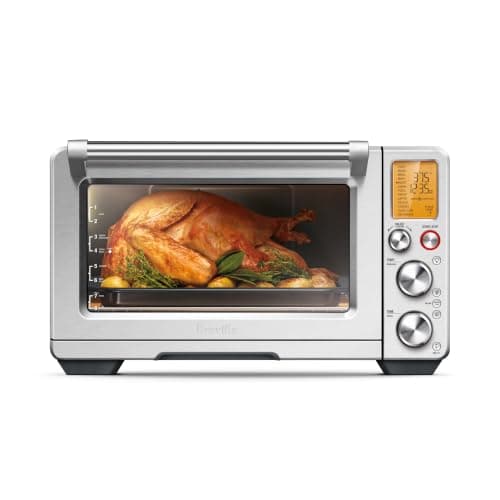
The Breville Smart Oven Air Fryer Pro (BOV900) leads, and it leads on documentation as much as on hardware. Breville publishes the 1,800-watt rating in the instruction book as a rating-plate figure rather than a marketing headline, publishes a one-cubic-foot interior, and publishes the element layout. Six elements driven independently — rather than switched in banks — is the actual mechanical difference behind the price, and it is the thing a cheaper oven cannot replicate at any setting. Our full review is here. It is also 21.4 inches wide, which is the honest catch.
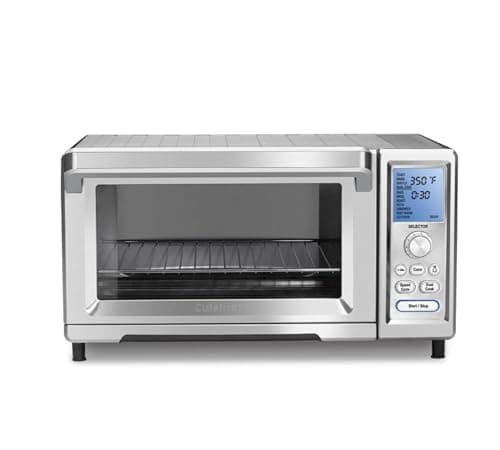
The Cuisinart TOB-260N1 is second and is the value pick of this band by a distance. It is the only oven on this site whose manufacturer publishes both a wattage and an interior volume on the same page — 1,800 watts, 0.95 cubic feet — and it adds a dual-cook mode that runs two temperatures in sequence, which is genuine control rather than another preset. Fifteen functions, at meaningfully less than the Breville. Its review is here.
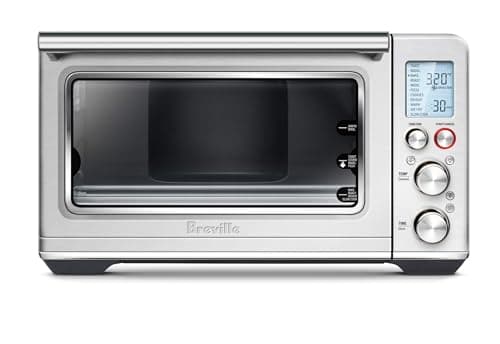
The Breville Smart Oven Air Fryer (BOV860)is third: the Pro's electronics in a chassis two and a half inches narrower, at less money, with the same 1,800-watt rating plate and two fewer functions. For a standard 24-inch counter it is the more realistic Breville, and the running cost is identical because the rating is. Its review is here.
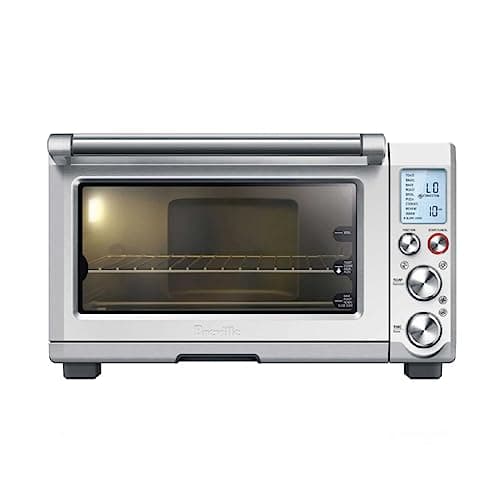
The Breville Smart Oven Pro (BOV845) is fourth and is the deliberate one. No air fry function at all — this is the convection oven of the range with the marketing layer removed. Ten functions, 1,800 watts published, and a published 120°F floor on Bake and Roast, which is why it earns a place in our bread ranking. If you bake more than you crisp, it is arguably the right Breville. Its review is here.
What separates them, in one table
| Oven | Published interior | Functions | Air fry |
|---|
| Breville BOV900 | 1 cu ft | 13 | Yes |
|---|
| Cuisinart TOB-260N1 | 0.95 cu ft | 15 | No — convection, dual-cook |
|---|
| Breville BOV860 | None published | 11 | Yes |
|---|
| Breville BOV845 | None published | 10 | No — deliberately |
|---|
All four publish a rated 1,800 W. Function counts are as each manufacturer states them; a function is a heat profile at a set point, and a higher count is not a capability ranking.
Is the premium band worth it?
Honestly: for a household that uses a countertop oven daily and will keep it a decade, yes — the element control is real, the documentation lets you check what you bought, and Breville's build quality is not marketing. For toast, reheating and a tray of vegetables twice a week, no, and comfortably no. A hundred-dollar 1,800-watt oven does those three jobs at the same speed and the same running cost, and our budget ranking is not a consolation prize.
The middle answer, and the one we would give most people asking this question: the Cuisinart TOB-260N1. It publishes more than anything else in the category, gives you genuine temperature control, and sits well below the Brevilles. Every score on this page is compiled from published specifications rather than from cooking — the rubric is here — which is exactly why an oven that publishes more can rank higher without us having turned one on.
How we picked
Ovens we claim to have cooked in: 0
Everyone in this category tells you they roasted forty chickens. We have roasted none, and we say so. Here is what we do instead: read the manufacturer's manual and spec sheet, record the published wattage, interior volume, temperature range and warranty term, work out what the oven costs to run for an hour and for a year, show the arithmetic so you can redo it with your own electricity rate, and cite all of it. Where a brand publishes no wattage, we print no running cost rather than borrowing a number from a similar model. Prices come live from Amazon's API and disappear rather than go stale.
The scores above are judgments from that documented research — not test results. One of the five metrics is Documentation: whether the manufacturer will tell you what its oven draws at all. The full rubric, including what disqualifies an oven, is published in full.