Skip to content
CC

HUB 02 · Countertop Convection Ovens

The Best Countertop Convection Ovens for Pizza

Pizza is the one job in this category with a hard physical requirement: heat, and enough of it, under a stone or a pan that actually fits. Two published figures settle it — the temperature ceiling and the stated pizza diameter — and most makers publish neither.

By Stephen V.Updated How we rank
#ad

We earn a commission if you buy through our links. It does not change the price you pay, and it does not decide our picks — the scoring rubric is published in full, including what disqualifies an oven. How this works.

The short answer

Quick picks

#OvenBest forScorePrice
01
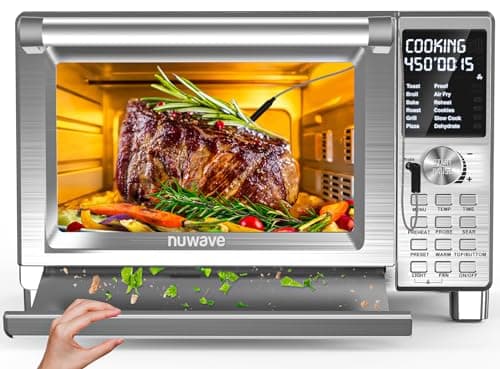
Nuwave Nuwave Bravo XL Pro Air Fryer Toaster Oven (30 Qt, with probe)
Nuwave Bravo XL Pro Air Fryer Toaster Oven (30 Qt, with probe)

The most oven around a probe for the money

1,800 W
7.7
$167.96Amazon
02
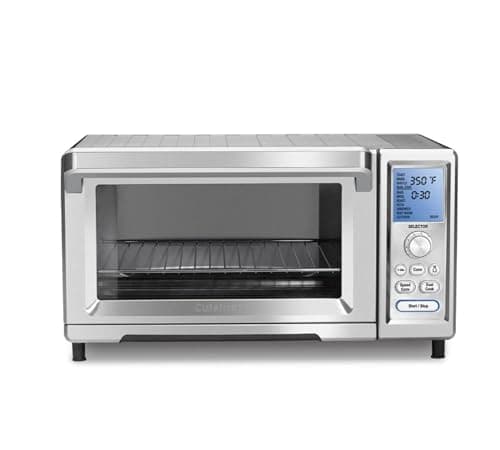
Cuisinart Cuisinart Chef's Convection Toaster Oven (TOB-260N1)
Cuisinart Chef's Convection Toaster Oven (TOB-260N1)

The best-documented interior in the category

1,800 W
8.6
$212.24Amazon
03
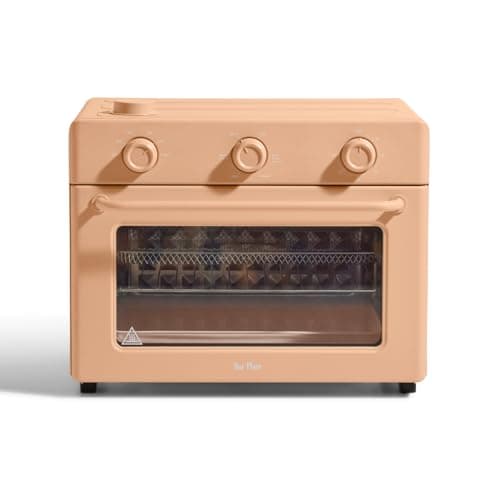
Our Place Our Place Large Wonder Oven (6-in-1, 28 L)
Our Place Large Wonder Oven (6-in-1, 28 L)

The Pro's cavity at the standard oven's controls

1,700 W
8.2
$175.00Amazon
04
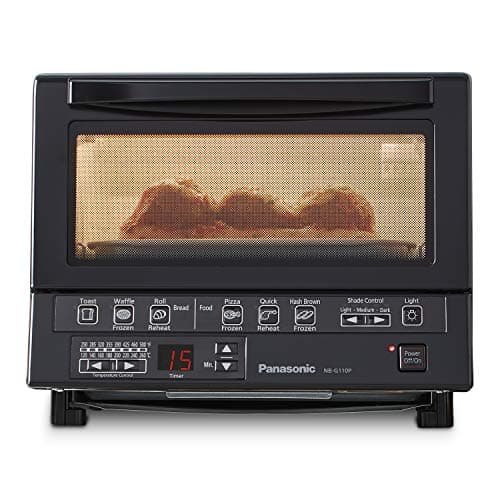
Panasonic Panasonic FlashXpress Toaster Oven (NB-G110P)
Panasonic FlashXpress Toaster Oven (NB-G110P)

The best-specified small oven here

1,300 W
7.8
$117.99Amazon
05
no image
BLACK+DECKER 8-Slice Extra Wide Convection Toaster Oven (TO3250XSB)

Mid-size convection with dials and a published wattage

1,500 W
7.2
Check priceAmazon

#ad · Prices pulled live from the Amazon Product API, last checked November 22, 2026. Where we have no verified live price we show none — we would rather leave a gap than print a number that has gone stale. The wattage column is what the manufacturer publishes; “not published” means exactly that, and we have not estimated one. Scores are ours, compiled from published specifications, and are not test results.

The short answer

Buy the Nuwave Bravo XL Pro. It is for anyone who wants the hottest published set point in this catalog inside a cavity big enough to use it: Nuwave prints 50–500°F in 5°F increments, a 30-quart interior with four rack levels, the interior dimensions in inches, and its own FAQ states the oven takes two 13-inch pizzas. If you want the largest stated pizza from a manufacturer specification, the Cuisinart Chef's Convection TOB-260N1 publishes 13 inches alongside 1,800 watts and 0.95 cubic feet — the only oven here publishing both power and volume in the same place. The budget pick is the BLACK+DECKER TO3250XSB: under a hundred dollars, and the maker publishes a 12-inch pizza, a 9 x 13 pan with handles, a 1500 W rating line and a two-year warranty.

We have not baked a pizza in any of these. Our rubric says so in those words. Everything below is a figure from a manufacturer document, or it is not on the page.

Pizza is a temperature problem before it is an oven problem

A home pizza is limited by how hot the deck under it gets and how quickly the top browns before the base goes soggy. That is why 450°F and 500°F are not interchangeable: fifty degrees is the difference between a crust that sets and a crust that steams. And 450°F is the published ceiling for most of this category — of the forty ovens in this catalog, exactly two publish a 500°F set point, and both are on this page.

The second figure is fit. A 12-inch pizza needs more than twelve inches of usable width, because the pan has a rim and the cavity has walls. Four makers in this catalog publish a pizza diameter their oven takes; everyone else publishes a quart figure and leaves the geometry to you. A quart number cannot tell you whether a round pan fits, because volume says nothing about shape.

OvenPublished ceilingPublished pizza / pan fitRated powerPer hourPrice
Nuwave Bravo XL Pro500°FTwo 13-inch pizzas; 13 x 9 x 3 in. pan (Nuwave FAQ)1800 W (brand Q&A)33.0¢$167.96on Amazon
Cuisinart TOB-260N1Not published as a band13-inch pizza; 9x13 pan; nine slices1800 watts33.0¢$212.24on Amazon
Our Place Large Wonder Oven450°F12-inch pizza; 13.75 x 13 x 7.75 in. interior1700 W31.2¢$175.00on Amazon
Panasonic FlashXpress500°FNot published — 7.2 quart interior1300 W23.8¢$117.99on Amazon
BLACK+DECKER TO3250XSBNot published as a band12-inch pizza; 9 x 13 pan with handles1500 W27.5¢Check price on Amazon →

Every price in the table above and on every card below was last checked November 22, 2026, read from the same live price layer the buy buttons read. All five makers here publish a wattage, which is unusual for this catalog. Amazon moves these daily and the price at checkout is the one that counts — where a row says “Check price”, we had no verified offer at that check and we would rather show a gap than a number we cannot stand behind.

Per-hour figures are the published wattage times 18.34¢ per kWh, the US average residential rate for June 2026, and they are an upper bound rather than a bill. Every published wattage on this site, with its source.

The finding is at the bottom of the table. The cheapest oven on this page is the one that publishes a 12-inch pizza, a 9 x 13 pan, a rating line in its own manual, its exterior dimensions, its weight and a two-year warranty. The most expensive is three and a half times the money and publishes a bigger pizza. Everything between is paying for something other than pizza.

1. Nuwave Bravo XL Pro — the only hot oven with room to use the heat

Who it is for: the household making pizza for more than two, who wants the set point to go where pizza wants it. 500°F published, in 5°F steps, with four rack levels in a 30-quart cavity and Nuwave's own FAQ stating two 13-inch pizzas. It also publishes the interior in inches, which is the only way to check a round pan against a rectangular cavity before you buy.

The cons. The 1,800 W comes from a Nuwave Q&A answer on its own product page rather than a rating line, and we flag that on the card instead of promoting it. There is no stone or steel included, and a pizza baked on a wire rack at 500°F is still a pizza baked on a wire rack. Twelve functions plus a hundred presets is marketing depth, not capability. One-year warranty, original purchaser only. Our full review.

2. Cuisinart Chef's Convection TOB-260N1 — the biggest stated pizza

Who it is for: the buyer who wants the fit guaranteed on the manufacturer's own page. Cuisinart publishes a 13-inch pizza, a 9x13 pan and nine slices of toast beside 1,800 watts and 0.95 cubic feet — the only oven in this catalog whose maker prints a wattage and an interior volume in the same place. Fifteen functions, dual-position racks, and a cavity shaped like a pizza rather than like a toaster.

The cons. It publishes no temperature band, so the one figure a pizza cares about most is missing: you get a dial and a claim, not a stated ceiling. At 530 mm it is the deepest oven in this catalog, which is the dimension people forget to measure until the door will not clear the backsplash. And it is the most expensive oven on this page by a wide margin. Our full review.

3. Our Place Large Wonder Oven — the published 12-inch pizza, in a published box

Who it is for: the buyer who wants the fit arithmetic to actually check out. Our Place publishes a 13.75 x 13 x 7.75 inch interior, a 16.75 x 13.25 x 13 inch exterior, three rack levels, six slices per wire rack and a 12-inch pizza — and the interior dimensions and the pizza claim agree with each other, which is rarer in this category than it sounds. 1,700 W on a published rating line, and a 450°F ceiling.

The cons. 450°F is fifty degrees short of where a thin crust wants to be, and the published floor is 200°F with a 60-minute timer — so no proofing the dough in the same appliance. It draws the Pro's 1,700 W to do the standard oven's job, and the Pro is the only model in the line that publishes the 80°F floor and the 24-hour timer. Our full review.

4. Panasonic FlashXpress — 500°F in the smallest box here

Who it is for: one or two people who want the heat and do not need the room. Panasonic publishes more about this oven, relative to its size, than anyone else in this catalog publishes about anything: 1,300 W, 120 V 60 Hz, 7.2 quarts, a 250–500°F range and exact millimetre dimensions. It is one of only two ovens here with a published 500°F ceiling, and it is the cheaper of the two.

The cons. 7.2 quarts is a small oven and no amount of documentation adds capacity — Panasonic publishes no pizza diameter, and at this interior you should assume a personal pizza rather than a 12-inch one. The 250°F floor is high, so proofing and dehydrating are out. And at 1,300 W it has less element behind the 500°F claim than the bigger ovens above it, which matters on recovery after the door opens. Our full review.

5. BLACK+DECKER TO3250XSB — the budget pick, and the one that publishes the fit

Who it is for: anyone who wants a 12-inch pizza to fit, for under a hundred dollars, with the claim in writing. BLACK+DECKER publishes a 12-inch pizza and a 9 x 13 pan with handles, a 22 x 14.5 x 11.5 inch exterior, 12.1 lb, a two-year warranty and the rating line 1500 W, 120 V~, 60 Hz in its own manual. For the money that is a more complete specification than several ovens here costing three times as much.

The cons. It is a convection baker, not an air fryer: there is no basket and no air-fry setting, and the crisping the rest of this site discusses needs both. It publishes no temperature band, the controls are dials, and a knob thermostat at this price is an approximation rather than a set point — which for pizza matters more than it does for toast. It is also 22 inches wide, the widest footprint on this page. Our full review.

The honest summary

For pizza specifically, spending more buys you very little in this category and the published figures say so plainly. The two hottest ovens we can document are the second-cheapest and the mid-priced one; the cheapest is the only oven that writes down what size pizza goes in. What more money reliably buys here is cavity, rack levels and a paper trail — all genuinely useful, none of them pizza.

If crisping rather than baking is the real goal, the air-fry hub ranks the same question on fan speed instead. If capacity is the constraint, the full-size ranking is the page that orders this hub by interior.
In detail

The picks, in full

01
Nuwave Nuwave Bravo XL Pro Air Fryer Toaster Oven (30 Qt, with probe)

The most oven around a probe for the money

Nuwave Bravo XL Pro Air Fryer Toaster Oven (30 Qt, with probe)

Interior dimensions publishedWattage from a brand Q&A answer, not the manual
7.7/10

A 30-quart, four-rack-level convection oven with an integrated temperature probe that stops the cook at a set internal temperature, and a maker that publishes its interior and exterior dimensions, weight, capacity, temperature range and warranty term — most of which the Ninja probe ovens do not. The 1,800-watt figure comes from a Nuwave support answer on its own product page rather than the manual's rating line, and we say so.

Power
8
Usable space
9
Footprint
6
Documentation
7
Value
8.5

What it gets right

  • An integrated probe that stops the oven at a target between 50°F and 212°F — per the manual, not a preset that merely displays a reading
  • Nuwave publishes both outer and inner dimensions, weight, capacity and a 50–500°F range; its own FAQ states a standard 13 x 9 x 3 inch pan fits
  • Four rack levels in a 30-quart cavity — Nuwave's own figures are a 10 lb chicken or two 13-inch pizzas — for well under either probe-equipped Ninja

What it doesn't

  • The 1,800 W figure is a Nuwave support answer on the product page, not a rating line in the manual or a row in the spec table
  • 12 functions plus 100 recipe presets is deep into the territory where the count is marketing
  • One-year limited warranty, valid only for the original purchaser and only in the continental US per the manual

What it costs to run

About 33.0¢ an hour at full draw, or $60.25 a year at 30 minutes a day, 365 days a year and 18.34¢ per kWh.

1,800 W ÷ 1000 × 182.5 h × 18.34¢ = $60.25

1800 watts, or 15 amps, as stated by Nuwave in its own answer (dated 06/30/2026) to a customer question on the Bravo XL Pro product page. The model 20813 owner's manual and the page's specification table give the supply as 120 V but print no wattage, so this is brand-supplied rather than a rating-plate reproduction. This is an upper bound: the elements cycle off once the cavity is at temperature, and no manufacturer publishes a duty cycle, so we compute at full rated draw rather than invent a correction factor. The full method is published.

Skip this if…

…you do not roast to an internal temperature. Everything this oven does better than a cheaper 30-quart box is the probe and the four rack levels; if you mostly air fry vegetables and reheat, a smaller oven with a rating-plate wattage is the better-documented buy.

$167.96on Amazon

$219.9924% off

Price last checked November 22, 2026. Prices move constantly — Amazon's at checkout is the one that counts.

#ad · we may earn a commission from this link to Nuwave Bravo XL Pro Air Fryer Toaster Oven (30 Qt, with probe)

02
Cuisinart Cuisinart Chef's Convection Toaster Oven (TOB-260N1)

The best-documented interior in the category

Cuisinart Chef's Convection Toaster Oven (TOB-260N1)

Wattage and volume both publishedDeep cabinet footprint
8.6/10

The only oven here whose manufacturer publishes both a wattage and an interior volume in cubic feet on the same page. 0.95 cubic feet at 1,800 W, with a stated list of what fits — a 13-inch pizza, a 9x13 pan, nine slices.

Power
9.5
Usable space
9.5
Footprint
5.5
Documentation
10
Value
8.5

What it gets right

  • 0.95 cubic feet published in the same place as the 1,800 W rating, which makes it the easiest oven here to compare on paper
  • Within 5% of the Breville Pro's interior for a good deal less money
  • Fifteen functions including a genuine dual-cook mode that runs two temperatures in sequence

What it doesn't

  • 530 mm deep is a lot of counter — deeper than the Breville Pro
  • Fifteen functions on a backlit panel is a lot of interface between you and heat
  • Cuisinart lists this model as discontinued on its own site, so availability moves around

What it costs to run

About 33.0¢ an hour at full draw, or $60.25 a year at 30 minutes a day, 365 days a year and 18.34¢ per kWh.

1,800 W ÷ 1000 × 182.5 h × 18.34¢ = $60.25

1800 watts as published by Cuisinart on the TOB-260N1 product page, alongside the 0.95 cubic foot interior figure. This is an upper bound: the elements cycle off once the cavity is at temperature, and no manufacturer publishes a duty cycle, so we compute at full rated draw rather than invent a correction factor. The full method is published.

Skip this if…

…your counter is shallow. At 530 mm deep this is the deepest oven on the list, and depth is the dimension people forget to measure until the door will not clear the backsplash.

$212.24on Amazon

Price last checked November 22, 2026. Prices move constantly — Amazon's at checkout is the one that counts.

#ad · we may earn a commission from this link to Cuisinart Chef's Convection Toaster Oven (TOB-260N1)

03
Our Place Our Place Large Wonder Oven (6-in-1, 28 L)

The Pro's cavity at the standard oven's controls

Our Place Large Wonder Oven (6-in-1, 28 L)

Interior and exterior dimensions publishedThree rack levels and a 12-inch pizza published1,700 W with a 200°F floor and a 60-minute timer
8.2/10

Dimension for dimension this is the Wonder Oven Pro: Our Place publishes the same 13.75 x 13 x 7.75 in. interior, the same 16.75 x 13.25 x 13 in. exterior, the same 28 L and the same three rack levels for both. What it does not get is the Pro's control board — the floor stays at 200°F and the timer still stops at 60 minutes — and it draws the Pro's 1,700 W to do it. Cheapest route to the big Wonder Oven cavity, and the wrong one if a published low temperature is why you are shopping.

Power
9
Usable space
8.5
Footprint
7.5
Documentation
8
Value
8

What it gets right

  • The Wonder Oven Pro's published cavity for substantially less money: Our Place prints an identical 13.75 x 13 x 7.75 in. interior, an identical 16.75 x 13.25 x 13 in. exterior, 28 L and three rack levels for both models, and says so itself in its own comparison table
  • More than doubles the standard Wonder Oven's published fit — six slices of toast per wire rack against four, a 12-inch pizza against nine, and three levels against two — in a box 16.75 inches wide
  • Our Place publishes a wattage, a voltage, a temperature range, a timer range, a capacity, interior and exterior dimensions, a weight, a rack count, the modes, the materials and a per-accessory dimension and weight, which is more of the spec sheet than most brands print at any price

What it doesn't

  • It draws the Pro's 1,700 W to deliver the standard oven's 200°F floor and 60-minute timer, so there is no proofing, no dehydrating and no long cook — the electricity bill of the capable model without the capability
  • The stated 28 L does not follow from the interior Our Place prints beside it: 13.75 x 13 x 7.75 in. is about 1,385 cubic inches, or roughly 22.7 L, and Amazon rounds the stated figure further still to “30 Qt”
  • The same product page gives three figures two different ways — 16.75 in. and 16.7 in. of exterior width, a 4.5 lb and a 5.5 lb chicken, 4–6 and 1–2 teaspoons of steam water — and no manual is published to settle any of them
  • Hand wash only: Our Place's own care instructions say to avoid the dishwasher for the accessories, and the bake pan's release coating is ceramic rather than PTFE

What it costs to run

About 31.2¢ an hour at full draw, or $56.90 a year at 30 minutes a day, 365 days a year and 18.34¢ per kWh.

1,700 W ÷ 1000 × 182.5 h × 18.34¢ = $56.90

1700w at 120V, published by Our Place in the “Wattage & Voltage” row of the Getting Technical block on its own Large Wonder Oven product page. As with the Wonder Oven Pro, Our Place links no manual PDF for this model, so this is a product-page figure and not a rating-plate one — the standard Wonder Oven is the only model in the line whose rating line we have read. This is an upper bound: the elements cycle off once the cavity is at temperature, and no manufacturer publishes a duty cycle, so we compute at full rated draw rather than invent a correction factor. The full method is published.

Skip this if…

…you are buying a bigger Wonder Oven in order to proof dough, dehydrate or run anything past the hour mark. This model's published floor is 200°F and its timer stops at 60 minutes, exactly like the standard oven, and no mode on the dial changes either — only the Pro publishes the 80°F floor and the 24-hour timer.

$175.00on Amazon

$245.0029% off

Price last checked November 22, 2026. Prices move constantly — Amazon's at checkout is the one that counts.

#ad · we may earn a commission from this link to Our Place Large Wonder Oven (6-in-1, 28 L)

04
Panasonic Panasonic FlashXpress Toaster Oven (NB-G110P)

The best-specified small oven here

Panasonic FlashXpress Toaster Oven (NB-G110P)

Fully specified by the manufacturerSmall interior
7.8/10

The most completely documented oven on this entire site relative to its size: 1,300 W, 120 V, 60 Hz, 7.2 quarts, 250–500°F, exact millimeter dimensions and a stated weight. Panasonic publishes all of it, and almost nobody else does.

Power
7
Usable space
5
Footprint
9.5
Documentation
10
Value
7.5

What it gets right

  • Panasonic publishes power, voltage, frequency, capacity, temperature range, dimensions and weight — the complete set, which no other brand here manages
  • 1,300 W and infrared elements means no preheat in the usual sense
  • 500°F ceiling in a 7.2-quart cavity is a genuinely high heat density

What it doesn't

  • 7.2 quarts is small — four slices, and a 9-inch pizza is optimistic
  • The infrared elements are not adjustable in the way a multi-element oven's are
  • Expensive for its size, and you are paying partly for the engineering discipline

What it costs to run

About 23.8¢ an hour at full draw, or $43.51 a year at 30 minutes a day, 365 days a year and 18.34¢ per kWh.

1,300 W ÷ 1000 × 182.5 h × 18.34¢ = $43.51

1300 W at 120 V / 60 Hz, published by Panasonic as a power consumption figure with the supply conditions stated — the most complete electrical specification of any oven on this site. This is an upper bound: the elements cycle off once the cavity is at temperature, and no manufacturer publishes a duty cycle, so we compute at full rated draw rather than invent a correction factor. The full method is published.

Skip this if…

…you need to cook for more than two. This is a beautifully specified small oven and it is still a small oven; no amount of documentation adds capacity.

$117.99on Amazon

$149.9921% off

Price last checked November 22, 2026. Prices move constantly — Amazon's at checkout is the one that counts.

#ad · we may earn a commission from this link to Panasonic FlashXpress Toaster Oven (NB-G110P)

05

Mid-size convection with dials and a published wattage

BLACK+DECKER 8-Slice Extra Wide Convection Toaster Oven (TO3250XSB)

Wattage published in the manualNo air-fry setting or basket
7.2/10

A dial-controlled convection toaster oven whose maker publishes the wattage, the dimensions, the weight and a two-year warranty on its own page, and prints the rating line in the manual — 1500 W, 120 V, 60 Hz. Eight slices, a 12-inch pizza and a 9 x 13 pan with handles, for under a hundred dollars. It is a convection baker, not an air fryer: there is no basket and no air-fry setting.

Power
7
Usable space
8
Footprint
5
Documentation
7.5
Value
8.5

What it gets right

  • BLACK+DECKER publishes the wattage, dimensions, weight and a two-year warranty on its own page, and the manual reproduces the rating line — more than the Cuisinart it replaces ever published
  • Extra-wide cavity: a 13 x 9 pan with handles goes in, which is the pan most kitchens already own
  • Dials and a mechanical timer, so there is no capacitive panel or control board to retire the oven while the elements are fine

What it doesn't

  • 22 inches wide is the widest oven in its price band — measure the counter and the cabinet clearance first
  • No air-fry basket and no air-fry mode; the fan is for convection baking, and crisping is not what this oven is built for
  • BLACK+DECKER's own listing copy warns that oven temperatures run lower than the set point by design, which is a real thing to know for bread

What it costs to run

About 27.5¢ an hour at full draw, or $50.21 a year at 30 minutes a day, 365 days a year and 18.34¢ per kWh.

1,500 W ÷ 1000 × 182.5 h × 18.34¢ = $50.21

1500 W 120 V~ 60 Hz is the rating line printed in BLACK+DECKER's own use and care manual for the TO3250XSB, and 1500W is repeated in the specifications block on its product page. This is an upper bound: the elements cycle off once the cavity is at temperature, and no manufacturer publishes a duty cycle, so we compute at full rated draw rather than invent a correction factor. The full method is published.

Skip this if…

…you want to air fry. This is a convection baker with a wide cavity and a published wattage; the crisping the rest of this site talks about needs a basket and a fast fan, and this oven has neither.

Check price on Amazon →

We don't have a verified live price right now, so we aren't showing one.

#ad · we may earn a commission from this link to BLACK+DECKER 8-Slice Extra Wide Convection Toaster Oven (TO3250XSB)

500°F is a published figure or it is nothing

Dial-controlled ovens frequently top out at a mark labelled “450” or simply “Max”, and a mark is not a calibration. Where a maker publishes a numeric band — Nuwave's 50–500°F, Panasonic's 250–500°F — you are being told the controller targets a number. Where it does not, assume the top of the dial is an aspiration. What these ovens actually reach, by published figure.

A stone or steel matters more than the last fifty degrees

None of these ovens ships a baking stone. A cheap stone or steel left on the lower rack stores heat and gives the base the fast contact that makes a crust set, which is a bigger change than moving from 450°F to 500°F on a wire rack. Check the published interior height first: a stone costs you an inch or more of headroom.

Check the pizza claim against the interior, not the quart figure

Volume says nothing about shape. An oven can hold thirty quarts and still refuse a 12-inch round pan if the cavity is tall and narrow. Where a maker publishes interior dimensions in inches, do the arithmetic yourself: a 12-inch pan with a rim wants about 13 inches of clear width. Which pans fit which published cavity.

Convection helps the top, not the base

A fan moves hot air across the surface of the pizza, which browns cheese and sets the rim. It does nothing for conduction into the base, which is what the deck does. That is why a convection setting plus a stone beats convection alone, and why the oven with the most fan presets is not automatically the pizza answer. What the fan is and is not doing.

How we picked

Ovens we claim to have cooked in: 0

Everyone in this category tells you they roasted forty chickens. We have roasted none, and we say so. Here is what we do instead: read the manufacturer's manual and spec sheet, record the published wattage, interior volume, temperature range and warranty term, work out what the oven costs to run for an hour and for a year, show the arithmetic so you can redo it with your own electricity rate, and cite all of it. Where a brand publishes no wattage, we print no running cost rather than borrowing a number from a similar model. Prices come live from Amazon's API and disappear rather than go stale.

The scores above are judgments from that documented research — not test results. One of the five metrics is Documentation: whether the manufacturer will tell you what its oven draws at all. The full rubric, including what disqualifies an oven, is published in full.

Questions

Frequently asked

What temperature do you need for pizza in a countertop oven?
As hot as the oven publishes. A home pizza benefits from every degree up to about 500°F, which is why the two ovens in this catalog publishing a 500°F set point lead this page. Most of the category publishes 450°F, and several publish no band at all — on those, the top of the dial is a mark rather than a calibrated target.
Will a 12-inch pizza fit in a countertop convection oven?
Only if the maker says so or the published interior is wide enough. Four makers in this catalog publish a pizza diameter: BLACK+DECKER and Our Place state 12 inches, Cuisinart states 13, and Nuwave's FAQ states two 13-inch pizzas. Everyone else publishes a quart figure, and volume cannot tell you whether a round pan clears the walls. The published pan fits.
Is convection better than conventional heat for pizza?
For the top of the pizza, yes — moving air browns the cheese and sets the rim faster. For the base, no: that is conduction from whatever the pizza sits on, and a fan does not help it. The practical answer is convection plus a stone or steel, not convection alone. The two heat modes compared.
What is the cheapest countertop oven that fits a 12-inch pizza?
In this catalog, the BLACK+DECKER TO3250XSB — which is the budget pick here, and the only oven under a hundred dollars whose maker publishes both a 12-inch pizza and a 9 x 13 pan with handles. It has no air-fry function, which is the trade. The ovens that publish a 9x13 pan fit, ranked.

Keep reading

Receipts

Sources

We have not cooked in these ovens and we do not pretend to have. Specifications come from the manufacturer's own published documents; electricity rates come from the US Energy Information Administration; prices come from the live Amazon API. Where a figure is not published, the page says “not published” rather than guessing. Read the full method.