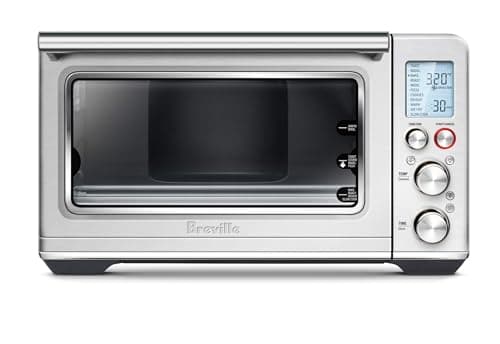
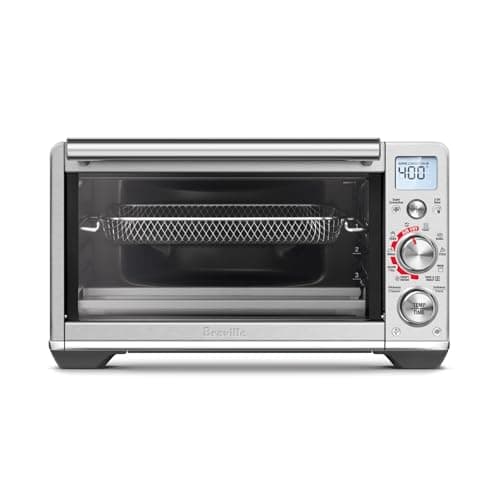
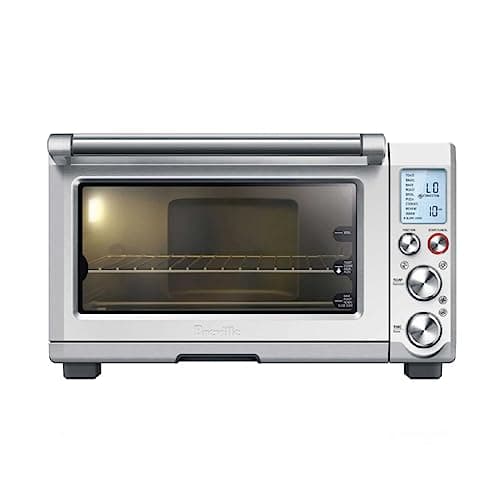
The short answer
Buy the BOV845 Smart Oven Pro if you will not air fry. It is the same chassis, the same 1,800 watts and the same Element IQ control for less money, and Breville publishes the wattage on the product page rather than burying it in a manual. Buy the BOV860 Smart Oven Air Fryer if you want air fry as a named function with a basket — and, less obviously, if you want the third convection speed that comes with it, which is the part no spec sheet mentions.
This is the pair where the published difference was supposed to be a single line item. Breville lists ten functions for the BOV845 and eleven for the BOV860; the eleventh is Air Fry. Both ovens measure 18.9 by 15.9 by 10.9 inches. Both are 1,800 watts. Both toast one to six slices on a darkness scale that runs one to seven, with Light at 1 or 2, Medium at 3, 4 or 5 and Dark at 6 or 7, published in identical tables. Reading the two books side by side is what turns up the differences the comparison tables do not carry.
The convection button is not the same button
On the BOV845, convection is a setting you turn on. The book's control list names a CONVECTION button and the manual's conversion tables refer to one convection state; there is no second speed anywhere in it.
On the BOV860, the book says something different in as many words: press the CONVECTION button to choose between no convection, convection and super convection, with the note that both convection settings may adjust the temperature to compensate for the faster air flow and that super convection “will deliver a crispier food result”. The Air Fry function is locked to super convection — the book states that air fry only allows the use of super convection.
That matters more than the basket does, because the fan speed is the mechanism. Air frying is a convection fan run fast enough to strip moisture off the surface of food before the inside is done; the mechanism takes one paragraph. A second fan speed is therefore a genuine hardware difference between these two ovens, and it is available on the BOV860 outside the air-fry preset — you can select super convection on other functions. Buying the BOV860 for the basket and getting the fan speed is the better way round than the marketing puts it. The difference between the two settings is worked through here.
The bagel function is a different function
This is the detail that made the pair worth a page. Both ovens have a BAGEL button and the two books describe it doing two different things.
The BOV845 book: the BAGEL function “crisps the insides of your cut bagel while only lightly toasting the outside”, and the wire rack goes in the middle rack height position — the same position the book gives for TOAST, PIZZA and COOKIES.
The BOV860 book: the BAGEL function “directs more heat on the top elements in order to brown and crisp one side more than the other”, the top of the bagel can face up or down depending which side you want crisped, and the rack goes in the top rack height position — the same position the book gives for BROIL and for the air-fry basket.
Same brand, same chassis, same button name, different element behavior and a different published rack. Neither product page mentions it. If you are the kind of person who buys a three-hundred-dollar oven partly for bagels, that is the row that decides it — and it is a reminder that on this pair the instruction book is the spec sheet. We tabulated every published rack position across both books and four other brands.
What is genuinely identical
Power and running cost.Both are 1,800-watt ovens — the BOV860's figure is the rating-plate line reproduced in its instruction book (120 V ~ 60 Hz 1800 W), the BOV845's is published on Breville's product page. The cost per hour is therefore identical to the cent, and nothing about the air-fry basket changes it. The arithmetic is shown in full.
Footprint. 18.9 by 15.9 by 10.9 inches, both. This is the width that makes the pair sensible on a normal counter where the 21.4-inch BOV900 is awkward.
Element IQ and the auto-eject rack. Described in the same words in both books, with the same three rack heights, and the same behavior where the rack ejects halfway when the door opens from the middle position.
What neither publishes. An interior volume. Breville states one cubic foot for the BOV900 and nothing for either of these, so the only honest capacity comparison between them and anything else is by pan and by slice.
Where the compact fits
The third pick is the BOV680 Smart Oven Air Fryer Compact, and it belongs in this decision because it answers the question a lot of people are actually asking: can I have the air-fry function without the 18.9-inch box? Breville measures it at 15.7 inches wide, it keeps the full 1,800 watts, and its instruction book prints the rating plate line, a 120–445°F Bake and Roast band and a stated capacity of one to four slices. The ceiling is lower in both senses: 445°F against 450°F, and four slices against six. Its review is here.
The decision rule
If air frying is not on your list, take the BOV845 and keep the difference — it is deliberately the model without it, and buying it and then wishing it had one is the most predictable regret in the range. If air frying is on your list, the BOV860 is the right size for most kitchens and you are getting a second fan speed with it. If the counter is the binding constraint, the BOV680 is the same power in three fewer inches. And if you want proof, dehydrate, nine slices and a published cubic foot, that is the BOV900, which is a separate comparison.
Reading a Breville spec sheet against a Breville book
The lesson of this pair generalizes. Breville's product pages carry a function count, a wattage on some models, dimensions and a photograph. The instruction books carry the rating plate, the per-function rack positions, the per-function temperature ranges, the convection options and the clearance requirement. On this pair the difference between the two documents is the entire content of this page.
Three things are worth pulling out of any book before you buy. The rating line, because it is the only wattage that is a measurement rather than a headline — look for a line reading 120 V ~ 60 Hz and a figure in watts. The clearance, because it decides whether the oven can live where you plan to put it; both of these books ask for four inches on each side and six above, and the brands disagree about this by a factor of six. And the per-function tables, because that is where a function that sounds generic turns out to be specific, as BAGEL does here.
The one thing neither book gives you is a usable interior volume, and no amount of careful reading conjures one. For these two ovens the checkable capacity figures are six slices of toast and a 13-inch pizza pan, and that is what we rank them on rather than converting a pan claim into liters.